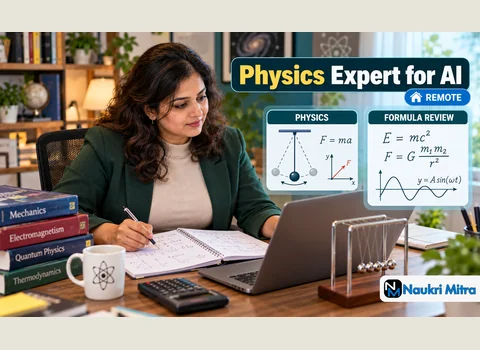
A physics solution may reach the right number for the wrong reason, or use a formula outside the conditions where it applies. This remote role focuses on writing challenging physics problems and checking AI-generated explanations with careful analytical work. It is part-time, with a listed rate of $45 per hour (USD), for candidates with advanced physics knowledge.
People searching for
online physics expert for ai training jobs should understand that this is specialist evaluation work, not a promise of guaranteed weekly hours. The work is completed remotely, on a part-time basis, and compensation is listed at $45 per hour (USD). Assignment volume, onboarding requirements and payment schedules can vary by project, so read the written terms carefully before accepting a task.
Advertisement
Building a problem with a verifiable answer
Good tasks test understanding rather than formula recall alone. Depending on the project, you may work with mechanics, electromagnetism, thermodynamics, waves, statistical physics or quantum theory. State the assumptions clearly, define variables and ensure that the problem contains enough information to solve it. Prepare a complete reference solution, including intermediate steps, units and the conditions under which the result holds.
A useful habit is to keep a short evidence trail for every decision: the rule you applied, the point you checked and the reason for your score. This makes reviews easier to audit and helps a second evaluator understand the judgement without repeating the entire task.
Checking equations, assumptions and units
When reviewing an AI answer, inspect the physical model before checking the arithmetic. Did it choose the right conservation law? Is the coordinate system consistent? Are boundary conditions stated? Does the result have the correct dimensions and limiting behaviour? A numerically plausible answer can still be physically impossible. Where relevant, compare special cases or estimate the order of magnitude to catch errors that a calculator will not reveal.
Using computational tools without losing the physics
Python or Mathematica can help reproduce calculations, explore parameter values and verify symbolic steps. LaTeX is useful for presenting derivations cleanly. Still, computational agreement is not proof that the model selected the right physical assumptions. Explain whether a failure comes from conceptual misunderstanding, an invalid approximation, algebra, units or code. This classification helps the project team improve its evaluation data.
Documenting errors in a useful way
Work is often organised through a task queue and a written rubric. Review calibration examples first, apply consistent scoring and keep feedback focused on the earliest important error. If a prompt is under-specified, document what information is missing instead of silently inventing a value. Respect deadlines, but do not trade accuracy for speed; a carefully explained correction is more useful than a bare score.
Qualifications for the role
Candidates should hold an MSc or PhD in physics and be strong in areas such as mechanics, electromagnetism and quantum theory. Fluency in LaTeX and working knowledge of Python or Mathematica are expected, along with clear written English. You need a dependable home computer and internet connection. Previous experience in AI evaluation or technical content review is useful but is not the only way to demonstrate suitability.
Pay, schedule and expectations
The advertised rate is
$45 per hour (USD). This is an hourly listing rather than a guarantee of a fixed monthly income. Some projects have steady batches while others pause between evaluation rounds. Confirm the payment method, currency conversion fees, minimum payout threshold, expected turnaround time and whether onboarding or qualification tasks are paid. Keep your own record of approved hours and submitted work.
Because this is remote work, you will generally need a computer, stable broadband and a workspace where you can concentrate. Follow the project's security instructions, protect login credentials and never pay a recruiter to unlock a job or release wages. Verify the organisation and contract details independently before sharing sensitive information.
What makes a strong candidate?
Candidates should hold an MSc or PhD in physics with strong problem-solving across mechanics, electromagnetism and quantum theory. Fluency in LaTeX and working knowledge of Python or Mathematica are expected, plus clear written English and a reliable home computer with internet. Strong candidates also explain their decisions clearly, apply guidelines consistently and are willing to flag uncertainty. You do not need to pretend to know everything: careful, evidence-based judgement is more valuable than guessing confidently.
Core responsibilities
- Write hard physics problems with complete worked solutions
- Verify ai answers analytically and with python or mathematica
- Typeset derivations in latex
- And document conceptual or numerical errors in model responses.
Skills to highlight in your profile
Relevant skills include Physics problem solving, mechanics, electromagnetism, quantum theory, dimensional analysis, LaTeX, Python, Mathematica, numerical verification, technical writing, error analysis. Give concrete examples from study, research, professional work or personal projects. Describe the problem you checked, the method you used and how you documented the result, while avoiding confidential information from previous employers or clients.