
Two sentences can grow from the same need to be heard: "You never listen" and "I'd like ten minutes where we both put our phones away." The first lands as an accusation and starts a fight; the second is a request the other person can actually say yes to. Coaching teaches people to move from the first kind of sentence to the second, calmly and with practice. This listing is for online relationship coach jobs: part-time, paid $15 per hour (USD), open worldwide, with sessions held on Zoom in English or Hindi. ICF accreditation or Gottman Method training is preferred, and a psychology degree is not mandatory.
You will run two kinds of sessions. In an individual session, one person talks about their side of a relationship: a partner who goes quiet during arguments, a pattern of saying yes when they mean no, or a wish to start difficult conversations better. You cannot coach the absent partner, so the focus stays on what your client can change in how they speak, listen and respond.
Couples sessions are different. Two people are in the room, often with two versions of the same story. Your job is to stay balanced, slow things down and help each person say what they need without attacking the other. You do not decide who is right.
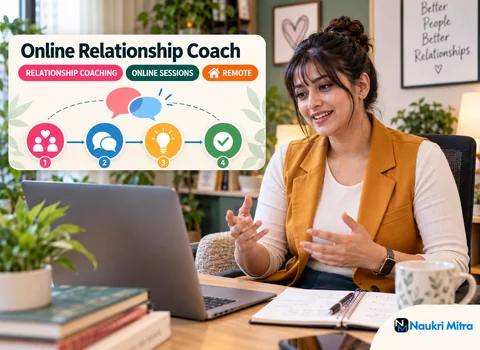
Put simply, an online relationship coach helps clients communicate better, work through conflict, set goals and practise new habits, and refers them on when they need clinical support.
The skills you teach are simple to describe and hard to do when emotions run high. Active listening means repeating back what you heard in your own words before replying, so the speaker knows the message arrived. In couples work you often coach one partner to summarise the other before giving their own view.
Timeouts are agreed pauses. When an argument heats up, either person can call one, say when they will come back to the topic, and use the break to calm down rather than rehearse a counter-attack. The coming back matters as much as the pause.
A repair attempt is any small move that stops a conflict from getting worse: a joke, an apology, "I said that badly, let me try again." Spotting them in a live session, and helping the other partner accept them, is one of the more useful relationship coach skills to build.
The Gottman Institute, founded by Drs John and Julie Gottman, uses the term "Four Horsemen" for four communication patterns their research links with relationship trouble: criticism, contempt, defensiveness and stonewalling. Criticism attacks the person rather than the behaviour. Contempt adds mockery or disgust. Defensiveness turns every complaint back on the speaker. Stonewalling is shutting down and withdrawing from the conversation.
The Gottman approach pairs each pattern with an alternative, such as a gentle start-up instead of criticism or taking some responsibility instead of defending. In coaching you use these ideas as a shared vocabulary, not as a verdict on the couple. Naming a pattern calmly can help people see it without feeling blamed.
Each client or couple should leave with a goal they chose and an exercise to try before the next session. Good exercises are small and concrete: one phone-free conversation, one request made in place of a complaint, one timeout taken and returned from properly. At the start of the next session you ask what happened, without grading it. A failed attempt is useful material, because it shows where the skill breaks down.
You will track progress in session notes: the goals agreed, the exercises set, what changed and what to pick up next time. Keep notes factual and brief, store them securely, and never discuss a client with anyone outside the work. In couples coaching, agree at the start how you will handle something one partner tells you privately, so nobody feels tricked later. Clients should also know that confidentiality has limits when someone's safety is at risk.
People often ask about the difference between a relationship coach and a marriage counsellor. A licensed counsellor or therapist is trained and regulated to assess and treat mental health conditions and deep relational distress. A coach works with people who are broadly functioning and want better skills and clearer goals. Coaching is not therapy, and you should never present it as such.
If a client describes signs of depression, trauma, addiction or abuse, the right step is a referral to a licensed mental health professional. You can explain this kindly: coaching may still have a place later, but the clinical need comes first. Referring clients to licensed counsellors when clinical support is needed is part of this role, not a failure of it.
Safety comes before any coaching goal. If a client tells you about violence, threats, coercion or fear of their partner, stop the skills work. Couples sessions are not the right setting when abuse is present, because speaking openly in front of the partner can put the client at greater risk. Where possible, talk with the person on their own, check whether they are safe right now, and point them to local emergency services, domestic violence helplines and licensed professionals in their country. Do not try to manage the situation yourself.
Sessions run on Zoom, so you need a stable connection, a working webcam and a headset or clear microphone. Learn the basics, such as waiting rooms, passcodes and calls where two partners join from different places. Calendly is a scheduling tool that lets clients pick a slot from times you have made available and sends confirmations, which cuts down on back-and-forth messages.
The private space matters just as much. This is relationship coach work from home, and clients will share things they have never said aloud. Use a room with a door that closes, where nobody else can hear or walk past the screen.
The International Coaching Federation (ICF) is a professional body that accredits coach training programmes and awards individual credentials at different levels, based on training hours, coaching experience and an assessment. ICF training covers general coaching skills, which you then apply to relationships.
The Gottman Institute offers training built on the Gottmans' research. Some of its programmes are designed for licensed clinicians, while others are open more widely, so check the eligibility of any relationship coach course before you enrol. Either route counts in your favour here, but neither is a formal requirement.
People without a psychology degree often begin with a recognised coach training programme, practise under supervision or mentoring, and build a short record of coaching hours. For people looking at relationship coach jobs for freshers, strong listening, empathy and clear English or Hindi count for a lot in this listing, and a credential helps a new coach stand out.
On relationship coach salary per hour, this part-time post states $15 per hour (USD). For illustration alone, nine coaching hours in a week would bring in $135 before tax, and a lighter or fuller week moves that number. No per-session rate, commission or other payment is mentioned.
Beyond part time relationship coach jobs like this one, coaches find clients through coaching marketplaces, wellness platforms, their own websites and referrals. Freelance relationship coach jobs can work well alongside other commitments. As a career it is legitimate when it is done ethically, within its limits, and through openings that pay you rather than charge you.
That last point is where scams appear. Be wary of anyone who promises clients only after you buy their "certified couples coach" badge, pay for a "lead pack" of client contacts, or pay to activate a coaching app profile. A genuine opening pays you for your hours. It does not sell you the right to work.