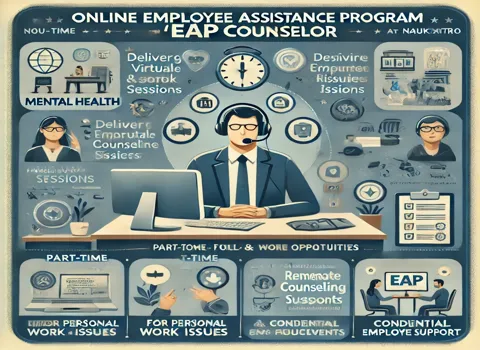
An employee calling an EAP line rarely opens with the actual problem. They lead with something smaller — a scheduling issue, a vague complaint about stress — and the real thing surfaces two minutes in, if you know how to wait for it. This role is built for someone who's already good at that wait, delivered entirely through video, chat, and phone instead of a physical office.
What the job is
You'd provide confidential counseling to employees across a range of companies, addressing everything from everyday work stress to genuine crises. Some of it is short-term, solution-focused work. Some of it means recognizing when someone needs more than a single session can offer and getting them there. Beyond direct counseling, you'd also help shape the wellness programming that reaches employees before they ever pick up the phone.
Responsibilities
- Run confidential individual and group sessions over video, chat, or phone
- Deliver short-term, solution-focused therapy for workplace stress, anxiety, and personal concerns
- Assess each employee's situation and build a support plan that actually fits it, not a generic template
- Handle crisis intervention when someone's in acute psychological distress
- Apply evidence-based methods like CBT and mindfulness practices, adjusted to the person in front of you
- Keep documentation and data handling fully HIPAA-compliant
- Build wellness initiatives and educational content — webinars, workshops, self-help resources — aimed at emotional resilience and work-life balance
- Run awareness campaigns on things like burnout prevention and stress management
- Work with HR and leadership to fold EAP services into a company's broader wellness strategy
- Track employee well-being trends and flag where the program needs to adjust
What's required
A
Master's degree in psychology, counseling, social work, or a related discipline is required, along with active licensure as a professional counselor (LPC, LCSW, LMFT, or equivalent) in at least one U.S. state. You'll also need at least
3 years of experience in EAP counseling, psychotherapy, or broader mental health services.
Beyond the license and years on the job, a few things matter just as much:
- You can run a full assessment and land on the right intervention without a lot of back-and-forth
- You're steady under pressure — crisis calls don't rattle your judgment
- You're genuinely comfortable with telehealth platforms and digital documentation, not just functional with them
- You can read data on program outcomes and turn it into a real recommendation
- You adapt quickly to new mental health technology instead of resisting it
Also a plus
- Additional training in trauma-informed care
- Background specifically in workplace mental health, not just general clinical practice
- Experience with AI-assisted mental health assessment tools
Pay
This role pays
$115,000 a year. It's fully remote, with the schedule built around consistent availability for employees who may be reaching out during a difficult moment.
Benefits
- Full remote flexibility, working across a wide range of industries and employee populations
- Health, dental, and vision coverage
- Paid time off and holiday leave
- Funded continuing education, certifications, and access to industry conferences
How the work gets supported
Crisis cases don't get carried solo here — there's a real expectation that a tough case gets brought to the team early, not managed quietly until it becomes something bigger. Naukri Mitra has placed EAP counselors into remote roles like this before, and one thing that keeps coming up is how seriously this team treats peer support compared to typical solo telehealth setups. The organization's own numbers back up the model's effectiveness: a 95% satisfaction rate among employees using the service and a documented 40% drop in workplace stress among regular participants.
Employees come from dozens of different companies and industries, so the work rarely repeats itself in the same way twice. If you've adjusted your counseling style for people whose workplace context looked nothing like the last client you saw, that range is exactly what this role calls for.
Applying
Send a resume along with your licensure details and a short note on how you'd handle a crisis call in the first two minutes — that tells us more than a general cover letter would. Licensed clinicians based in the U.S., Canada, the UK, EU countries, Australia, India, and elsewhere are welcome to apply, provided you hold the required U.S. state licensure. Applications are reviewed on a rolling basis.