
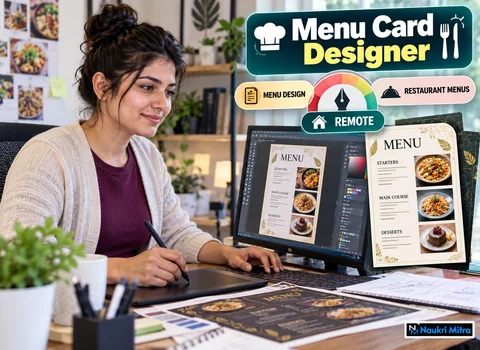
Brief: a 40-seat South Indian restaurant, two languages, veg and non-veg, prices change every quarter. The owner had a laminated card guests squinted at and a printer quoting fresh plates every time coconut prices moved. That is the kind of problem behind these online menu card designer jobs. You take a kitchen's real list of dishes and turn it into a card people can order from quickly, in print and on a phone. You work part-time from home, people in any country can apply, and each hour pays $18 per hour (USD).
Owners rarely ask for "pretty". They want fewer questions from guests and a file they can update without calling you. In plain terms, the menu card designer job description is this: design restaurant menu cards with clear sections, prices and food photos in Canva, Illustrator or InDesign, match the restaurant's branding, prepare print and QR digital versions, and update items or prices when asked.
Guests do not read a menu top to bottom like a book. They scan for a category, then a dish, then a price. Your job is to make that scan short. Group items the way the kitchen thinks, and put the dishes the owner most wants to sell where the eye lands first.
Back to that South Indian brief. The owner sent 74 items across WhatsApp voice notes and a photographed notebook. The designer sorted them into seven sections, cut four duplicates ("ghee roast" appeared under two names), and moved the all-day tiffin items to the front because they made up most morning orders. English sat on the left of each line and Tamil on the right, set in the same size so neither language looked like an afterthought. Three dishes got photographs. The rest got one-line descriptions.
Price confusion causes more friction at the counter than any font choice. Keep prices in one column, aligned to the right, in the same weight as the dish name or one step lighter. Avoid dotted leader lines across a wide page; they pull the eye straight to the cost.
Good typography here means a readable size under dim lighting and enough contrast on a coloured background. If a dish has half and full portions, give both prices their own small column header rather than squeezing "180/320" into one line.
In India, FSSAI labelling rules require the green veg and brown non-veg symbols on packaged food. FSSAI display rules also expect restaurants to show whether each dish is veg or non-veg, and larger chains must list calorie values, but the details depend on the licence, so confirm with the owner what applies. Place the mark in the same spot on every line, usually just before the dish name, and explain it once in a small key.
Allergen or calorie rules for menus vary by country. You are not the legal adviser, but ask whether any statements are required and leave room for them.
Most clients now want both. The print card needs correct trim size, bleed, safe margins and CMYK colour, and you should know common sizes such as A4, A5, DL and a tri-fold. Ask the printer for their specs before you start, not after.
A QR digital menu has different requirements. It is read on a small screen, often in one long scroll, so sections need a sticky or repeated heading, text must be large enough without zooming, and files must load fast on patchy mobile data. The QR code itself needs a quiet border, enough size on the table tent to scan from a seated position, and a test on several phones before anything goes to print. Many owners now ask for this digital version as standard.
Prices that change every quarter mean the file matters as much as the design. Build menus with paragraph and character styles in InDesign, or linked text and named layers in Illustrator, so a price update takes minutes. In Canva, keep a master design and duplicate it per version. Hand over a clean, version-named file (for example, menu_v2026Q4_print.indd) along with a short note on fonts and image sources.
Updating items or prices on request is part of the role, and it is often where repeat work comes from.
A restaurant branding designer builds the identity: logo, colour palette, signage, packaging and sometimes the interior graphics. Menu design works inside that identity and is more about information, hierarchy and print production. You match the brand; you rarely invent it.
To find restaurant clients, start local. Visit places with faded or handwritten menus and show two before-and-after samples on your phone. Marketplaces such as Fiverr and Upwork list menu design gigs too, and freelance menu card designer jobs there reward a clear profile and fast replies. For this listing, the pay is $18 per hour (USD). Whether the restaurant adds any bonus is up to the employer; none is promised. When comparing a menu card designer salary per hour across platforms, remember marketplace fees.
Hours are not fixed, and nobody can promise you a set number each week. A typical stretch might look like this:
Settle how many rounds of changes are included before the first draft. Two is common. Beyond that, extra rounds are billed time.
You need a computer that runs Canva, Illustrator or InDesign comfortably, plus basic photo editing for cleaning up food shots. Your monitor does not need to be expensive, but it should be calibrated or at least consistent, because a curry that looks golden on your screen and grey on the printed card is a reprint.
Stable broadband matters, since print files with photos get large. Save every menu to cloud storage with the version in the file name, and treat client files as private: do not post a client's unreleased menu or prices in your portfolio without permission.
Formal design training is not required. A portfolio of menus or print layouts is enough, which makes this a real option among menu card designer jobs for freshers. With no clients yet, design three practice menus for invented restaurants and show each in print and on a phone mockup.
Many clients set a short design test, such as laying out one section with prices. On your menu card designer resume, list tools, print sizes you have handled and any repeat clients. Common menu card designer interview questions cover long dish lists, printer files and two-language layouts. Menu card designer skills that stand out are clean typography, print knowledge and patience with last-minute price changes. A short course in print production or typography helps, but a strong portfolio carries more weight than a menu card designer course certificate.
Most owners are honest. Stop and step back if a client shows any of these signs:
Applying is free. Send a short note with your portfolio link, the tools you use, and one example where you designed or updated a menu. If you are looking for menu card designer work from home that fits around other commitments, or part time menu card designer jobs with a clear hourly rate, mention your usual availability so the brief can be matched to you. Growth usually runs toward full restaurant branding or menus for several outlets.