
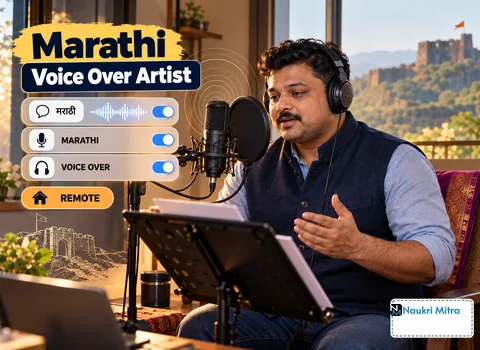
On a Marathi stage, a natak teaches the voice to carry. An actor learns to land the last word of a line in the back row of a hall without shouting, to let a pause hang until the audience leans in. Put that same actor in front of a microphone for an audiobook and everything has to shrink. The feeling stays the same size, but the volume drops to something close to a whisper, and the projection that worked in the auditorium now sounds like someone yelling into your ear. Learning to make that adjustment is a big part of what this part-time role asks. This listing is for online Marathi voice over artist jobs: voicing Marathi audiobooks, ad spots and dubbing scripts from home, paid at $25 per hour (USD), open worldwide, with selection based on a demo recording.
The work comes in three shapes.
Narration is the long game. You hold one steady, warm narrator voice across chapters, then step lightly into characters when dialogue appears. A grandmother in a Konkan village and a young engineer in Pune should sound like different people, yet neither should pull the listener out of the story.
Ads are short and exact. The brand name must be crisp, the offer must be clear, and the tone has to match the product, whether that is a formal आपण-style address for a bank or a warmer तुम्ही for a snack. Timing matters more here than anywhere else.
Dubbing means speaking Marathi lines over existing video, so you match the length of a line, the energy of a scene and, where it applies, a mouth on screen. That is the main split between a Marathi voice over artist and a Marathi dubbing artist: the first usually sets the pace with the voice alone, the second performs to picture. This role includes both.
Read each script aloud before recording, once for sense and once for feeling. Mark where you will breathe, which words carry the weight of a sentence and where the emotion turns. Long literary sentences will sag if you have not planned your breath.
Pace is the other half. An audiobook reader who rushes loses the listener, while an ad that drags misses its slot. Rehearse the emotional colour too, the bhav of a line. A small shift in pitch carries more on a mic than any stage gesture.
Correct pronunciation is a stated requirement, and in Marathi a few sounds give a speaker away quickly.
Scripts with English loanwords may also use ॲ or the ॅ sign for the open English "a" sound, as in बॅट. Read it as written rather than guessing.
Marathi shares the Devanagari script with Hindi and Sanskrit, and Hindi is never far away in films and television. That closeness can cause errors. A narrator may say पानी where the script says पाणी, or drop the ळ because Hindi lacks it.
The fix is listening back to your own takes with a Marathi ear, line by line. Puneri, Varhadi or Malvani colouring belongs in a take only when a brief asks for it; narration otherwise stays in clean standard Marathi.
This listing accepts either a USB microphone or a condenser microphone. A USB mic plugs straight into a laptop and is simple to set up. A condenser, typically connected through an audio interface that supplies phantom power, captures more detail. That detail is a gift for the breathy edge of a whispered line and a curse for the pressure cooker in the next room, because a condenser also hears your walls.
So the quiet room matters as much as the mic. For home soundproofing, soft surfaces help: a wardrobe full of clothes, heavy curtains, blankets behind you. A stage actor is used to a hall's echo; at the mic, you want almost none.
Recording and editing takes in Audacity is part of the job. A sensible routine for a Marathi chapter or spot:
Adobe Audition is a paid editor some voice artists use, though this listing names Audacity. Either way, give the finished file one listen without watching the waveform.
Every finished file has to match a client brief. Treat it the way you would a director's notes before an opening night. The brief may set the file format, the tone, the pace, how names should be said or whether a dialect is wanted. Follow it exactly, name files the way the client asks, and when retakes or revisions come back, turn them around in good time.
Voice training or theatre experience is a plus here, not a must. Natak work gives you breath control, diction and the habit of taking direction. If you have not acted, a voice training course for beginners can cover the same ground: posture, breathing, articulation and reading a script for meaning. This listing does not name a required course or certification.
For Marathi voice over artist jobs for freshers, the honest route is practice. Read aloud daily from Marathi novels, newspapers and poetry, record it and listen back critically. Mention any stage, radio or recitation work on your resume.
A demo recording is part of selection, so treat it as your audition piece. Keep it short and varied: a passage of audiobook narration, a lively ad read and a dialogue excerpt that shows emotion. Record it in your actual room with your actual mic, since that is what a client will hear on real work. Lead with your strongest piece, and make sure every ळ and ण is clean.
This role pays $25 per hour (USD) and sits among part time Marathi voice over artist jobs that can be done from anywhere. As an illustration only, 3 booked hours at the mic would mean $75 before tax, and the weekly sum grows or shrinks with your hours; no fee per spot or per finished minute is described. Voice123, Voices.com, Fiverr and audio apps like Pocket FM turn up when people chase freelance Marathi voice over artist jobs, but they appear here purely as examples, run on their own terms and have nothing to do with this listing.
A caution from backstage: be wary of anyone who says they will "produce your professional Marathi demo" for a fee before you can be considered, or who asks for a registration deposit to release scripts. Genuine Marathi voice over artist work from home is paid to you. You do not pay to audition.