
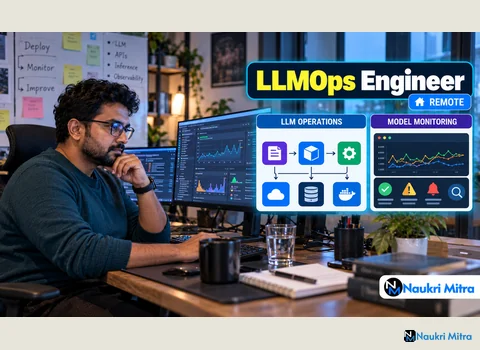
03:12. Your phone buzzes on the nightstand. The alert says p95 time-to-first-token on the chat endpoint has doubled over twenty minutes and is still climbing. You open the laptop, squint at Grafana, and see the vLLM pods are healthy but the KV cache is pinned near full and requests are queuing behind three very long prompts. You cap max model length on that route, restart one replica, and watch the line fall back. Back to bed by 03:40. That is a decent picture of what remote LLMOps engineer jobs involve: keeping large language models fast, cheap and correct in production. The job is full-time and done remotely, you can apply from any country, and it pays $125,000 per year (USD).
Most of your day sits here, and it is the core of any LLMOps engineer job description. You deploy and scale LLMs with vLLM on Kubernetes. That means picking the right GPU node pools, setting tensor parallelism, tuning batch sizes and memory utilisation, and deciding when a model gets its own deployment versus sharing one.
Autoscaling LLMs is not autoscaling web servers. CPU tells you nothing. You scale on queue depth, pending requests or tokens in flight, and you accept that a cold GPU pod can take minutes to pull weights and warm up. So you keep warm capacity, and you argue about how much of it the budget allows.
Someone fine-tunes a model. Someone else changes a system prompt. A week later quality drops and nobody knows which change did it. Your job is to make that question answerable.
You track experiments and model versions in MLflow: which base model, which adapter, which eval scores, which config shipped to which environment. A model does not reach staging without a registry entry and an eval run attached. It sounds like paperwork. It is the thing that lets you roll back with confidence at 3 a.m.
Prometheus tells you the endpoint is slow. Langfuse tells you why. You instrument applications so every request leaves a trace: prompt, retrieved context, model call, tool calls, tokens in and out, latency per span.
Cost lives here too. LLM spend scales with tokens, and tokens scale with things product teams change casually, like a longer system prompt or a retrieval step that pulls ten chunks instead of three. You build dashboards that show cost per feature and per customer, and you flag the change that quietly tripled spend before finance does.
New model weights are a deploy. A new prompt template is a deploy. Treat both that way. You automate pipelines that push changes through canary or shadow traffic, compare latency and eval scores against the current version, and promote only when the numbers hold.
Rollback has to be boring. One command, or one merged revert, and the previous model version is serving again. If rollback needs a runbook with eleven manual steps, you have not finished the pipeline. CI/CD here usually means GitHub Actions or GitLab CI feeding Argo CD or a similar GitOps tool, with gates for evals as well as tests.
The opening scene was not a joke. LLM serving runs around the clock, so the job usually includes an on-call rotation. Good teams keep it sane: clear alerts with runbooks linked, a handoff note at the end of each shift, and a postmortem culture that fixes the alert rather than blaming the person.
Remote infrastructure access is part of the setup. Expect SSO into cloud consoles, short-lived credentials, a VPN or zero-trust proxy, and kubectl access scoped by role. You will need a reliable connection and a laptop you are allowed to use for production work. Ask in the interview how pages are split across time zones. A worldwide team can run follow-the-sun, which means fewer 3 a.m. wake-ups for everyone.
Candidates typically bring three to five years in MLOps, DevOps or platform engineering. Hands-on experience with vLLM, MLflow, Langfuse and Kubernetes is expected, along with strong Python, CI/CD and cloud cost management.
On LLMOps engineer certification: the AWS ML Engineer certification or the Kubernetes CKA is a plus, not a gate. The CKA is the more useful of the two for daily work, since so many incidents end in kubectl. The AWS credential helps if the stack runs on SageMaker or EKS. Neither replaces a repo where you actually served a model and measured it.
Core LLMOps engineer skills, in rough order of how often you will use them:
The LLMOps engineer salary for this role is $125,000 per year, paid in USD. It is a full-time position. It counts among LLMOps engineer work from home jobs in the literal sense: you can work from any country, the listing is worldwide, and there is no city requirement. The posting states a single figure rather than a range.
MLOps grew up around models that were small, cheap to call and evaluated with clean metrics like accuracy or AUC. You retrained on a schedule and watched for data drift.
LLMOps changes the failure modes. Models are huge, so GPU memory and serving efficiency matter more than training pipelines. Output is free text, so evaluation needs rubrics, LLM judges and human review instead of a single number. Behaviour shifts when a prompt changes, even if the weights stay put. And cost per request is real money you watch daily. The fundamentals carry over: versioning, reproducibility, monitoring, safe deploys. The details are new.
Most people in these roles came from MLOps or platform work. If you are wondering how to become an LLMOps engineer from there, the path is short but specific. Stand up vLLM on a small Kubernetes cluster and load-test it. Wire Langfuse into a toy RAG app and read the traces. Put a fine-tuned adapter through MLflow with an eval gate in CI. Write up what broke.
An LLMOps engineer course can give structure, but the write-up is what interviewers ask about. For people with no ops background at all, entry-level LLMOps openings are rare; this one asks for three to five years. A junior DevOps or MLOps seat is the usual first step.
These roles turn up on general remote boards and on developer-focused ones; arc.dev is one example of a board that lists remote engineering work. The kind of organisations hiring for this include AI product companies, cloud and platform teams, and enterprises running their own models. Demand follows production LLM usage: as more teams move from demos to real traffic, someone has to own the serving, tracing and cost side.
For this listing, send your resume. Keep your LLMOps engineer resume concrete. Name the models you served, the cluster setup, the latency or cost problem you fixed, and how you knew it was fixed. A line like "cut p95 TTFT on a 70B deployment by tuning batch size and prefix caching" says more than a paragraph of buzzwords.
Expect LLMOps engineer interview questions on the layers above: how you would scale vLLM on Kubernetes, what you trace in Langfuse, how a rollback works, and what you do when the pager goes off at 3 a.m. and the dashboard looks fine. That last one is the real test.