
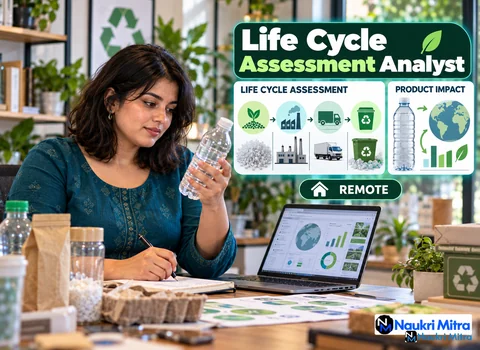
Pick up a stainless steel water bottle. Its chromium came out of a mine, probably in a different continent from its nickel. A press drew the steel into a cylinder and a kiln baked on the powder coat. A ship and a truck carried it to a warehouse. Somebody refilled it a thousand times, dented it, and threw it in a bin. Every step left a mark, and somebody has to count those marks. Counting them is what remote life cycle assessment analyst jobs pay people to do. This one is full-time, takes applicants worldwide and is set at $72,000 USD a year, built around product models in SimaPro or openLCA with ecoinvent data.
Below, the bottle's stages line up with the analyst's day. What does an LCA analyst actually do? They turn a product's whole biography into numbers a client can defend.
Before anyone opens software, the analyst writes the goal and scope. For the bottle, that means choosing a functional unit. Is it "one bottle", or "providing 500 ml of drinking water a day for three years"? The second is more honest, because a cheaper bottle that dents after six months needs replacing, and that changes the result.
Scope also sets the system boundary. Cradle-to-gate stops at the factory door. Cradle-to-grave runs all the way to the bin. You also pick impact categories and allocation rules for co-products such as smelter slag. A loose scope tends to cause trouble later, when a reviewer starts asking questions.
This is the longest stretch of the job. The life cycle inventory lists every input and output: kilograms of 18/8 stainless sheet, kilowatt-hours of electricity at the drawing press, litres of cooling water, grams of polypropylene for the lid and silicone for the seal.
Much of this comes from the client's bill of materials and from supplier questionnaires. A typical frustration: the coating supplier reports energy use per month for the whole plant, not per part, so you have to ask for production volumes and divide it yourself. Where primary data is missing, you pick a background process from ecoinvent, for example a market dataset for chromium steel, and note the regional mismatch in your assumptions log. In SimaPro or openLCA you link these into a product system and fix the units someone typed in tonnes instead of kilograms.
For a remote analyst, supplier data is the real dependency: video calls with plant engineers, chased spreadsheets, and explaining why a 2015 figure will not do.
Freight gets modelled as tonne-kilometres by sea and by road, each linked to its own ecoinvent transport process. Once the inventory is complete, you run the impact assessment. The software multiplies each flow by characterisation factors from a method such as EF 3.1, ReCiPe or IPCC GWP 100, and you get results for climate change, acidification, water use, resource depletion and more.
A product carbon footprint is a slice of this: the climate change category alone, often reported in kg CO2e per functional unit. Many clients ask for that slice first, so building carbon footprint models for products is a large part of the brief here. A bottle that wins on carbon might still lose on water.
Hand wash or dishwasher? Three years or ten? Use-phase choices can swing the total more than manufacturing.
Interpretation is the step where you find out which assumptions drive the answer. You run sensitivity analyses, for example changing dishwasher cycles from zero to one a day, or swapping the grid mix from coal-heavy to hydro-heavy at the factory. Monte Carlo runs in openLCA or SimaPro show the spread. Then you write it plainly: "the result is most sensitive to lifespan; below two years, the reusable bottle loses its advantage."
End of life covers recycling rates for the steel, landfill for the lid and the credits you may or may not claim for recycled content.
Then comes the report. An ISO-aligned LCA report under ISO 14040 and 14044 sets out goal, scope, inventory, impact results, interpretation and limitations. If the client plans a public comparative claim, a critical review panel will go through it line by line. Writing for that reviewer is part of the analyst's real work.
People often ask how an LCA analyst differs from a product carbon footprint analyst. The footprint specialist usually works on one impact category, greenhouse gases, often following ISO 14067 or a product category rule. The LCA analyst covers the full set of impact categories and the full ISO 14040/44 method. This listing asks for both, and both stay at product level, unlike a corporate emissions inventory.
The work comes from manufacturers, packaging firms, retailers, building product makers and the sustainability consultancies that serve them. Firms that build LCA software and data, such as Sphera and PRé Sustainability, are part of the same field. This listing is not from either of them and does not say they are hiring for it, so check their own career pages if you want to apply there.
Regulation adds to the need for this work. The EU Ecodesign for Sustainable Products Regulation and the Digital Product Passport plans point towards life cycle data for more product groups, and Environmental Product Declarations are commonly requested in construction. The work also suits life cycle assessment analyst jobs remote worldwide, because the inputs arrive as files and calls anyway.
Employers expect a degree in environmental engineering, sustainability or a related science, plus two or more years of LCA modelling. You need hands-on SimaPro or openLCA with ecoinvent and a working knowledge of ISO 14040/44. The ACLCA LCACP credential is a plus but is not required. With two years of modelling asked for, this opening sits a step above entry level remote life cycle assessment analyst jobs.
If you typed "how to become life cycle assessment analyst" while holding an engineering degree, the route is short. Chemical and materials engineers already think in process flows. Add complete studies, ideally one with real supplier data, to reach the two years asked for. Life cycle assessment analyst jobs no experience searches find little, but a thesis built around a full LCA can count.
The life cycle assessment analyst skills that matter most are careful data handling, a feel for numbers that look wrong, and plain writing for non-specialist clients.
This position pays $72,000 USD per year, full-time, as stated in the listing. That is the life cycle assessment analyst salary per year on offer here, and it is the same figure whether you work from Lisbon or Lagos. Tax and contract details depend on your country, so raise them at offer stage.
openLCA is free, and its documentation and sample databases are a good place to practise. A useful life cycle assessment analyst course need not be expensive; university short courses and vendor training both cover the ISO method. The LCACP from ACLCA is the best-known life cycle assessment analyst certification, and the listing names it as a plus.
Build one study end to end on a product you own. A kettle or a backpack will do. Document the functional unit, the boundary, every dataset you chose and one sensitivity run. That project will help with life cycle assessment analyst interview questions far more than reading definitions, because interviewers ask you to defend a modelling choice.
Your life cycle assessment analyst resume should list the products you have modelled, the tools and database versions used, the standards you worked to and whether a study passed review. Attach a sample report or your practice study.
The opening accepts applicants worldwide, and sending your file costs nothing; a request for money for tests or onboarding marks a scam, so stop there. Check the life cycle assessment analyst job description above against your record, and apply with the study you are proudest of.