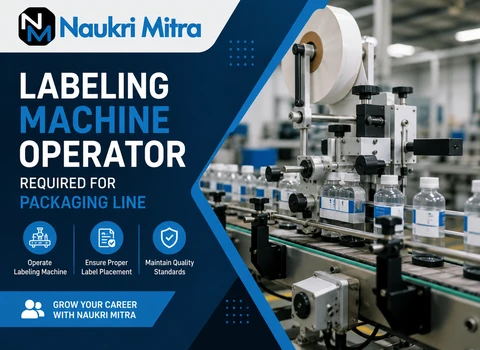
What Actually Happens at a Labeling Station
Walk onto any packaging line, and you'll spot the labeling machine within seconds — it's usually the point where things slow down just enough for someone to be watching closely. That someone is the Labeling Machine Operator. Their job is simple to state and harder to do well: make sure every bottle, pouch, carton, or container gets the right label, in the right place, before it moves further down the line. Product name, batch number, manufacturing date, expiry date, barcode — miss any one of these and the product technically can't leave the factory. This is exactly the kind of role you'll find on production floors across India, and Ahmedabad, Gujarat, has no shortage of factories that need it filled.
Why This Job Still Exists in an Automated Factory
You'd think a machine that applies labels wouldn't need a person standing next to it. But labels jam. Rolls run out mid-shift. Print heads drift out of alignment without warning. Someone has to catch that before hundreds of units go out with a smudged batch code. That's really the whole justification for the role — machines are fast, but they don't notice when something's gone slightly wrong. People still do.
A Shift, Start to Finish
Most days start the same way: check the machine, load the correct label roll, confirm the artwork matches that day's production batch. Then the line runs, and the real work is watching — tension on the label feed, print clarity, whether containers are coming through straight or tilted. A few things fill up most of the shift:
- Threading and loading label rolls or spools
- Adjusting sensors for different bottle or pack sizes
- Spot-checking barcodes and batch print quality
- Freeing minor jams fast, without holding up the whole line
- Logging output numbers and rejected pieces at the end of the shift
Where You'll Find This Work
Food processing units, pharma packaging lines, cosmetics plants, beverage bottling operations, FMCG warehouses — labeling operators show up in all of them. Ahmedabad's industrial belt has plenty of such units, and a Full-time position here typically sits within a packaging or production department, not off on its own as a standalone job.
The Equipment You'll Get Familiar With
Depending on the product, the machine itself might run pressure-sensitive labels, shrink sleeves, or wrap-around labeling — each behaves a little differently. Beyond the main unit, operators reach for spanners to make quick adjustments, alignment gauges, tension meters, and often a handheld barcode scanner to double-check prints before anything gets boxed and dispatched.
What Separates a Good Operator From an Average One
Strength isn't really the requirement here — attention is. Someone who notices a label sitting a millimeter off before it becomes a full rejected batch is worth more on this line than someone who's simply strong or fast. A working mechanical sense helps too, enough to guess why labels are slipping or printing unevenly. And there's discipline involved: following the standard procedure exactly, every time, because a shortcut that saves two minutes can cost an entire batch later.
What Employers Typically Look For
An ITI certificate in Mechanical, Electrical, or Electronics tends to open doors here, as does a Diploma in Mechanical or Packaging Technology. That said, plenty of freshers get hired with just basic machine-handling exposure, and experienced hands who've run similar packaging equipment elsewhere are often preferred over someone with only paper qualifications and no floor time.
On Your Feet, All Shift Long
This isn't a desk job by any stretch. Expect long stretches of standing, regular bending, and the kind of repetitive hand movement that gets easier with time but never fully disappears. Packaging floors tend to be noisy, and in some units, warm — machinery running nearby doesn't help. Since this is a Full-time role with rotational shifts, mornings, evenings, and the occasional night shift should all be on the table when you're weighing this up.
Safety Isn't Optional Around This Equipment
Moving rollers, cutting blades, live electrical components — a labeling machine has more moving parts than it looks like from a distance. Safety shoes, gloves, and depending on the industry, a hairnet or apron are pretty standard. One habit worth building early: always follow lockout procedure before reaching in to clear a jam, even a small one. It's the kind of shortcut that seems harmless until it isn't.
The Rough Patches New Operators Hit
Almost everyone struggles with the same things at first — labels going on crooked, changeovers between rolls eating up time under pressure, machines behaving differently depending on the product's shape. Give it a few months, though, and most operators start picking up on a jam before it even shows up on the product — the machine just sounds different, and you learn to trust that.
Where This Can Lead
Stick with it and the path forward usually runs through handling more than one machine at a time, taking on shift-level responsibility, or shifting into a quality-check role within the same department. Nobody gets fast-tracked here — it's accuracy and hands-on machine knowledge, built up over time, that tend to decide who moves up.
Pay and What Comes With It
This particular Labeling Machine Operator role, based in Ahmedabad, Gujarat, India, pays ₹28,000 a month on a Full-time basis. Beyond the base salary, some employers add overtime pay, PF, ESI coverage, an annual bonus, uniforms, or transport and canteen facilities — though none of these are guaranteed and vary from one company to the next.