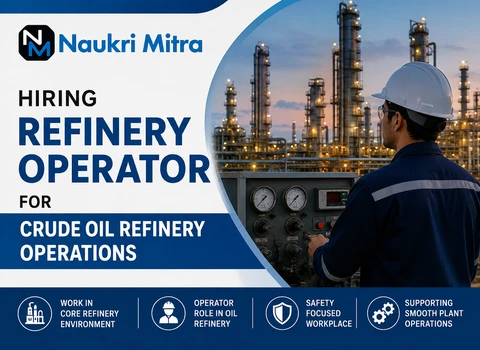
What Does a Refinery Operator Actually Do?
Crude oil doesn't turn into petrol, diesel, or LPG on its own. Someone has to sit in front of the panels, watch the numbers, and make sure the whole system stays balanced. That's the job of a Refinery Operator - a full-time role based in Jamnagar, Gujarat, working inside one of India's crude oil processing units. If you've never looked closely at this profession before, here's what it involves once you're past the interview and actually standing on the plant floor.
Why This Role Exists in the First Place
Refineries don't really switch off. Starting a distillation unit back up after a shutdown takes hours, sometimes longer, and it isn't cheap. So the plant needs eyes on it constantly - people who notice when a pressure reading creeps up half a point too far, or when a valve isn't closing the way it should. That's why companies hire operators specifically for this, rather than pulling in general workers. A missed reading here isn't a small mistake; it can shut down a unit or worse.
Walking Onto the Floor for a Shift
Most shifts start the same way: a handover from the outgoing team, a quick briefing on anything unusual from the last few hours, then a walk-around of the assigned section. From there, the day settles into a rhythm:
- Reading gauges and control room screens, checking they match expected ranges
- Opening or closing valves as the process calls for it
- Logging temperature, pressure, and flow figures at set times
- Reacting fast when an alarm goes off, before it turns into something bigger
- Working alongside maintenance staff when equipment needs attention
It sounds routine written out like this, but the pace can shift quickly if something goes off-normal.
Beyond the Daily Checklist
There's more to the job than watching dials. Operators are also responsible for starting up and shutting down units safely, adhering to written procedures rather than improvising, and keeping logbooks accurate enough that the next shift can pick up without confusion. During planned maintenance, when a unit is opened up for cleaning and inspection, operators are usually pulled in to assist as well.
The Kind of Facility You'd Be Working In
This work happens inside large petroleum refining complexes - think distillation towers, tank farms, pump houses, and a central control room tying it all together. Gujarat accounts for a large share of India's refining capacity, and Jamnagar in particular has built a strong reputation in this space, making it a sensible place to start or grow a career in refinery operations.
Equipment You'll Get Familiar With
Forget hand tools for a moment - this job leans more on monitoring systems and process equipment.
- DCS (Distributed Control System) panels for tracking the process in real time
- Pressure gauges, temperature indicators, flow meters
- Pumps, compressors, and heat exchangers
- Manual and automated valves
- Gas detectors and alarm systems
None of these work in isolation. Once you understand how a change in one reading affects the others, spotting trouble early becomes much easier.
What Qualifications Actually Help Here
Most refineries look for some technical grounding before hiring - an ITI in Chemical Plant Operation, Electrician, or Instrumentation trades, or a Diploma in Chemical Engineering, tends to open doors. That said, knowing how to read a process instrument and understanding basic hydrocarbon chemistry often counts for just as much as the certificate on paper. Freshers coming straight out of ITI or diploma programs get considered here, and so do experienced plant workers looking to move into refining from adjacent industries.
Skills That Matter on the Floor, Not Just on Paper
Attention to detail is non-negotiable. So is staying level-headed when something unexpected happens - panic doesn't help anyone at 3 a.m. during a night shift. Clear handover communication and a genuine willingness to work as part of a team round out what supervisors usually look for.
Physical Side of the Job and Shift Timing
Expect to be on your feet a fair amount - walking across large plant areas, climbing platforms and stairs, sometimes working near equipment that's running hot or loud. Since the plant operates round the clock, this job type is full-time and typically runs on rotational shifts, which means night duty comes up regularly rather than occasionally.
Staying Safe Around Flammable Material
There's no cutting corners on safety in a refinery, given the hazardous and flammable substances involved. New operators undergo training in emergency response, gas leak handling, and fire drills before they're left unsupervised on the floor. On the PPE side, expect flame-resistant coveralls, a helmet, gloves, safety shoes, and respiratory gear where required. Lockout-tagout procedures during maintenance work aren't optional either - they're followed strictly, every time.
What Trips Up New Operators
Staying sharp through a long shift is harder than it sounds, especially in the early weeks before the plant layout becomes second nature. A lot of new hires say the first few alarms feel overwhelming - not because the response is complicated, but because it's unfamiliar. That settles down with time and supervised practice; it's rarely a sign someone isn't cut out for the work.
Where This Can Lead Over Time
Operators who stick with it and build a clean track record can move up to senior operator roles, or into shift-in-charge positions overseeing a team. Some specialize further, focusing on a particular unit, such as distillation, cracking, or utilities. None of this happens overnight, but consistency and a willingness to keep learning the process tend to pay off.
Pay and What Might Come With It
The monthly salary for this position is ₹43,800. Beyond that, some employers offer overtime pay, PF and ESI coverage, an annual bonus, uniforms, or transport and canteen facilities - though this varies by company and shouldn't be assumed as guaranteed.
For anyone based in or around Jamnagar, Gujarat, looking to get into India's petroleum refining sector, this role offers a fairly grounded starting point - steady work, hands-on technical learning, and room to grow if you're willing to put in the time.