
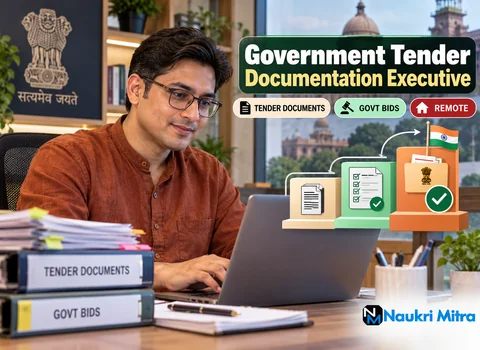
Halfway through packing a works tender, the bidder sees a corrigendum appear on the portal. It swaps one eligibility document for another and moves the bid submission date. This is why a careful tender executive opens the corrigendum list before every single upload, even when the bid feels finished. This listing is for remote government tender documentation executive jobs: a full-time role paid $450 per month (USD), open to applicants worldwide, preparing technical and financial bid documents and submitting them on the CPPP eProcure portal. The work sits on the bidder's side; this is not a listing from CPPP, GeM, NIC or any government body.
Every bid starts with the Notice Inviting Tender (NIT) and the full tender document published with it. The NIT gives the headline facts: the work, the authority, the EMD, the key dates and the cover system. The tender document holds the detail: instructions to bidders, eligibility, scope, contract conditions, formats and the price schedule.
The executive's first job is to read all of it and turn it into a working checklist. That means noting each document asked for, each format that must be used unchanged, each page that needs a seal or signature, and every clause where a missing paper would make the bid non-responsive. A government tender documentation executive job description that leaves out this reading step misses the step where bids most easily go wrong.
Eligibility, sometimes called pre-qualification, decides whether the financial offer is ever opened. Conditions can ask for proof of similar completed work, minimum turnover, registration and tax documents, and declarations about blacklisting.
Here the executive matches each condition against what the company actually holds. If a work order, completion certificate or audited balance sheet is missing or does not meet the wording, that gap goes to the bid manager before work continues.
Tenders on CPPP can use a two-cover system. Cover one is the technical bid: eligibility proofs, technical documents, filled formats and declarations. Cover two is the financial bid, such as a price schedule or Bill of Quantities (BoQ), in the format the tendering authority provides. In general, the technical covers are opened first, and only bidders found technically qualified have their financial bids opened. Some tenders use a single cover or more covers, and the tender document states which applies.
Preparing technical and financial bid documents means keeping the two strictly apart. Prices must never appear in the technical cover. The BoQ file is filled only in the cells meant for the bidder, without renaming it or changing its structure. The executive prepares the BoQ entries from figures the company approves; deciding the price is not part of this role.
Certificates of registration, PAN and GST documents, experience certificates, work orders, audited financials, power of attorney for the signatory, and the annexures printed in the tender document all need to be collected, checked for validity, signed where needed and scanned clearly.
Files are named the way the tender asks, scanned at a readable resolution, merged in the order the checklist gives, and kept within the size limits the portal allows. A flatbed or document scanner and a reliable PDF tool matter here as much as typing speed. Expired certificates are flagged early.
Earnest Money Deposit (EMD) is a security the bidder provides so it does not withdraw or change its offer during the bid validity period. The tender document states the amount, the accepted form (for example online payment, demand draft or bank guarantee, as permitted) and whether original instruments must also reach the tendering office by a stated time. Some tenders allow exemptions for eligible categories, such as registered micro and small enterprises, only as the tender itself lays out.
Other tenders ask for a Bid Security Declaration in place of EMD. In general terms, the bidder declares that if it withdraws or modifies its bid during validity, or fails to sign the contract when awarded, it may be suspended from bidding with that authority for a stated period. The executive uses the exact format given and attaches EMD proof or the signed declaration in the right cover.
The Central Public Procurement Portal at eprocure.gov.in requires bidders to enrol online and to sign and encrypt bids using a Class 3 Digital Signature Certificate (DSC). The DSC is held on a USB token issued in the name of the authorised signatory, and it is registered against the bidder's portal account. The portal encrypts bid documents so they cannot be read before opening.
The executive handles the token under the company's authority, uploads each document against the correct field, and saves the submission receipt. Because the token is a physical device, remote work needs a clear arrangement with the employer about who holds it and how signing happens. For government tender documentation executive work from home jobs, ask about this before joining. Late bids are not accepted, so uploads are never left to the last hour.
Where a tender allows pre-bid queries, the executive drafts clear, clause-referenced questions for the bid manager to approve and sends them by the method and date the NIT gives. Replies may come as a clarification or a corrigendum.
Tracking corrigenda is the habit this role is built on. Each live tender is checked for new corrigenda before any upload, and every change is carried into the checklist, the formats and the internal calendar. Deadline discipline means a shared calendar with each bid submission end date, the EMD submission date and the bid opening date, plus personal reminders well ahead of them.
This role keeps a tender submission register in Excel. Each row records the tender reference, authority, portal ID, EMD or declaration details, corrigenda received, submission time, receipt saved, opening status and result. Folders mirror the register: the downloaded tender document, every corrigendum, the final uploaded files and the acknowledgement.
These records serve internal audits, EMD refund follow-up and later queries from the tendering authority.
Government tender documentation executive skills are practical. MS Word for filling formats exactly, Excel for BoQs and the register, and PDF tools for merging, splitting, compressing and checking scans are all required by this listing.
A graduate with two to five years in government tender documentation is preferred. No single government tender documentation executive course is mandatory, and no particular certification is named. Short courses on e-procurement and tendering from training institutes, and the bidder manuals and help documents published on the portal, are useful ways to learn the steps. One route for freshers is assisting a bid team at a contractor, supplier or consultancy, handling scanning and annexures before moving to uploads. Tender information services such as TenderTiger and Tender247, and EPC firms that bid regularly, come up when people research this field; mentioning them here is purely illustrative, and none is connected to this listing.
Full-time work in this seat earns $450 per month (USD). Per-tender rates, award incentives and similar extras are absent from this listing. Over time, a documentation executive can grow into a bid coordinator or bid manager role. The difference is scope: an executive prepares, compiles and submits, while a bid manager decides which tenders to pursue, owns the pricing and strategy, and answers for results.
A note on scams. Some people sell a "tender consultant certificate" for a fee and claim it is required for jobs like this one. It is not, and no real employer asks you to pay for registration, training or a certificate to apply. Be equally wary of anyone promising a tender award, or asking for a DSC token, PIN or portal OTP outside a proper employment arrangement.