
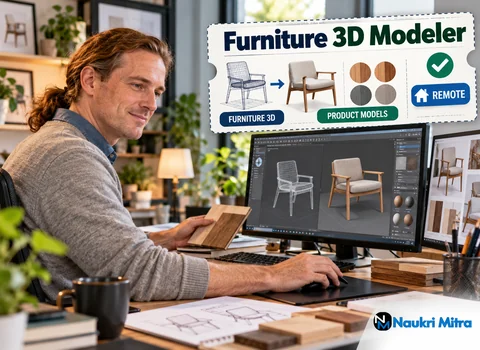
Overall width, overall depth, seat height, arm height, back height. That short list, pinned beside one reference photo of an upholstered armchair shot from the front three-quarter angle, matters more than the photo itself. Those figures decide whether the finished model looks right in a room or sits oddly beside everything else. This listing is for online furniture 3d modeler jobs where that habit of measuring first is the whole foundation of the work.
A typical measurement sheet for a lounge chair records each dimension along with exactly where it was taken:
Why fuss? A seat a few centimetres too high clips through a table in a room scene or makes a catalogue page look subtly wrong. A photo gives shape and proportion. Only the dimensions give size. The role is part-time and remote, paid at $18 per hour (USD), and open worldwide.
The core task is building accurate 3D models of sofas, chairs and tables from reference photos and given dimensions. You do this in 3ds Max, Blender or SketchUp, apply materials and textures, and export optimised files that are ready for catalogues or for rendering. That is the furniture 3d modeler job description in plain terms: turn photos and a spec sheet into a clean digital object someone else can render.
Online retail is a natural home for these models: product images made without a photo studio, restylable room scenes, and models shoppers can place in their own room through an AR view on a phone. Each needs a model that is the right size and light enough to load.
It helps to separate this role from a product rendering artist. The modeller builds geometry, UVs and base materials. A rendering artist focuses on lighting, camera and the final image. This listing centres on modelling.
Methodical work starts with a blockout. Set scene units, then place simple boxes for seat, back, arms and legs. Match each to the measured dimensions before adding a single bevel, and check the silhouette against front and side reference planes.
Only then refine: the cushion crown, the roll of an arm, the taper of a leg. Lenses distort, so when photo and measurement disagree, trust the measurement. Piping, seams and tufting come last, and only as far as the brief needs.
Clean topology means mostly quads, evenly spaced edge loops where the form bends, no stray triangles on curved surfaces, and no hidden overlapping faces. The next person may need to subdivide it or reduce polygons for a web viewer, and messy meshes make that slow.
UV basics are part of the requirement. Unwrap so that seams sit where a real upholsterer would put them, keep texel density consistent so a fabric weave does not look larger on the arm than on the seat, and avoid stretching. These are some of the most visible furniture 3d modeler skills: a viewer may not know the word topology, but they notice stretched fabric straight away.
Accuracy with real dimensions is listed as a requirement, and it deserves its own attention. Work in real units from the start, centimetres or millimetres, and keep the pivot point at the base of the object so it sits on the floor when imported. Check the final bounding box against the spec sheet before export. Apply or freeze transforms so the scale reads as 1 in the receiving software.
A wrongly scaled model looks fine alone and fails only when it meets other assets, usually late.
Strength in any one of the three is acceptable here, and each tends to live in its own corner of the industry. 3ds Max is long established in architectural visualisation and interior studios, often paired with commercial render engines. Blender is free, open source and capable across modelling, UV unwrapping, materials and rendering, which makes it a common choice for independent modellers. SketchUp is popular with interior designers for quick, dimension-driven modelling of hard-edged pieces such as cabinets. Fluency in one, plus clean exports to the others, is enough.
Applying materials and textures is part of the job. Name every material clearly, such as fabric, leg wood or metal frame, so the person rendering can swap finishes without guessing. Use relative texture paths so nothing goes missing when folders move.
On formats, the client or project will usually specify what they need. Common general choices include FBX and OBJ for moving models between 3D packages, glTF or GLB for web viewers and AR, and USDZ for AR on Apple devices. Exporting optimised files means sensible polygon counts, no unused materials and no leftover hidden objects in the scene.
A portfolio of furniture or product models is required. Ideally you also have around one year of 3D modelling experience. This makes furniture 3d modeler jobs for freshers a realistic aim only if your portfolio already shows clean, accurate pieces. Include wireframes and the dimensions you worked to. Your furniture 3d modeler resume should point straight to that portfolio.
A PC with a capable graphics card is also needed. High-poly sofas, material previews and test renders all lean on the GPU. A dedicated card with enough video memory, ample RAM and a three-button mouse help. Check your software developer's published system requirements before buying.
For anyone wondering how to become a furniture 3d modeler, Blender is the obvious place to start because it costs nothing to install. Official documentation and many tutorial series on hard-surface and furniture modelling are available. A structured furniture 3d modeler course can help, though no specific certificate is required for this listing. The portfolio is what reviewers look at.
A practical study plan: model one chair from a real product page using its listed dimensions, then a sofa, then a table with a wood material. Unwrap each and compare renders with the product photo.
Some modellers sell finished furniture models on marketplaces. CGTrader and TurboSquid are two well-known examples of places where 3D assets are listed for sale. Income there depends on whether buyers purchase your models.
This listing is different. Here your time is what gets paid: $18 per hour (USD), part-time. Anyone weighing furniture 3d modeler salary per hour figures can run a quick sum, before tax and for illustration only: ten hours equals $180, and the real amount tracks the hours you put in. If you are looking at part time furniture 3d modeler jobs, compare both approaches before you commit.
Getting a first client in freelance furniture 3d modeler jobs usually comes down to evidence. A tidy portfolio and a short, specific message about what you model beat a long skills list. Furniture 3d modeler work from home suits people who can keep that same discipline without someone checking over their shoulder.
If a so-called employer wants payment from you before work starts, be suspicious. A genuine modelling role does not charge for registration, for a test project, for a software licence bundle or for a training pack. Be wary of large unpaid tests that look like real client work, and watermark shared samples.