
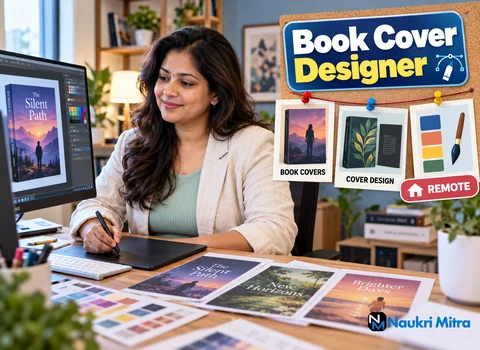
Open any online bookstore on a phone, type a genre into the search bar, and look at the grid. Each cover is now a tile about the size of a postage stamp. The tiny serif subtitle has vanished. The delicate watercolour background is mud. What survives is one strong shape, one colour mood and a title you can read without squinting. That shrinking act is the daily reality behind online book cover designer jobs, and this part-time remote role is built around passing it, cover after cover, for self-published authors.
In this book cover designer work from home role, you design ebook and paperback covers from author briefs and build print wraps that upload cleanly. You can do it from any country, it is part-time, and it pays $18 per hour (USD).
Day to day, the work is mostly translating a brief into the visual language of one shelf. Cosy mystery buyers look for illustrated scenes and warm palettes. Thrillers favour bold condensed type. Epic fantasy leans on ornate titles and painted landscapes.
A cover that ignores its genre is a cover that the right reader scrolls past. Studying current bestsellers in the category, before sketching anything, is part of the book cover designer job description.
Typography carries more weight on a cover than most newcomers expect. The title has to read at roughly the width of a thumbnail, so you pick faces with clear letterforms, set generous weight, and stack long titles on two or three lines rather than shrinking them.
Strong book cover designer skills here include kerning by eye, pairing a display face with a quiet secondary face and knowing when a glow effect cheapens the result. Every font you use must carry a licence that covers commercial book covers, including print runs and ebooks. A font marked free for personal use will not cover a client's book.
An ebook cover is a single front image. A paperback is a full wrap: back cover, spine and front cover laid out as one flat file, plus bleed around the outside edge. The back holds the blurb and a clear barcode area.
Spine width is never a guess. It depends on the final page count and the paper type the author chooses, because cream paper is slightly thicker than white, and colour interiors have their own figures. A late extra chapter means a rebuilt wrap, and very thin books may be too slim for spine text at all.
For authors publishing through Amazon KDP, the KDP cover calculator is your starting point. You enter trim size, page count, paper type and interior ink, and it gives you a template showing the exact wrap dimensions, the spine, the bleed and the safe zones. KDP's guidance asks for bleed on the outer edges, commonly an eighth of an inch, and for important text to stay inside the safe area so nothing is trimmed off.
KDP cover size and bleed requirements are updated from time to time, so you check the official help pages before each job rather than trusting a number memorised two years ago. For the ebook, KDP publishes a recommended pixel size and aspect ratio, and other retailers have their own rules.
Every photo, texture and illustration on a cover must be licensed for commercial use or be your own original work. Some stock licences limit print runs, so read the terms and keep each licence with the project files.
Is there still demand now that AI can generate covers? Cheap generated art has flooded the low end of the market, and some platforms and retailers now ask for disclosure or restrict it. Authors who care about a series still pay for a designer who knows genre, type and print specs, and can prove where every image came from.
Imagine an author, invented for this example, publishing a 312-page cosy mystery called The Marmalade Alibi, set in a seaside tea shop. She wants a 5.5 by 8.5 inch paperback on cream paper and an ebook. Her brief mentions a ginger cat, a teacup and a lighthouse.
For part time book cover designer jobs like this one, pay is $18 per hour (USD). Authors often ask whether covers are priced per design or by the hour. The open market has both: many freelancers quote a package per cover, and any book cover designer salary per hour you see quoted elsewhere varies with country and portfolio. This role pays by the hour. Incentives rest with the employer and none are promised here. Hours follow the briefs on hand, with no set weekly total.
A typical week: two new briefs, rough concepts for one, a revision round on another, and a wrap rebuilt after a page count change. Deadlines cluster around launch dates.
Is a graphic design degree needed? Not for this role. What matters is a strong cover portfolio and about one year of book or graphic design experience, plus skill in Photoshop and Affinity Publisher, comfort with the KDP calculator and sound knowledge of licensed fonts and images. A book cover designer course can teach the craft, and a book cover designer certification may look good on paper, but neither replaces finished work.
Starting with no clients? Make premade covers for imaginary books in three or four genres, each shown as a front, a thumbnail and a full wrap. If you are aiming at book cover designer jobs for freshers, show process, not only finals. For your book cover designer resume, list genres, tools and print platforms you have built for. Typical book cover designer interview questions, like most design tests, probe spine width, bleed and font licensing.
Marketplaces such as Reedsy, 99designs and Fiverr show how the wider market works, and freelance book cover designer jobs also turn up in author communities. They are examples of the market, not this listing's employer.
Cover design and book illustration are often confused. An illustrator paints or draws the artwork, often for interiors or children's books. A cover designer may use illustration, but owns the whole package: genre positioning, typography, layout, spine and print specs. From here, growth can mean series branding, box sets, audiobook squares or art direction for small presses.
There is no fee to apply. Send a portfolio with at least one full paperback wrap, a short note on the genres you know best, and the tools you use. If your covers already hold up at stamp size, we would like to see them.