
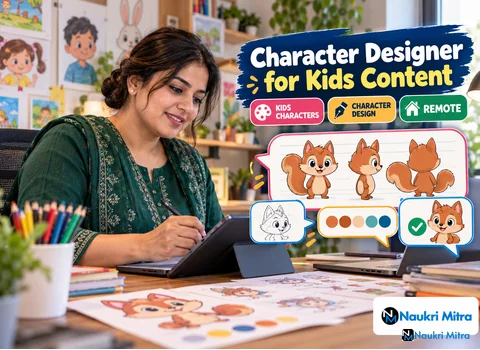
Try a small experiment before any new project. Print three black silhouettes of characters you have just invented and show them to a four-year-old. The first is Bramble, a tall, thin heron postman with a satchel. The second is Mossy, a lumpy rock troll who is mostly shoulders. The third is Dottle, a round harbour mouse with two enormous ear discs and a stubby tail. A child will usually point at Dottle within a second and say "mouse!" The ears do all the work. That instant read is the heart of online character designer for kids content jobs, and it is what this part-time, fully remote role asks you to deliver, week after week.
The character designer for kids content job description starts here: you create original cartoon characters for children's YouTube channels and similar kids video content. In practice that means drawing turnaround sheets and expression sets in Procreate or Illustrator, preparing layered files that Toon Boom Harmony animators can rig without rebuilding your work, and refining each design when the story team sends feedback.
The terms are simple. This is character designer for kids content work from home, open to applicants worldwide. The character designer for kids content salary per hour is $18 (USD), on a part-time basis. Hours follow the projects you are given, so they are not fixed or promised. Incentives are for the employer to decide.
A degree in animation or fine arts is a plus, not a must. What matters is strong illustration and a portfolio of cartoon characters, which is why character designer for kids content jobs for freshers are realistic here when the drawings are good.
Young viewers read shapes before they read faces, so shape language sits at the centre of character designer for kids content skills. Circles feel soft and friendly, so a helper character often starts as a stack of round forms. Squares feel steady and dependable: a grandad tortoise or a sturdy tugboat. Triangles feel sharp and quick, which suits a mischievous fox or a villain who is silly rather than frightening.
Keep the silhouette test in your pocket. Fill your sketch with solid black. If the character is still recognisable, and still different from the rest of the cast, the design is working.
A turnaround shows one character from the front, three-quarter, side, three-quarter back and back, all at the same height and lined up on horizontal guides for the eyes, chin, belt and feet. Animators use it to keep volumes consistent when the character turns, so measure carefully. A mismatched ear height forces the animator to guess.
The expression set gives the character an emotional range: happy, sad, surprised, cross, scared, sleepy, giggling and thinking at a minimum. For preschool audiences, push the eyebrows and mouth shapes further than feels natural. Keep the eyes readable; small pupils lost in a large eye white can look blank or uneasy on a small screen.
Many children watch on a parent's phone or a tablet in a bright room. Choose a limited palette, usually four to six main colours per character, with clear value contrast between the character and typical backgrounds. Check your design in greyscale: if the face and the body merge into one grey, the colours are doing too little. Fine stripes shimmer when video is compressed. Give the client a colour sheet with hex values so every artist paints the same red.
Harmony animators build cut-out rigs from the parts you give them. That makes your layer structure part of the design. Separate the head, eyes, pupils, eyebrows, mouth, ears, torso, upper arms, forearms, hands, legs and tail onto their own named layers. Draw a little extra at each joint so a forearm can rotate at the elbow without opening a gap. Draw a set of mouth shapes for lip sync. Avoid details that cross two body parts, like a scarf that wraps over the shoulder and the arm, unless you split it cleanly. Harmony imports layered PSD files, which Procreate can export, so tidy layer names save the rigger real time.
Imagine an invented brief from a preschool channel making four-minute bedtime songs about the seaside. They want a gentle lead who keeps the lighthouse lamp shining. Day one, you send three rough silhouettes: a round mouse, a long-bodied mouse with a cap and a pear-shaped mouse with a lantern. The story lead picks the round one but asks for something to hold. You add a small brass lantern. Next, you draw the five-view turnaround and an eight-pose expression set, then a palette of warm cream, soft navy, lantern gold and a pink nose. The first review says the giggle pose looks smug, so you widen the eyes and lower the eyebrows. Finally, you deliver dottle_v04_layered.psd with every joint split, a mouth chart and the colour sheet.
A typical week might start with a brief on Monday and a short call or voice note about the story. You send roughs by midweek, get one or two rounds of notes, and finalise turnarounds before an agreed deadline. As with other part time character designer for kids content jobs, the load varies. Some weeks bring a whole new cast; others bring small fixes. Most freelance character designer for kids content jobs run this way.
You need a computer or iPad that runs Procreate or Illustrator smoothly, plus access to Toon Boom Harmony or at least a working knowledge of how it handles layers. A drawing tablet is required. Pressure sensitivity matters more than brand; a Wacom pen tablet, a pen display or an iPad with Apple Pencil all work. Use a monitor with consistent colour, calibrated if you can. Stable broadband matters because layered files get large. Keep work in cloud storage with version-named files, and never share client designs publicly or on social media before the channel releases them.
Show eight to twelve original characters, never fan art of existing shows. For at least two, include the full package: silhouettes, turnaround, expressions, colour sheet and a screenshot of the layer stack. Show one small cast together.
A design test is usually one character from a short brief. Deliver exactly what was asked. Character designer for kids content interview questions often cover how you handle conflicting notes, how you prepare files for riggers and what you watch for in preschool designs.
Your character designer for kids content resume can be one page: software, projects, and a link to the portfolio. A character designer for kids content course or a children's animation class can help structure practice, but no particular certification is required for this role.
A children's book illustrator paints finished scenes for print, with rich detail and texture, and a character may appear in one or two poses per spread. A character designer for animation builds a system: the same character must work from every angle, in many emotions, with parts that move. The drawing skills overlap; the thinking is different.
Demand comes from kids YouTube channels, educational apps and animation studios, and some studios post remote openings on job boards such as ArtStation Jobs. Over time, designers can move into lead design, art direction or full pre-production work, including background and prop design.
There is no charge to apply. Send the portfolio link, a few words on the characters you love drawing and your usual weekly hours. If your silhouettes pass the four-year-old test, we would like to see them.