
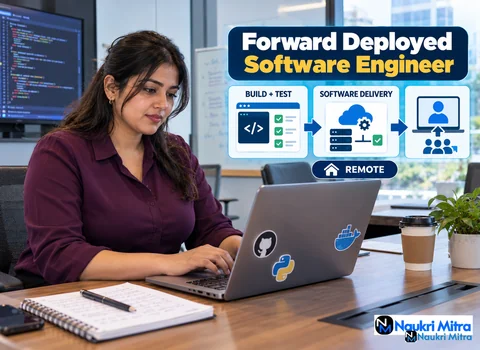
Stack: React, Python and Kubernetes. Pay: $145,000 a year in USD, full-time, remote from anywhere. It is one of the remote forward deployed software engineer jobs hiring now, aimed at people who like writing integration code for one client at a time and staying long enough to see it run in that client's environment.
It suits an experienced full-stack engineer who is comfortable on a call with a customer's IT team at 9am and in a pull request by 10.
Here is the forward deployed software engineer job description stated plainly, in the order work happens on an engagement:
So what does a forward deployed software engineer do, day to day? That loop, repeated per client. The sections below take it one layer at a time, each with an illustrative task, not a real client.
The client judges you on the front end because it is what they see. Usually you are adding a custom view to an existing React app so one customer's operations team can do something the standard product does not cover.
Illustrative task: a logistics client wants a reconciliation screen that lists shipments where their ERP and the platform disagree on quantity. You build a table component with server-side pagination, a filter for date range and warehouse, and an inline "accept ERP value" action that calls a Python endpoint. The detail that matters: their users work on old laptops over a VPN, so you keep page size at 50 rows and avoid loading the full dataset into state.
This is where building client integrations gets interesting. Enterprise systems have quirks that never make it into the docs. Expect SOAP endpoints wrapped in REST, OAuth tokens that expire after 15 minutes, rate limits nobody mentioned, and CSV exports dropped on an SFTP server at 2am.
Illustrative task: write a FastAPI service that pulls purchase orders from a client's ERP every ten minutes, normalises field names, and writes them to Postgres. You add retry with backoff for 429 responses, idempotency keys so a re-run does not create duplicates, and a dead-letter table for records that fail validation.
Deploying to your own cluster is easy. Deploying into a customer's is a different job: their network policies, their image registry, their change window on Thursday nights. You need to read a Helm chart quickly and work out why a pod is stuck in CrashLoopBackOff without root on the nodes.
Illustrative task: the integration service runs fine in staging but fails in the client's production namespace. You check the events, find the readiness probe hitting /healthz on port 8080 while the container listens on 8000, fix the values file, and then discover outbound traffic to the ERP is blocked by an egress policy. You write a one-paragraph request to their platform team naming the exact host and port, rather than "please open the firewall".
An integration you cannot hand off is a liability. Before you move to the next client, the support team needs enough to run it without paging you. A good hand-off pack covers:
Clear writing here is a real part of the job, and some interviewers ask to see an example.
On remote vs onsite: this role is listed as remote, open worldwide, so the work is done from wherever you are, over video calls, shared repos and VPN access to client environments. Some teams elsewhere expect site visits; none are stated here, so ask about travel in interviews. For people searching forward deployed software engineer work from home jobs, the practical requirements are a reliable connection and enough overlap with client time zones to join working sessions.
Forward deployed software engineer vs solutions architect is a fair question. A solutions architect typically designs the approach, runs technical discovery and supports the sale, and may write proof-of-concept code. A forward deployed engineer writes and ships the production integration, owns it in the customer's environment, and is judged on whether it runs.
The listing is specific: five or more years of full-stack engineering, with strong React, Python and Kubernetes, plus hands-on experience integrating with enterprise systems. Client-facing communication and end-to-end ownership are essential.
That makes this a poor fit for new grads, and people hunting entry level remote forward deployed software engineer jobs or forward deployed software engineer jobs no experience should read it as a target, not an opening. Becoming a forward deployed software engineer is mostly a matter of time spent on the right work: take integration tickets in your current job, volunteer for customer escalations, run your own services on a small Kubernetes cluster, and publish the code. There is no single forward deployed software engineer course or forward deployed software engineer certification that substitutes for this. Vendor docs, free learning material and finished projects do more.
The forward deployed software engineer salary for this listing is $145,000 in USD. As a forward deployed software engineer salary per year, it is the full annual figure for a full-time position; the listing does not quote a range, bonus or equity, so do not assume any. Ask early how pay is handled for your country, since the role is open worldwide.
The listing does not describe the hiring process, but teams hiring for this kind of role often set a practical exercise. A common shape: a mock enterprise API with bad docs, a small React view and Python sync service, and a note on deployment.
Forward deployed software engineer interview questions tend to fall into a few groups. Prepare one concrete story for each:
In each story, give specifics such as the status code, the log line or the config value you changed.
A forward deployed software engineer resume should read like a list of integrations you delivered, not a list of languages. One line per project: the systems you connected, the stack, and what changed for the client. "Built a Python sync service between an ERP and a warehouse app, deployed on Kubernetes, cut manual reconciliation from daily to weekly" beats "worked on backend".
Put the forward deployed software engineer skills you actually used near the top: React, TypeScript, Python, FastAPI or Django, Postgres, Docker, Kubernetes, Helm, REST and OAuth. The listing says public code samples strengthen applications, so link a repo in the resume text where a reviewer can see your code, ideally one with a README, tests and a deployment manifest.
Send your resume, a link to public code, and two or three lines on an integration you are proud of. There is no fee to apply or interview, and a real hiring team will never ask you for one. Anyone browsing forward deployed software engineer jobs remote worldwide will see this kind of role at AI startups, SaaS vendors selling to large enterprises, data platform companies and technical consultancies.
On exit opportunities: people who do this for a few years often move into solutions architecture, engineering management, product roles, or founding a company around a problem they kept seeing at clients.