
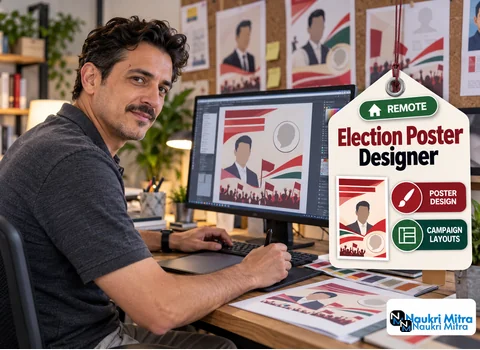
Two posters are pasted side by side on a junction wall near a bus stop. The first shows one face, one name in heavy Devanagari, the allotted symbol in the lower corner and a single line asking for your vote. A rickshaw passenger reads it before the signal turns green. The second carries eight faces, four slogans, three phone numbers and type so small it needs a ladder. Nobody reads it. The difference is a designer who knew what to cut. These online election poster designer jobs are for people who make the first kind of poster, remotely and to campaign deadlines, for $18 per hour (USD) on a part-time basis. The role is open worldwide, and the work is strictly non-partisan: you design for the brief in front of you, not for a side.
So what does the work actually involve? You design candidate posters and campaign banners, plus matching social media creatives, in CorelDRAW and Photoshop. You place photographs and approved symbols correctly, set text in Hindi or a regional language, and hand over print-ready files that a press can run without calling you at midnight. That is the plain election poster designer job description, and it changes very little between a ward election and a state one.
You are not the strategist. The campaign decides the message. Your job is to make that message legible from across a road, accurate in every letter and lawful in its details.
A brief usually arrives as a voice note, a phone photo of a handwritten line and a folder of candidate pictures of mixed quality. You confirm the sizes, the language, the deadline and who signs off. A first draft goes back within hours. Expect two or three revision rounds, mostly about the name spelling, the photo crop and which local leaders appear.
Outside campaign periods the week is quiet: a few banners, some festival greetings for local representatives, template work. Close to polling, briefs stack up and deadlines shrink to a day or less. Hours are not fixed or promised. You agree availability with each client, and you say no to a deadline you cannot meet rather than miss it.
This is where many designers from other fields struggle. Devanagari, Tamil, Bengali, Telugu or Gujarati text must be typed in a proper Unicode font, with conjuncts and vowel signs rendering correctly in both CorelDRAW and Photoshop. Legacy non-Unicode fonts still circulate in local print shops, so you may need to recognise them and convert text carefully. Always ask a native reader on the campaign team to check the final wording. One broken matra on a candidate's name is a reprint, and nobody has budget for reprints at election time.
The candidate's photo should be sharp, well lit and cropped consistently across every size. Clean up backgrounds and correct skin tones gently; do not alter a person's appearance in a misleading way. Symbols must come from the campaign as approved artwork, placed at the size and position they request, never redrawn from memory. Keep other people's photos out of a design unless the client confirms they have permission to use them.
In India, Section 127A of the Representation of the People Act, 1951 requires election pamphlets and posters to carry the names and addresses of the printer and the publisher on their face. Designers often leave this off as clutter. Do not. Reserve a clear, readable strip for it on every print layout and ask the client for the exact details before final export. The law also places separate duties on printers and publishers, and the Election Commission's Model Code of Conduct applies during the campaign period. Those obligations belong to the campaign and the press, but knowing them helps you ask the right questions. Rules differ in other countries, so check locally. Whatever the country, never design content that is hateful, misleading or defamatory, whoever is paying.
Here is a worked example. A fictional independent candidate for a municipal ward needs a 20x30 inch wall poster, a 10x4 foot flex banner, an A5 handbill and a square social post, all in Hindi, by tomorrow morning. You build one master in CorelDRAW: photo, name, symbol, one line of appeal, the printer and publisher strip. You then create each size as its own page, re-flowing rather than stretching. The banner gets a horizontal layout with larger type; the handbill drops to a single photo and adds a ward map reference; the social post keeps the same colours and type, and you ask whether the campaign wants the strip shown there too. You export print files as CMYK PDFs with bleed and the press's preferred settings, and an RGB JPEG for the social version. One client approval call covers all four.
You need a computer that runs CorelDRAW and Photoshop smoothly with large files open, a consistent monitor (calibrated if possible, since flex printing exaggerates colour shifts), and stable broadband for sending heavy PDFs. Use cloud storage with clear version names such as ward7_banner_v3_final. A pen tablet is optional but helps with photo cut-outs. Keep client files private, store them separately per client, and delete working copies when the job and payment are closed.
You do not need a degree. The election poster designer skills that count are CorelDRAW and Photoshop fluency, clean Indic typesetting, hierarchy and speed under pressure. Political or event design experience helps, and a portfolio of posters or banners is the strongest proof you can offer. With no track record yet, make three or four mock campaigns for invented candidates and invented symbols, each with the full size set and a visible printer and publisher strip.
A short election poster designer course or a software certificate can help with the tools, but no election poster designer certification is required here; clients judge the work. Expect a timed test: a brief, a photo, a symbol and a deadline. Typical election poster designer interview questions cover handling a last-minute name change, converting legacy font text and preparing files for flex. For your election poster designer resume, list your software, languages you can typeset in, sizes you have delivered and your fastest real turnaround. Election poster designer jobs for freshers do exist, but the portfolio has to do the talking.
The election poster designer salary per hour for this listing is $18 (USD), part-time. Some clients elsewhere pay per design instead; hourly pay suits revision-heavy work better. Incentives are not promised and would be the employer's call. Campaign work is seasonal, so plan for it: between elections, take festival, event and local business design, and keep templates ready. Remote orders come through freelance marketplaces, design job boards, regional print shops that outsource artwork, and referrals from earlier campaigns. For freelance election poster designer jobs, reliability on the last night is what earns the next call.
A political social media designer works in RGB, in motion, on daily volume and platform formats. You work in print logic: bleed, CMYK, distance legibility, legal strips. The skills overlap and many designers do both. Growth paths include leading a small campaign design desk, managing print vendors, or moving into broader brand and event design.
There is no cost to apply. Point us to your portfolio, name the scripts you can typeset, and mention your software versions. If you want part time election poster designer jobs that fit around other work, say which hours you are reliably available. Election poster designer work from home suits people who stay calm on deadline night and get every letter right.