
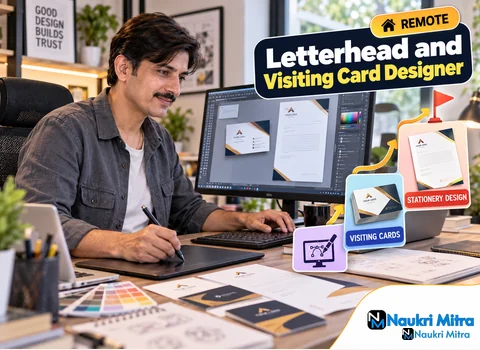
A standard visiting card in India and the US measures 3.5 x 2 inches. In Europe the usual size is 85 x 55 mm, and some printers elsewhere cut slightly different sizes, so ask first. Into that rectangle a client wants a logo, a name, a designation, two phone numbers, a WhatsApp line, an email, a website, a full street address, a GSTIN, a QR code and, quite often, a tagline. These online letterhead and visiting card designer jobs pay $18 per hour (USD) for deciding what fits, what moves to the back and what goes onto the letterhead instead. You can take this part-time work on from any country, entirely online.
The front has a single job. Someone glances at it across a table and should know, in a second, whose card it is and what they do. That means one dominant element and a clear step down in size for everything else. Three type sizes at most.
Text below 7 pt starts to fill in on uncoated stock, so contact details sit at 7.5 to 9 pt depending on the typeface. Hairline serifs that look lovely on screen vanish on a 300 gsm matte card.
The back takes the overflow, with discipline: a large logo on a brand colour, a short service list, or a QR code with a line saying what it opens. If the client insists on two addresses and three numbers, set them in a tidy two-column block and agree the order in writing first.
Letterheads in India and Europe are mostly A4 (210 x 297 mm), while US clients want Letter (8.5 x 11 inches). Ask before you open a file. Leave the writing area clean, because the office will type into it in Word for years; a left margin of 20 to 25 mm is a sensible start.
The footer carries the registered address, phone, email and, where local rules require them, registration numbers such as a GSTIN or company identification number. Rules differ by country and business type, so the client confirms which numbers must appear. Test print a page to check that an office printer does not clip it.
Designing business stationery sets for small businesses is mostly about consistency. The visiting card, letterhead, envelope and sometimes a compliment slip or invoice template should share one grid, one colour palette and one type family. A DL envelope (110 x 220 mm) takes an A4 sheet folded in thirds; a C4 holds it flat. Some Indian offices order a 10 x 4.5 inch envelope instead, so confirm the printer's stock size.
Finishes change how a card feels in the hand. Know matte and gloss lamination, spot UV, foil stamping, embossing, letterpress and rounded corners. Spot UV and foil are usually supplied as a 100% black mask on an extra page, but ask the client's press for its exact requirements first.
Visiting card size and print bleed settings trip up more beginners than any typeface choice. Add bleed on every side, typically 3 mm or 0.125 inches, so a 3.5 x 2 inch card becomes a 3.75 x 2.25 inch document and an 85 x 55 mm card becomes 91 x 61 mm. Keep a safe zone of about 3 mm inside the trim line for text.
Work in CMYK from the start, not RGB converted at the end. Small text goes in 100% black only, never a four-colour rich black, because slight plate shifts make it blurry. In CorelDRAW, convert text to curves before export; in Illustrator, outline fonts or embed them in a PDF/X file. Canva can export a print PDF with crop marks and bleed, and on paid plans it offers a CMYK colour profile, but check the result against the printer's specification.
An invented clinic in Pune sends a phone photo of its old card, a pale green logo and a note: two doctors, one shared letterhead, envelopes to follow. You set up two 91 x 61 mm CorelDRAW pages with guides at the trim and safe lines. The front carries each doctor's name in 11 pt semi-bold, qualifications in 7.5 pt, and the logo at top left. The back holds the clinic address, timings and a QR code linking to the booking page, which the client supplies.
Round one: the client wants the logo bigger. You enlarge it and move the timings into a single line. Round two: a phone number changes. You then export a PDF with bleed and text in curves, match the letterhead to the same CMYK green and send the files once the agreed payment arrives.
That is the letterhead and visiting card designer job description in miniature. A normal part-time week mixes a few new card layouts, one full set and small edits such as a changed address, usually with one or two revision rounds. Printers set the deadlines, so Thursday means Thursday. Hours vary with the work available and are not fixed.
The letterhead and visiting card designer skills clients want are tight typography, grid alignment, CMYK colour discipline and redrawing rough logos as clean vectors. CorelDRAW is the common choice with Indian presses, Illustrator suits agencies abroad, and Canva handles quick jobs for clients who want to edit later.
Show sets, not loose cards: front, back, letterhead and envelope together, with a note on stock and finish. Six strong sets beat thirty single cards. Letterhead and visiting card designer jobs for freshers are realistic if your samples are print-correct: include the bleed version of one file to prove it.
On a letterhead and visiting card designer resume, list your software, the finishes you have prepared and any presses you have worked with. A short course in print production helps, but no certificate replaces a correct file. The design test is usually a single card from a short brief. A paid or limited test is fair; a request for a complete stationery set for free is not a test.
A logo designer builds the mark from scratch through research and several concepts. A card designer usually receives that mark and makes it work on small formats and paper, though clients often ask for a logo tidy too. Identity design is the natural next step, then brand guidelines, packaging or art direction.
Shops, clinics, start-ups, consultants and printers who outsource layout all need stationery. Marketplaces such as Fiverr and 99designs carry steady gigs of this kind, though pricing there is competitive. To find clients online, publish finished sets, contact printers without in-house designers and keep repeat customers, since every new hire needs a card. Print matters less than it did, yet a new business still orders cards in its first week. This listing covers part time letterhead and visiting card designer jobs, and the letterhead and visiting card designer salary per hour here is $18 (USD). Bonuses are up to whoever hires you, and nothing extra is promised here.
Applying is free. Send three or four stationery sets as PDFs, at least one with bleed and crop marks visible, and a note on the software you use. Freelance letterhead and visiting card designer jobs and letterhead and visiting card designer work from home roles both reward the same habit: files a printer can run without phoning you first.