
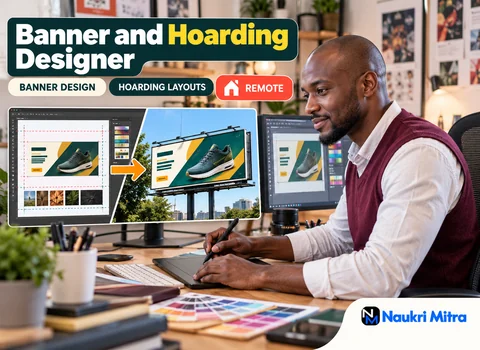
On your laptop, a hoarding design sits eighteen inches from your nose and every hairline looks sharp. On the highway, a driver doing sixty sees it for maybe four seconds from a hundred metres back. Most of what looked clever on screen disappears. This listing is one of our online banner and hoarding designer jobs, and the whole job is designing for that second view, not the first one.
The role is remote, open worldwide, and part-time. Pay is $18 per hour (USD). Hours depend on the work clients send in, so we do not promise a fixed weekly number.
Here is the plain banner and hoarding designer job description. A shop, school, builder or event organiser needs a large printed sign. You get the brief, measurements, logo and photos, build the layout at the exact dimensions, set resolution, bleed and CMYK colours, and send a print-ready file to the vendor. Then the client changes the phone number twice and you update it.
Indian print shops mostly work in feet: a 10 x 4 ft shop banner, a 20 x 10 ft or 40 x 20 ft hoarding. Clients abroad may give metres. Confirm the unit before you open a document.
An invented case: a local furniture store wants a 20 x 10 ft hoarding for a Diwali sale. The brief: store name, "Flat sale on sofa sets", one product photo, address and phone number.
Freshers often ask for 300 DPI at full size on a 40 ft hoarding. Resolution at this size follows viewing distance. A common shop habit: around 300 DPI for things held in the hand, roughly 100 to 150 DPI for indoor standees and banners seen from a few metres, and somewhere around 20 to 50 DPI at full size for hoardings seen from across a road. The vendor's spec always wins.
Designing at 1:10 scale at 300 DPI gives you an effective 30 DPI at full size. Keep text and logos as vector in CorelDRAW so they stay sharp at any size. A rough shop guide for type: one inch of letter height per ten feet of reading distance.
Screens show RGB. Flex and vinyl printers lay down cyan, magenta, yellow and black ink, so bright RGB greens, oranges and electric blues often print duller. Convert to CMYK early, with the vendor's profile if they have one, and judge colour after conversion. Use rich black for big areas only if the printer agrees, since heavy ink on flex dries slowly. Small text stays in plain 100% black.
Vendors usually accept a press PDF, a high-quality JPEG or TIFF, or the native CDR. Convert text to curves or embed fonts. A missing Devanagari font on the vendor's machine turns your hoarding into boxes.
Bleed is extra background that runs past the trim line so no white edge appears when the print is cut. On large format it is measured in inches, and flex needs extra for eyelets, hemming or frame wrapping. Keep text and logos well inside a safe zone.
Banner and hoarding designer work from home arrives in waves around festivals, elections, exams and store openings. A week might hold two or three briefs: first layouts within a day, one or two revision rounds over chat, final files before the printer's cut-off. Part time banner and hoarding designer jobs reward quick replies and kept deadlines more than fancy drafts.
Core banner and hoarding designer skills: fast, clean CorelDRAW layout, Photoshop retouching and masking, typography that reads at distance, colour sense in CMYK, and enough print knowledge to talk to vendors. Hindi or regional-language typesetting helps with Indian clients.
No degree is required if your portfolio shows large format print work. One year of design experience is preferred, not compulsory. If you are starting out, a short DTP or banner and hoarding designer course helps, but a banner and hoarding designer certification matters far less to clients than proof you have printed real work.
Portfolio and design test. Show five to eight pieces. Note size and resolution for each, plus a phone photo of the printed flex if you have one. Expect a small paid or short design test: a 10 x 4 ft banner from a fake brief. Hit the size exactly and name the file properly.
Resume tips. A good banner and hoarding designer resume lists software versions, print sizes handled, and the kinds of clients served. For banner and hoarding designer interview questions, be ready to explain bleed, why you would pick 30 DPI for a hoarding, and how you would handle a client who sends a blurry WhatsApp logo.
Clients turn up on marketplaces such as Fiverr and 99designs, on job boards like this one, and through local and online print shops that need overflow help. Small-town print shops often have machines but no strong designer, so a short message with your portfolio can bring steady work. Freelance banner and hoarding designer jobs there pay in many ranges; this one pays $18 per hour (USD). No bonus or incentive is promised; only the employer could offer one. Elsewhere, the banner and hoarding designer salary per hour you will see quoted varies by country, client and skill.
Banner designer vs flyer designer. A flyer is held at arm's length, printed at around 300 DPI on paper, and can carry dense text. A banner or hoarding is read from far away, printed at low DPI on flex or vinyl, and can carry only a few words.
Send watermarked low-resolution proofs. Release the print file after payment, as agreed in writing.
Is this a good freelance career? For people who like print and can work fast, yes. You can grow into outdoor ad campaigns, shop branding, vehicle wraps or running a print house's design desk. Banner and hoarding designer jobs for freshers exist too, and even an entry-level start can lead somewhere if your portfolio shows real printed pieces.
It costs nothing to apply. Share your portfolio, list the largest print sizes you have prepared, and tell us roughly when you can work.