
"When will the production go out?" Outside counsel tends to ask it as a status call wraps up, as if it had a one-word answer. It never does. The honest reply depends on collections arriving from the last custodians, processing clearing its exception files, the review team being staffed for the second-level queue, and quality control passing without sending a batch back. Owning that answer is the job. Remote ediscovery project manager jobs like this one cover litigation and investigation matters, and this position is full-time, pays $85,000 a year (USD) and is open to people based anywhere.
Strip any ediscovery project manager job description down and you get four verbs: scope, schedule, budget and coordinate. Analysts process and load the data, attorneys make the coding calls, and you make sure both happen in the right order and on a date the court will accept. US discovery practice governs most matters, which means some days run on US hours; location and time-zone conditions differ by posting.
Every project starts with an intake call and a list of unknowns. Who are the custodians, and are any of them former employees whose laptops were reimaged? Which sources matter: mailboxes, Teams or Slack channels, shared drives, mobile phones, a legacy database nobody has opened in years? Is the volume closer to a few hundred gigabytes or several terabytes? What date range, what search terms, and has the production format been agreed with the other side?
You turn those answers into a short scope document with assumptions written out plainly, so that when one of them proves wrong, everyone can see which part of the plan moves.
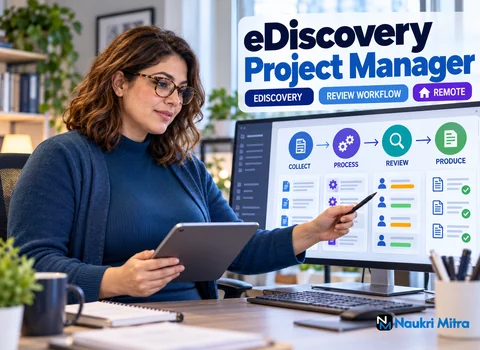
The Electronic Discovery Reference Model is usually drawn as a diagram. For a project manager it is a dependency chart. Identification and preservation feed collection. Collection feeds processing, and processing produces the reviewable document count that sets review staffing. Review feeds privilege logging and QC, and only then does a production set get built and delivered.
Managing a matter from collection to production means knowing which of those handoffs sits on the critical path this week. If a phone extraction is late, does it hold up the whole first production, or can it roll into the second? Your plan should answer that before anyone asks.
You work backwards from the court date or the date agreed with opposing counsel, then add buffer where experience says things slip: data from third parties, foreign-language material, password-protected files. Budgets cover processing, hosting, review hours, technical work and project management time. Give estimates as ranges tied to stated assumptions, track spend against them weekly, and raise the flag early when burn runs ahead of plan. Clients forgive a revised estimate far more readily than a surprise invoice.
Once processing gives you a culled count, you estimate reviewer pace from past matters, decide headcount and shifts, and line up language skills or US-licensed attorneys where the matter needs them. You arrange protocol training with the case team, plan first-level, second-level and privilege queues, and rebalance people when one queue backs up. The judgement on what is responsive or privileged belongs to the reviewers and counsel; your part is making sure enough qualified people are looking at the right batches on the right days.
Building every workspace yourself is not the job, but you must know Relativity and Everlaw well enough to ask for the right thing and spot when something is off. That means clear requests for workspace set-up, coding layouts, batching, term reports, saved searches and production specifications, each with an owner and a due time. When the technical team sits in another time zone, a well-written ticket at the end of your day becomes a finished task at the start of the next.
A good risk log is short and honest. Entries look like this: a custodian on leave may delay collection; privilege volume could run well above estimate; chat data may need a different review format. Every line names an owner, a likelihood and a fallback.
Change requests handle the rest. When counsel adds custodians mid-review or widens the date range, you write up the cost and schedule effect, get approval in writing, and only then start the work. That habit protects the client relationship as much as the budget.
Working remotely puts more weight on the written record. A weekly status report should show document counts by stage, review progress against target, spend to date, open risks and the production schedule, including any rolling productions. Calls confirm decisions; email or the project tracker records them. When a date is genuinely at risk, tell counsel with options attached, such as adding reviewers, splitting the production or seeking an extension, rather than delivering the bad news on its own.
Technology-assisted review and newer generative AI review tools change the shape of a project. Whether to use them is a planning decision you model for counsel: data volume and richness, what the ESI protocol allows, whether the other side has agreed to the method, how results will be validated, and how cost and timing compare with linear review. Counsel decides. You lay out the options, the defensibility steps and the effect on staffing, then plan around whatever is chosen.
Plan on a bachelor's degree and a minimum of five years in eDiscovery or litigation support, with project management forming part of that time. Deep working knowledge of the EDRM workflow, Relativity and Everlaw is required. The ACEDS Certified E-Discovery Specialist (CEDS) credential is valued, and a structured ediscovery project manager course can help you prepare for it, though nothing replaces running live matters. Above all, you need clear, calm client communication when court deadlines press. Pitched at $85,000 a year in USD, the ediscovery project manager salary for this position rewards experience, and the core ediscovery project manager skills it pays for are estimating, sequencing work and keeping counsel informed.
On an ediscovery project manager resume, show matters by scale and outcome rather than tool lists: number of custodians, platforms used, productions delivered on schedule, budgets held or recovered after a change in scope.
Ask people how to become an eDiscovery project manager and many will say they arrived from litigation support. The route usually runs through ownership. Volunteer to write the status report, sit in on scoping calls, draft the first budget estimate for a lead to correct, and keep a risk log on a matter even when nobody asks for one. After a few cycles you have evidence that you can plan as well as execute.
The difference from a litigation support manager is mainly direction. A litigation support manager typically runs the technical team and its capacity across many matters. An eDiscovery project manager owns the plan, budget and client relationship for specific matters, drawing on that team.
This work exists at eDiscovery vendors and managed review providers, in law firm practice support teams and in corporate legal departments with in-house discovery programmes. Searches for ediscovery project manager jobs remote worldwide or ediscovery project manager work from home jobs mostly lead back to those three settings.
AI-assisted review is likely to shift how many reviewer hours a matter needs and how productions are validated. It does not remove the need for someone to scope the data, weigh the options, hold the budget and explain the schedule to counsel. How the field looks in a few years is anyone's guess, yet planning and client trust are hard to automate.