
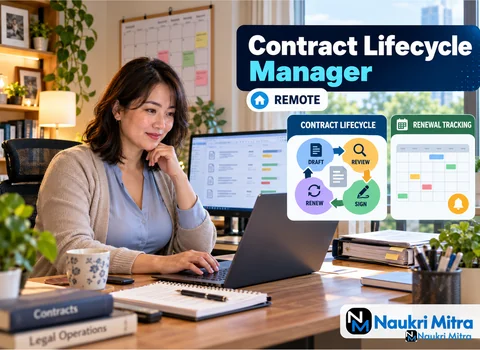
A supplier agreement renews itself for another full term. The business had wanted out for months, the cancellation notice had to land by a fixed date, and nobody saw that date pass because it was buried deep in a PDF in someone's inbox. Stopping that from happening across many agreements, quietly and every week, is part of this job. This posting sits among remote contract lifecycle manager jobs: full-time, worked entirely online from any country you like, and salaried at $85,000 a year (USD).
You will own the contract process inside a CLM platform such as Ironclad, Icertis, Agiloft or DocuSign CLM, from the first request to the renewal decision years later. The sections below follow a contract through each stage, then cover what you need to bring and where the work can take you.
Most contracts start as a vague message from sales or procurement: "We need an NDA with this vendor by Friday." Your first job is to make sure that request comes through a proper intake form instead of a chat thread. You design the form, decide which fields are mandatory (counterparty, contract type, value band, data involved, business owner) and set the rules that route each request to the right queue.
Good intake saves hours later. If the form asks whether personal data changes hands, the privacy reviewer is pulled in automatically rather than discovered at the last minute. You will tune these forms regularly as people find ways around them.
For standard paper, business users should be able to generate a first draft themselves from a template you maintain. That means keeping templates current, mapping intake answers to the right merge fields, and building conditional logic so a higher-value deal pulls in a stronger limitation of liability clause.
The clause library is where legal's positions live. You keep preferred wording, acceptable fallbacks and the lines that need a lawyer's sign-off, each tagged so reviewers can find them. When counsel changes a position, you update the clause, retire the old version and tell the people who use it. A library that drifts out of date is worse than none, because people trust it.
Approval workflows are where contract management either runs smoothly or stalls. You configure who must approve what: finance above a spend threshold, security for anything touching customer data, a senior lawyer for non-standard indemnities. You keep those rules simple enough that people understand why a contract is waiting on them.
Because everyone works remotely, much of the stakeholder work happens on short video calls and in comment threads inside the CLM. A typical week includes a call to unblock a deal stuck with procurement, a quick walk-through of redlines with a commercial lead in another time zone, and written summaries so nobody has to attend a meeting just to learn the outcome. Once approvals clear, you send the document for e-signature, confirm the signed copy files back to the right record, and check that key metadata (dates, value, governing law, renewal terms) is captured correctly.
This is the stage that would have caught the supplier renewal. After signature, you or the tool extract the terms that matter: auto-renewal clauses, notice periods, price review dates, service levels, audit rights and reporting duties. Each one becomes a tracked obligation with an owner and a reminder set well ahead of the deadline.
Setting the reminder is easy. Getting the owner to act on it is harder. You will chase business owners for a renew, renegotiate or terminate decision, and escalate when a date gets close with no answer.
A CLM only works when the people requesting contracts actually use it. You run onboarding sessions, record short how-to videos, write one-page guides and hold office hours for questions. You also listen. If account managers keep emailing contracts around the platform, the intake form is probably too long, and fixing that is your job too.
Legal leadership will ask how long contracts take, where they get stuck and which teams generate the most volume. You build dashboards in the CLM showing time from request to signature, time spent in each approval step and how often fallback clauses get used. Then you explain what the numbers mean and suggest changes: a template that needs a better default position, an approval step that could become a notification instead.
Expect to show a bachelor's degree and 5+ years in contract management or legal operations. A paralegal certificate or a JD counts in your favour. Strong hands-on experience is required on Ironclad, Icertis, Agiloft or DocuSign CLM (one of them is enough), ideally including configuration work rather than just using the platform day to day.
The WorldCC CCMP (Certified Commercial Contract Management Practitioner) certification is valued here. As a contract lifecycle manager certification, it shows you understand commercial contracting beyond any single tool, and it is a sensible course to take if you are building credentials. Core contract lifecycle manager skills include clear writing, careful reading of contract language, workflow design, data hygiene, comfort with reporting tools and, above all, excellent stakeholder skills. US commercial practice shapes most of the contracts, and eligibility rules differ between employers, so confirm them before you apply.
A contract administrator usually handles individual agreements: logging them, chasing signatures, filing executed copies and answering questions about specific terms. It is careful, detailed work focused on each document.
A contract lifecycle manager looks after the process those documents move through. You decide how intake works, which templates exist, who approves what and how obligations are tracked, and you answer for cycle times across the whole portfolio. Many people do the administrator role first, and that experience shows up well on a contract lifecycle manager resume because it proves you know where contracts actually get stuck.
Paralegals often make strong candidates. You already read agreements closely, manage deadlines and work with lawyers who expect accuracy. To make the move, volunteer for contract work in your current team, ask for access to the CLM and learn how its workflows are built, and take a commercial contracting course or start on the CCMP. Keep notes on processes you improved, because interviewers will ask for examples.
People searching for contract lifecycle manager jobs with no experience should be realistic: this particular role needs five years. Contract coordinator and administrator posts are the usual first step.
AI features in CLM platforms already help pull metadata from signed contracts, flag clauses that depart from the playbook and suggest fallback wording. That speeds up intake review and makes obligation tracking more complete, especially for legacy agreements nobody has ever tagged.
What the tools do not do is decide. Someone still has to judge whether a risky clause is acceptable for this deal, negotiate with the counterparty and explain the trade-off to the business. Expect the role to shift towards checking AI output, tuning playbooks and owning those decisions, rather than disappearing.
The contract lifecycle manager salary for this full-time post comes to $85,000 in USD annually, with no country excluded. Contract lifecycle manager work from home jobs exist across software companies, healthcare groups, manufacturers, financial services firms and legal operations consultancies, wherever contract volume is high enough to justify a CLM. Contract lifecycle manager jobs remote worldwide vary a lot; the platform in use and the time zones you must cover are the two details worth checking first.
When you apply, your CV should list the CLM platforms you have configured, the types of agreements you have managed and one or two process changes you led, with the result described plainly. If you hold the CCMP or a paralegal certificate, put it near the top.