
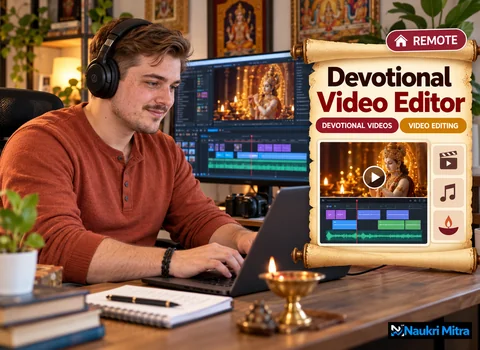
On the timeline, the temple bell sits a few frames ahead of the first beat of the harmonium. You nudge the clip, play it back, nudge it again, until the bell rings just as the singer draws breath and the aarti begins. Then you leave it alone. No zoom punch, no flash transition, no whoosh laid over the top. Knowing when to stop is most of this work, and it is the quality we look for in people applying to these online devotional video editor jobs. Editors anywhere in the world can apply; it is part-time, fully remote work, and it pays $18 USD per hour.
If you have wondered what a devotional video editor does day to day, the answer is quieter than most editing work. You take recorded bhajans, aartis, kirtans and spiritual talks and shape them into finished videos for YouTube. In practice that means laying the audio track down first, cutting temple, shrine and performance footage to sit with it, adding lyrics, titles and gentle transitions, correcting colour, and exporting optimised files along with a thumbnail. That is the devotional video editor job description in plain terms. The tools are Premiere Pro or DaVinci Resolve, with After Effects useful for title work.
Most sessions involve one main video and some smaller pieces cut from it, such as a short vertical clip or a lyric-only version. You work from your own setup, on your own hours, within the deadlines agreed for each piece.
Devotional music carries the whole video, so the edit is built around it. You sync multicam performance footage to a clean studio mix, line up a lamp being lifted with the swell of a chorus, and make sure a bell, conch or cymbal lands on screen when it lands in the ear.
Good headphones matter here more than a fast machine. You need to hear breaths, tabla strokes and the soft decay of a bell clearly enough to cut on them, and you need to catch hum, clipping or a muffled vocal before the file goes out.
A bhajan is not a music video in the usual sense. Viewers often play these at home during prayer, in the morning or at dusk, and they want to settle into the song rather than be jolted by it. Cuts tend to be longer. A slow dissolve from the deity to the lamp is usually right, and a rapid montage usually is not. You follow the rhythm of the singing: let the opening verse breathe, build gently as the chorus repeats, and allow the final notes to fade on a still frame instead of rushing to an end card.
The best cut in a long aarti is often the one you chose not to make.
Much of the footage you receive is shot in difficult light: oil lamps, camphor flames, mixed tube lights in a temple hall, or a home shrine lit from one window. Your job is to keep that light warm and honest. Skin tones should look natural, the gold of a lamp should glow without blowing out, and the colours of flowers, cloth and sindoor should stay true. Heavy stylised grades and teal-and-orange looks rarely suit this material.
Lyrics on screen are a big part of why people watch. You will place verses in Devanagari or other scripts, and often a Roman transliteration beneath, timed so each line appears just before it is sung. That calls for clean fonts that render the script correctly, sensible line breaks that follow the meter of the verse, and enough contrast to read on a phone. A missing matra or a wrongly joined letter is not a small typo to a devotee, so you check spelling against the source text you are given and ask when anything is unclear.
Familiarity with bhajans, aartis and devotional customs is part of the job, not a bonus. You should know that certain moments in a ritual are not trimmed, that images of deities are not cropped carelessly or flipped, and that comic effects, stickers or meme sounds have no place in this footage. Different traditions have different expectations, and you are not expected to know all of them. You are expected to ask, to listen to the channel or label you are working with, and to treat every clip as something that matters deeply to the people watching it.
You should be confident in Premiere Pro or DaVinci Resolve. Either is fine; what counts is that you can sync audio quickly, manage a timeline with many layers of text, grade footage, and export to YouTube settings without fuss. After Effects helps with animated lyric titles and light motion, though it is not required.
On hardware, you need a powerful computer, good headphones and fast internet. In practice that means a laptop or desktop that can play back long high-resolution timelines smoothly, with a capable graphics card, plenty of memory, and enough storage for raw footage.
Music rights matter too. Usually the audio is supplied by the channel or label. When you need background music, use copyright free or properly licensed tracks only, and keep a note of the source so a video is not claimed after upload.
We ask for at least a year of video editing experience and a showreel. The reel does not need to be devotional, but if you have cut a bhajan, an aarti or any slow, music-led piece, put it near the start. Show us a sync you are proud of and some on-screen text you placed.
Your devotional video editor resume can be brief: the software you use, the kinds of projects you have finished, and a link to the reel. The devotional video editor skills that stand out are steady audio sync, calm pacing, careful text and an eye for natural colour.
This is part-time remote work at $18 USD per hour. Some editors in this field are paid per finished video instead, but this role pays hourly, so you track your time against each project. Volume of work can vary from week to week, and nothing here promises a fixed number of hours.
Many people treat it as devotional video editor work from home alongside other commitments, and freelance devotional video editor jobs of this kind suit editors who like unhurried, music-led projects. Devotional YouTube channels, temple media teams and music labels publish bhajan and aarti content, and that is where most of this editing work comes from. Demand changes by channel and season, so plan around a varying workload.
Wedding editing and devotional editing share tools but not temperament. A wedding film chases emotion through quick cuts, slow-motion highlights and dramatic music swells. Devotional work asks you to step back and let the prayer or song lead. Both need good sync and colour, but here the audience is often participating, singing or praying along, so clarity and calm come before spectacle.
The usual route to becoming a devotional video editor is cutting a few bhajans or aartis to licensed audio and sharing them for feedback. A general video editing course in Premiere Pro or DaVinci Resolve covers the technical side; a dedicated devotional video editor course is hard to find, so the cultural side comes from watching well-made devotional channels and paying attention at real aartis. No devotional video editor certification is needed. A strong reel matters more.
This role asks for some prior editing, so treat devotional video editor jobs for freshers as the next step once you have a few finished pieces to show. After that, part time devotional video editor jobs like this one fit well around study or other work.