
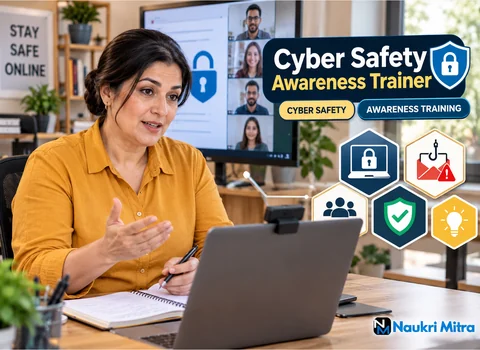
Twenty minutes into an evening session on Zoom, the trainer puts a message on screen: "Dear customer, your KYC expires today. Update now or your account will be blocked," with a short link underneath, and asks who would have tapped it. Most of the cameras nod, a few people laugh, and a retired teacher types "me, last month" in the chat. The group pulls the message apart line by line, and by the end of the hour the same learners can point out four separate tells. That is the heart of these cyber safety awareness trainer online part time jobs: live, patient teaching that turns a moment of embarrassment into a habit of checking.
Part-time sessions taught from home pay $15 per hour (USD), and anyone, anywhere, may apply. You run sessions on phishing, UPI and OTP fraud, password safety and social media privacy, show real scam examples with personal details removed, explain how to report cybercrime, and close each class with a short quiz. The six modules below are roughly how the teaching is organised.
Phishing is the starting point because almost every other fraud begins with a message. Learners practise reading a sender address slowly, hovering over or long-pressing a link to see where it really goes, and noticing pressure words such as "today", "blocked" or "final notice". Banks and government services do not ask anyone to confirm an OTP or password through a link. Fake delivery notices, disconnection threats and prize messages all get a turn on screen.
This module draws the most questions. The key facts are simple and worth repeating. You never enter your UPI PIN to receive money. Scanning a QR code is for paying, not for getting paid. A "collect request" from a stranger is a request to take money from you. Learners also see how screen-sharing apps and fake customer care numbers are used together. Demonstrations use a dummy screen or slides, never a live account, and you never ask anyone in the session for an OTP, PIN or password, not even as a joke during a demo.
Here the tone matters. Many adults reuse one password everywhere and feel foolish admitting it. You show how a passphrase works, why a password manager beats a notebook beside the laptop, and how to switch on 2-step verification for email, WhatsApp and social accounts. Privacy settings and what not to post, such as boarding passes or live location, fit here too.
When someone has already been cheated, panic wastes time. Teach a short, ordered response:
Speed helps, but you should not promise that money will come back. That depends on banks, the investigation and how quickly funds moved.
Trainers explain India's two main reporting channels. The national cybercrime helpline is 1930, mainly for financial fraud. The National Cyber Crime Reporting Portal at cybercrime.gov.in takes written complaints, including harassment and other non-financial cases, and gives an acknowledgement number for follow-up. You walk through the complaint form using a sample case on slides and mention that learners can also approach their local police station. Procedures can change, so check the portal yourself before each batch of sessions.
Older learners usually need a slower pace, larger text on slides and permission to ask the same question twice. Role-play works well: you play the "bank officer" and they practise hanging up. Students are quicker with apps but more exposed to gaming scams, fake internships and loan apps. Tell them clearly that being targeted is not their fault and that a trusted adult or 1930 can help.
Say a residents' welfare association asks for a 60-minute Hindi session for about 30 members, most over 60. The brief arrives on a Monday: focus on UPI and phone calls. You build twelve slides, including three mock messages you wrote yourself, one of them a QR poster labelled "scan to receive refund". On Thursday you teach for 40 minutes, take questions for 10, and run a five-question quiz using Zoom polls. Two people score low on the QR question, so you send the organiser a one-page recap in Hindi with that point in bold.
A typical week holds a few sessions, preparation, quiz review and short reports. Hours vary with bookings, and no fixed number is promised.
Some companies run awareness programmes on platforms such as KnowBe4, which sends simulated phishing emails and short training modules. You may be asked to explain those results in a live session, but tools differ by employer.
On the cyber safety awareness trainer online salary per hour: the figure here is $15 (USD), and the post is part-time. You need solid knowledge of phishing, UPI fraud, password hygiene and reporting channels, plus clear Hindi or English and a Zoom-ready setup. A graduate degree in IT or a related field is preferred, not required, so people from teaching, banking or NGO work can apply. CompTIA Security+ or ISEA awareness training is a bonus. ISEA is the Information Security Education and Awareness programme of MeitY, and its material is a good free place to learn.
These are also realistic cyber safety awareness trainer online jobs for freshers, as long as you can show you can teach. Record a ten-minute sample lesson and keep it ready as a demo class. Your cyber safety awareness trainer online resume should list sessions you have run (even for family groups or a college club), languages, any cyber safety awareness trainer online certification, and a link to slides you made.
The cyber safety awareness trainer online skills that matter most are plain explanation, patience with repeated questions, accurate facts and calm handling of upset learners. Schools, NGOs, housing societies and companies all book this kind of training, and freelance cyber safety awareness trainer online jobs often come through training agencies.
A cybersecurity analyst watches systems, investigates alerts and fixes technical weaknesses. A trainer works on the human side, helping ordinary people avoid being tricked. The cyber safety awareness trainer online job description is about communication, not network defence. As more payments and services move online, organisations keep asking for this teaching. From here, trainers move into designing awareness programmes, writing course material, corporate security awareness roles or, with further study and Security+, entry-level analyst work.
Fraudsters target trainers too. Be careful with any "employer" that:
This application costs nothing, and the same should be true of all part time cyber safety awareness trainer online jobs. Attach your resume, list the languages you can run a session in, and add the recorded sample lesson. If you can help a room laugh at a fake KYC message and then spot the next one alone, you are ready for cyber safety awareness trainer online work from home.