
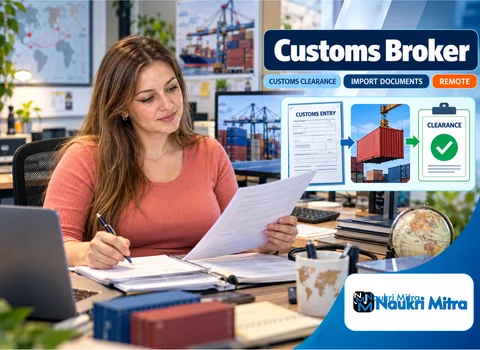
A container sits at the terminal on a hold. The entry declared plastic household articles, but the commercial invoice describes the same line as stainless steel kitchen tools with polymer handles, and the examining officer wants to know which is true. The importer is on the phone asking why the box has not moved. That mismatch was visible on paper before anyone pressed transmit, and catching it there is the work. This listing sits among remote customs broker jobs: a full-time, licensed role paying $60,000 per year (USD), done remotely and open to qualified candidates in any country who can work to US customs hours.
Everything here describes US practice. A US customs broker licence is granted after passing an examination set by U.S. Customs and Border Protection (CBP) and clearing a background review, and an individual licence also requires US citizenship. Other countries license brokers under their own systems, so check each posting for the licence and jurisdiction it actually needs.
Most of a broker's judgement lives in the Harmonized Tariff Schedule. The General Rules of Interpretation set the order of reasoning: start from the wording of the headings and their section and chapter notes, and move to the later rules only when the text alone does not settle it. Those later rules cover unfinished or unassembled articles, goods that could fit more than one heading, retail sets, and the specific description beating the general one.
In practice you ask what the item is, what it is made of, what it does and how it is presented, then test each candidate heading against its notes. You read rulings for similar goods, keep a short written rationale for every decision, and flag any product where the answer depends on a fact the client has not confirmed.
Valuation usually starts from the price actually paid or payable for goods sold for export to the United States, with additions such as certain assists, royalties or selling commissions where they apply. Related-party sales need a closer look to show the relationship did not shape the price.
Origin is a separate test from where the goods shipped from. Goods processed in several countries generally take the origin of the place where they were substantially transformed, and free trade agreements carry their own rules and paperwork. A wrong origin claim can affect duty, marking and any special programme the client tries to use.
The commercial invoice, packing list, bill of lading or air waybill and arrival notice should tell the same story. You compare them line by line:
When something does not reconcile, you go back to the shipper or importer and get it corrected or documented before filing.
Entries reach CBP electronically through ACE, and this role files through CargoWise or Descartes depending on the account. You build the entry from reviewed documents, add line-level classification and value data plus any agency information, and transmit. Then you watch the responses: releases, holds, requests for information and rejections to correct and resend.
Both systems keep a product library. Keeping it clean matters, because a stale classification saved against a repeat product gets copied onto every future entry until someone catches it.
Importers ask practical questions. Will this new product cost more to bring in? Can we use a trade agreement? What if we find an error on past entries? You explain how the rules apply to their goods, say what information you need, and point out when a binding ruling request, a correction process or outside trade counsel is the better route. You do not quote tariff rates from memory or give legal advice; every written answer is checked against the current schedule and CBP guidance.
Licensed brokers must exercise responsible supervision and control over customs business done under their licence. Here that means reviewing entry writers' work, spot-checking classifications and values, signing off on unusual entries and coaching newer staff on where errors start. A current checklist for each client does more for accuracy than correction after the fact.
Customs work runs on time limits: when an entry is due after arrival, when the entry summary and duties are due, when a correction or protest is still possible. The exact periods are set by regulation, and you track them in the filing system rather than by memory. Missing one can bring penalties or claims against the bond. Brokers must also keep transaction records for the period the regulations require and produce them when CBP asks.
Tariff measures can move quickly, with additional duties, exclusions and trade remedy cases arriving at short notice and touching goods already on the water. Brokers keep up by reading CBP messages and Federal Register notices, following trade association updates and checking the official schedule rather than secondhand summaries. When a change lands, you work out which clients and product lines it touches and tell them before their next entry. Frequent change tends to make careful brokers more useful to importers, though that is an observation about the work, not a forecast of hiring.
Customs broker work from home jobs depend more on access than on the desk. Expect a company VPN or virtual desktop into the filing system, multi-factor sign-in, client data kept off personal devices, and a reliable connection with a backup, since a failed transmission can push an entry past its deadline. Hours follow US port activity, so candidates outside the Americas should expect overnight or split shifts. Some employers limit where licensed staff may work from, which is why customs broker jobs remote worldwide still need a careful read of each posting.
Nobody should mistake this for one of the entry level remote customs broker jobs. It requires an active customs broker licence backed by three-plus years of customs brokerage or trade compliance work, plus expert knowledge of HTS classification, valuation, entry rules and both filing systems. People searching for customs broker jobs no experience usually start as entry writers or compliance assistants under a licensed broker and sit the exam along the way.
The exam is open-book and tests whether you can find and apply answers in the regulations and tariff schedule under time pressure. Typical preparation means working through past papers, building an indexed set of references and practising timing. A customs broker course can add structure, but the licence itself is the customs broker certification that matters here.
Licensed brokers work for freight forwarders with in-house customs teams, standalone brokerages, third-party logistics providers and importers with their own compliance departments. A forwarder arranges movement of the cargo; a broker handles clearance under a licence. Many firms do both, but responsibility for the entry sits with the broker.
This position is full-time at $60,000 per year (USD). Customs broker salary per year elsewhere tracks employer, experience and client mix. For your customs broker resume and any customs broker interview questions, expect to show real classification reasoning and the customs broker skills described above, since that is the core of this customs broker job description.