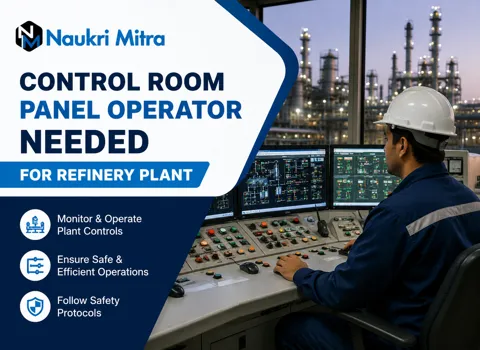
What Happens Inside a Refinery Control Room
Walk into a refinery, and you won't see the real action on the shop floor. It's happening in a quiet, air-conditioned room lined with screens, where a Control Room Panel Operator sits watching numbers move. Pressure, temperature, flow rate, level readings - all of it flows into that one room in real time. This Full-time position is based in Vadinar, Gujarat, India, and pays ₹42,800 a month. It's one of those jobs that looks calm from the outside but demands sharp attention every single minute.
Why This Job Exists in the First Place
Refining crude oil isn't a single step. It's dozens of processes running together - distillation, cracking, treatment - each one sensitive to small changes. A pressure spike that goes unnoticed for even a few minutes can mean lost product, damaged equipment, or something far more dangerous. That's the gap this role fills. No machine, however advanced, can fully replace a trained person who understands what "normal" looks like on a screen and can spot the moment something isn't.
A Shift, Start to Finish
Most shifts begin with a handover. The outgoing operator walks the incoming one through the logbook - what happened, what's pending, what to watch. From there, it's mostly screen time: tracking the DCS or SCADA display, checking that flow, pressure, and temperature stay where they should. When something drifts out of range, the operator doesn't panic - there's a sequence to follow. Adjust the setpoint, alert the field team, log the event.
Talking to field staff happens constantly through the shift. A pump vibrating oddly, a valve that won't respond as expected - these get reported and handled together, control room and field side working in sync.
What the Job Actually Involves
- Watching live process readings on control panels through the shift
- Reacting to alarms fast, within whatever time the SOP allows
- Keeping shift logs updated with production numbers and any unusual events
- Managing startup and shutdown sequences for process units
- Staying in constant contact with field operators and shift supervisors
- Sticking to procedure when things go wrong, not improvising
The Kind of Place You'd Be Working
This work happens in petroleum refineries, gas processing units, and petrochemical complexes - large-scale plants where crude or gas gets turned into usable products. Gujarat's western coastline has become a hub for this kind of industry, largely because of port access for crude handling. The control room itself sits apart from the actual process units, separated for safety, though the two are connected every second through instrumentation.
The Instruments You'll Get to Know
DCS terminals and SCADA software form the core of daily work. Alongside them are PLCs, pressure and temperature transmitters, flow meters, and alarm annunciator panels. None of these are useful on their own. What matters is understanding how they talk to each other, so a reading isn't just a number but part of a bigger picture.
What Gets You Hired
An ITI in Electrician or Instrumentation trades is the usual entry point. A Diploma in Instrumentation, Chemical, or Electronics Engineering tends to lead to more responsibility sooner. But paper qualifications only go so far - being able to read a process flow diagram, understand how interlocks work, and troubleshoot a basic fault matters just as much on the floor.
Beyond the technical side, this job rewards people who can stay alert through long, uneventful stretches and then switch instantly into problem-solving mode when an alarm goes off. Clear communication under pressure isn't optional here.
The Physical Side - and the Shift Pattern
It's not physically demanding in the traditional sense. You're seated, watching screens, not lifting or hauling. But refineries never stop, so this role runs on rotating shifts, including night duty. Staying mentally sharp at 3 a.m. is harder than it sounds, and that's exactly when a small mistake can turn into a real problem.
Safety Isn't a Checkbox Here
Refineries deal with flammable, hazardous material every day, so safety training runs deep. Operators learn emergency shutdown procedures, how fire and gas detection systems operate, and what evacuation looks like when needed. Step out into the process area, and you'll be wearing a helmet, fire-retardant coveralls, safety shoes, sometimes a gas detector clipped to your belt. Inside the control room, access is restricted and monitored - not because anyone's being paranoid, but because that room controls too much to leave loosely guarded.
What Trips Up New Operators
The hardest part early on is usually the multitasking - several screens, several parameters, and an alarm flood that can feel overwhelming the first few times. Adjusting to night shifts takes a while too. Most operators say the same thing after a year or two: you start anticipating problems before the alarm even sounds because you've seen the pattern.
Where This Can Lead
Panel operators who stick with it often move up to senior operator roles, then shift-in-charge, and eventually process supervisor positions with enough experience behind them. Picking up certifications in advanced instrumentation or process safety along the way tends to accelerate that progression, whether within the same plant or across the wider industry.
Pay and What Else Might Come With It
The salary for this Full-time role in Vadinar, Gujarat, India is ₹42,800 per month. Some employers add overtime pay, PF, ESI coverage, an annual bonus, uniforms, or transport and canteen facilities on top of that - though none of these are guaranteed and they vary from one company to another.