
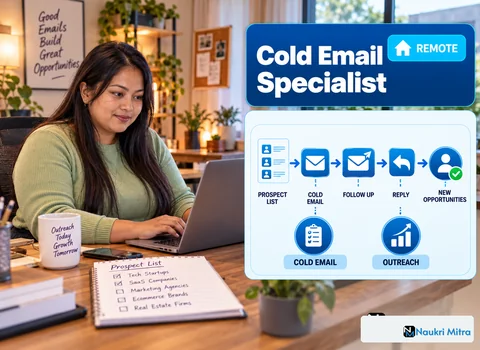
A founder opens her inbox between two calls. Her thumb does most of the reading: a webinar invite, gone; "Quick question" from a stranger, gone; a pitch with her company name wrong, gone. Once in a while something makes her stop. It names a problem her team really has, fits on a phone screen, and asks only for a reply. She writes back. Writing that email, and making sure it reaches the inbox instead of the spam folder, is what clients pay for in these online cold email specialist jobs.
In plain terms: this is part-time, freelance cold email specialist work from home, open to applicants in any country, at $18 per hour in USD. Think of that as the cold email specialist salary per hour, earned only for time spent on client campaigns. Hours follow the campaigns, so some weeks are busy and some quiet, with no fixed load promised. A degree is not required. Clients care about results from campaigns you have run before, and they will ask to see them.
Copy cannot rescue a campaign that lands in spam, so the job starts in DNS settings. Never send cold outreach from a client's main domain. If acme.com gets flagged, their invoices and support replies start bouncing too. Instead you buy one or more look-alike sending domains (something like tryacme.com or getacme.com), point them at the real website, and create a few mailboxes on each.
Each sending domain needs three records:
Get these wrong and your mail quietly goes to junk. No error message, just silence, which clients usually blame on the copy.
A brand-new mailbox that suddenly sends hundreds of messages looks exactly like a spammer. Tools such as Instantly and Smartlead connect your new inboxes to a network of other real inboxes that exchange mail with them, reply and pull it out of spam. Volume climbs over a few weeks. You set the ramp, keep warm-up running after launch, and watch the health score. A slipping domain gets rested, not pushed harder.
While inboxes warm, you build the lead list. Usually that means Apollo, filtering by title, company size, industry and location. The skill is in the filters. "Marketing people at software companies" is a list. "Heads of growth at bootstrapped accounting software firms with fewer than fifty staff" is a list someone might actually answer.
Then you verify. Run the export through a separate checker and drop anything invalid or risky, because bounces are poison for a young domain.
A typical sequence, built in lemlist or Instantly, has a handful of steps over a couple of weeks. The first line of the first email decides whether anything else gets read.
A personalised first line refers to something real: a recent hire, a launch, a post they wrote. A merge tag that inserts their city is not personalisation. After the opener you state one problem, one way you help, and one low-effort ask, like "Worth a look?" rather than "Book a 30-minute demo."
Follow-ups are two or three lines in the same thread, each adding a new angle or one proof point. Leave out images, heavy links and attachments; they hurt deliverability and nobody misses them.
Launching is checklist work: daily limits per inbox, sends spread across the prospect's business hours, every merge field checked, and test emails to your own accounts on different providers.
Then you watch three numbers: opens, replies and meetings booked. Treat open rates with suspicion. Tracking relies on a hidden image, and mail privacy features, security scanners and image blocking distort it badly. Many specialists switch it off, since the pixel itself can hurt placement. Replies and meetings are the numbers clients pay for. A reply rate full of "remove me" is a warning, not a win.
This weekly loop is the core of any cold email specialist job description. Every week you change one thing. If the second follow-up gets no replies, cut it. If one first-line style wins, write the next batch that way. One variable at a time, logged with its result; after a few months that log is the strongest thing in your portfolio.
The cold email specialist skills this role needs: copywriting for short personalised emails, hands-on use of Instantly, Smartlead, Apollo or lemlist, working knowledge of SPF, DKIM, DMARC and domain warm-up, and fluent written English. Your cold email specialist resume should lead with campaigns and outcomes described honestly, not a list of software logos.
Typical cold email specialist interview questions are practical: write a first email from this website, or explain why replies dropped after a second domain was added.
There is no official licence for this work, so any cold email specialist certification is a course completion badge, not a credential clients check. The tool makers' free documentation on warm-up and setup beats most paid programmes. If you do buy a cold email specialist course, pick one that covers DNS records and testing, not only templates.
Practice teaches more. Rewrite cold emails you deleted and ask why you deleted them. Tool plans and sending domains are usually a freelancer's own expense, and pricing moves, so compare each tool's present plans before committing.
Job boards carry few cold email specialist jobs for freshers, so with no track record, create one. Run a small campaign for yourself, offering your service to a narrow group of businesses, or for a friend's business. Do the whole thing: domain, records, warm-up, list, sequence, report. A modest result with clear notes is something real to show.
People hunting for freelance cold email specialist jobs and part time cold email specialist jobs often start on Upwork or Fiverr. Sell a specific outcome, not "email expert", and mention the client's offer in your opening sentence. Read the fee schedule and rules before you bid; both get updated. If your proposal reads like spam, clients assume your campaigns do too.
An email marketing specialist writes to subscribers: people who signed up, bought something or opted in. A cold email specialist writes to prospects who never opted in and have never heard of the sender. So volume per inbox stays low, plain text beats templates, and deliverability work never stops. The writing overlaps; the technical and legal ground does not.
It works when it is relevant and well targeted, and fails when people blast loosely matched contacts, which is also how domains get burned.
On legality, rules differ by country. In the US, CAN-SPAM sets requirements for commercial email, while the UK applies UK GDPR and PECR, and EU countries apply the GDPR alongside national electronic marketing rules, which treat business contacts and personal data in specific ways. The common ground: include a clear opt-out and honour it, use honest sender details and subject lines, and only contact business people for whom your message is plausibly relevant to their role. This is general background, not legal advice. Clients should check the rules with a qualified adviser.