
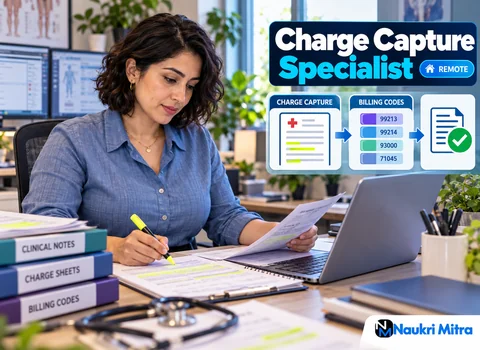
Every hospital keeps a master list of everything it can bill for. It is called the chargemaster, or CDM, and it runs to thousands of lines: a chest X-ray, a unit of physical therapy, a single dose of a particular drug, an hour in the recovery room. Each line carries a CPT or HCPCS code, a revenue code and a price. When a nurse hangs an IV or a surgeon finishes a procedure, the matching line is supposed to land on the patient account. Sometimes it never does. Nobody denies that claim, because nobody ever sends it; the hospital simply is not paid for care it gave. Making sure that doesn't happen is the job. This listing covers remote charge capture specialist jobs at $21 per hour (USD), full-time and home-based, with no country excluded.
Charge capture specialist jobs remote worldwide sound borderless, and hiring here is open to any country, but the work follows US coding sets and US payer rules, so a US-style billing background matters more than your location. Some employers also restrict which countries may open patient accounts, so raise that question early.
Most mornings begin with a daily charge reconciliation report. In plain terms, it lines up what the clinical systems say happened yesterday against what actually dropped as charges. A department logged several infusions but fewer infusion charges posted. The operating room shows a case with supply charges but no procedure time. An observation patient has hours documented and nothing billed for them.
None of these proves a problem by itself; a discharge may be pending, or a charge held for a reason. Your first task is sorting the gaps into three piles: timing differences that will clear themselves, genuine misses that need a charge entered, and lines that look wrong and need someone to explain them. Reconciling missing charges and charge entry errors daily sits at the center of any charge capture specialist job description.
Hospitals that run Epic route questionable charges into charge review work queues. A charge lands there when it trips a rule: a missing modifier, a quantity that looks too high, a code that doesn't fit the patient's age or sex, a service with no matching order. You open the item, read the account, and decide whether to correct the charge, release it as it stands, or send it back to the department with a note.
Queues fill fast. Part of becoming useful is learning which edits are usually noise and which ones hide a real error.
This is the detailed part. You read the documentation (an operative note, a medication administration record, a therapy flowsheet) and confirm that the charge on the account matches it. The CDM line has to be the right one, the CPT or HCPCS code has to describe what was done, the revenue code has to fit the department, and the units have to agree with the record.
For instance, a therapy note supports several timed units, but one was charged. Or a drug was given in a larger dose than the single vial charged on the account. In both cases the documentation supports more than was billed, and the fix is a corrected charge. The reverse happens too, where a charge exists that the chart does not support, and that one gets credited off.
Charges in Epic usually pass through a charge router before they post. When the router cannot resolve a charge, because a CDM line is inactive, a procedure is not mapped to the department that performed it, or a required field is empty, the charge sits in an error state and goes nowhere. Resolving charge router errors means working out which link in that chain broke and fixing it, or escalating to the chargemaster team when the CDM itself needs a change you cannot make.
A charge entered after the claim has already gone out is a late charge. It may mean a corrected or replacement claim, and many hospitals have rules on how long after discharge a late charge can still be added. Credits work the other way: a charge that was duplicated, entered on the wrong patient or not supported by documentation has to be reversed. Both need a clear note on the account explaining what changed and why, because the next person to open it, often an auditor, should not have to guess.
Fixing one missed charge recovers one charge. Finding out why a unit misses it every week recovers far more. Part of this role is spotting recurring capture gaps and reporting them to the departments involved: a clinic that rarely documents a separately billable injection, a unit whose supply scanning skips certain items, a new procedure that was never built into the CDM.
These conversations need tact; a vague message that charges are being missed goes nowhere. A short summary with example accounts, the pattern you saw and the specific documentation step that would close the gap tends to get a response.
Charge capture specialist work from home jobs are measured as closely as onsite ones. Expect daily productivity goals, usually counted in accounts or queue items worked, and accuracy goals checked by sampling your completed work. You will log into the EHR through the employer's secure remote access, typically a VPN or virtual desktop, and the usual HIPAA expectations apply: nobody else within sight of the monitor and no patient data on personal devices.
A steady connection matters. When the session drops halfway through a correction, you need to know exactly where you left off.
The baseline here is a high school diploma with one to two years in medical billing, coding or charge entry. Employers expect you to know CPT, HCPCS and revenue codes, understand how the chargemaster works and have used Epic charge review work queues. For charge capture specialist certification, a CPC or CRCR is a plus. AAPC issues the CPC as a coding credential, while HFMA's CRCR tests knowledge of the full revenue cycle; both tell a hiring manager you know where a charge fits. The charge capture specialist skills that get tested in practice are reading documentation closely and spotting a unit count that doesn't add up.
Hospitals and health systems hire for this directly, as do revenue cycle management vendors running charge capture for client hospitals. Vendor roles sometimes mean working in more than one client's Epic build. Charge capture specialist salary per hour figures on other postings move with region and credentials; this one is fixed at $21 USD.
Billing is the most common route for people working out how to become a charge capture specialist. If you have worked claims, you already know what a charge looks like once it reaches the bill; charge capture moves you one step earlier, to the point where the charge is created. To make the switch, get comfortable reading clinical documentation, learn how a CDM line is built, and ask to help with late charges or work queue edits where you are now. A short charge capture specialist course can fill gaps. On a charge capture specialist resume, name specific tasks, such as the queues you worked or the error types you cleared.
Searches for charge capture specialist jobs with no experience turn up little, for a reason: the one to two years of billing or charge entry is there because you need to recognize a wrong charge on sight.
Charge capture is often the first rung of a revenue integrity department. With experience, people move into revenue integrity analyst roles, where the work shifts from fixing individual accounts to analyzing patterns, maintaining the chargemaster, testing new charge builds and supporting audits. Others move toward CDM coordination or coding. By then you know how clinical work becomes money, which few people in a hospital can explain end to end. How quickly that happens varies from hospital to hospital.