
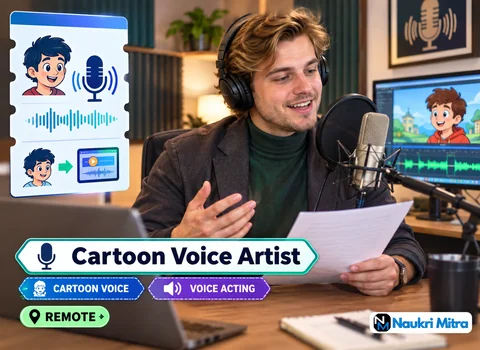
Children's cartoons need voices that are clear before they are funny. A young viewer has to understand every word, often without subtitles and sometimes over the noise of a busy living room, so diction comes first and the comedy sits on top of it. This listing is one of our online cartoon voice artist jobs: Part-time hours, recorded remotely at home, with casting open across all countries, paying $25 per hour (USD). Expect characters for games, explainer videos and kids content, recorded in your own home studio and returned as clean, edited audio files on schedule.
Most of the work falls into three kinds of project. Kids content means short animated episodes, songs with spoken links, and story clips where a character talks straight to the viewer. Explainer videos use a cartoon host to walk an audience through an idea, such as how a recycling bin works or why plants need light. Games need character lines, reactions and short barks (the little sounds a character makes when it jumps, wins or bumps into a wall).
Across all three, the job is the same: understand who the character is and give the director a performance they can cut in without fixing it. You are an actor first and a sound engineer second, but you need to be both.
Plenty of people can do one silly voice. What gets you cast again is range. A typical session might ask for a nervous young hedgehog called Pip, a booming lighthouse keeper named Captain Brindle, and a sly talking teapot, all in the same afternoon. Each needs its own pitch, its own speed and its own way of breathing, and each has to stay the same from the first line to the last.
When I listen to a reel, I am checking whether the voices are truly distinct or just the same voice pushed higher and lower. A strong set of cartoon voice artist skills includes:
A funny voice with flat acting falls apart fast. Kids notice when a character does not mean what it says. We look for real reactions: surprise that sounds surprised, sadness that a five-year-old can feel, a joke that lands because the pause before it was the right length.
Timing matters in a practical way too. Animators often work to your recording, so a line that rushes or drags changes the scene. Good voice acting techniques here include reading the line aloud a few times before recording, marking where the breath goes, and listening back for rhythm rather than just accuracy.
Each project comes with a script, and most also include a character sheet: a drawing, a short description, sometimes a reference for age and mood. Read both properly. If the notes say Pip whispers when frightened, a shouted line will be sent back no matter how good it sounds.
Stick to the words on the page unless you are invited to play. When you do have an idea for a better line, record the scripted version first and add your alternative as a separate, clearly labelled take. Directors like options, but not hunting for the version they asked for.
For most lines you will record several takes at different energy levels. A common pattern is a calm read, a middle read and a big, high-energy read. This gives the editor room to match the scene once the animation is timed. Label files so the energy level is obvious from the name alone, and keep the character's identity steady even when the volume and excitement change.
Big reads are where many beginners lose clarity. Shouting should still be understandable, and a laugh should not swallow the next word. Practise keeping consonants crisp when you push the energy up.
Cartoon voice artist work from home only works if your recordings sound professional without help. The requirements are a decent microphone, somewhere quiet to record, and working skills in Reaper or Audacity. A home studio setup does not have to be expensive. A closet lined with clothes, or a corner treated with blankets and soft furnishings, often does more than costly gear in an echoing room.
Before each session, check for fridge hum, traffic, computer fans and pets. Record a few seconds of silence so you can hear your room tone. In editing, remove mouth clicks, long gaps and stray breaths, then export using the client's chosen format. Clients and platforms publish their own file and level requirements, so check those for each project rather than relying on one fixed setting.
Character work can be hard on the throat, especially gravelly villains and squeaky sidekicks. Warm up before you record, keep water nearby, and take breaks between demanding characters. If a voice hurts to produce, change how you are making it rather than pushing through. A voice you protect lasts longer.
Classes in voice acting help, though they are not mandatory; a strong demo reel matters most. Keep it short and put your best character first, because casting listeners often decide early. A good cartoon reel includes:
Use characters you created yourself. Do not imitate well-known cartoon characters or use clips from existing shows, because those belong to their rights holders and casting teams want to hear your ideas, not someone else's.
Whatever your background, you need a reel and a working home setup before you apply. Many people start by recording short scenes from free practice scripts, getting feedback from other actors, and taking a beginner class or a cartoon voice artist course to learn microphone technique and character building. A certificate on its own will not get you cast; the sound of your reel does that.
Cartoon roles get posted on casting sites, with Voices.com, Casting Call Club and Backstage as examples, and browsing them shows what directors ask for. Read each listing carefully and research any client before you send work. Expect plenty of auditions before the first booking; that is normal.
The session rate is $25 per hour (USD). As freelance cartoon voice artist jobs go, this one is Part-time, remote and open to applicants in any country, so you can fit sessions around other work or study. Across the wider market, voice work for cartoons is paid in several ways: by the hour, by the project, by the line or by the finished minute, depending on the client. Here, it is the hourly rate that you are paid on.
A cartoon voice artist usually creates a character from scratch, shaping the sound before or alongside the animation. A dubbing artist replaces dialogue in an existing show or film, often in another language, and has to match lip movement and the original actor's timing closely. The skills overlap, but dubbing is about fitting a performance that already exists, while cartoon work lets you build one.
AI voices are being used for some simple narration and placeholder tracks, and nobody can say exactly how that will develop. What they still tend to struggle with is the thing we cast for: specific, playful acting that changes with each note from a director. Artists who bring real character, take direction quickly and deliver reliable audio are in a better position than those who offer only a pleasant tone.