
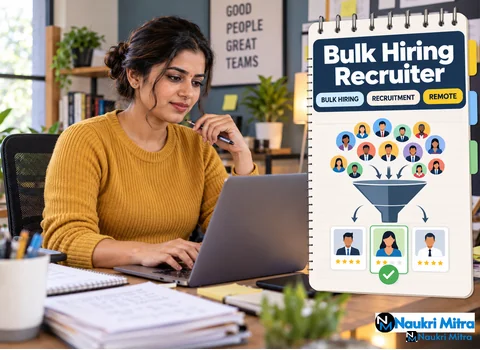
A requisition arrives on a Monday morning: 120 customer support associates for an English voice process, on a new BPO line that goes live in four weeks. The numbers are illustrative, but the shape is typical of remote bulk hiring recruiter jobs, and the work starts with arithmetic, not phone calls.
Work backwards from the go-live date. Training needs a full batch by the end of week three, so there are about 15 working days. Suppose the client's earlier drives produced roughly one joiner for every ten candidates screened, and that some offers will fall through. That means screening around 1,450 profiles, which becomes a daily target of about 100 screening calls, 30 to 35 interviews scheduled and 8 to 10 offers released. Those daily figures, not the headline 120, are what the recruiter manages each morning.
Each stage has a conversion rate worth watching. When one stage leaks, the target for the stage above it rises.
The opening is full-time, worked from home by applicants anywhere, and pays $400 per month (USD). The recruiter plans and runs volume hiring drives and virtual walk-ins, sources and screens candidates in bulk, schedules interview rounds, keeps pipelines current in Zoho Recruit, coordinates offers and onboarding paperwork, and reports daily closures against hiring targets. That is the bulk hiring recruiter job description in short.
The bulk hiring recruiter salary per month for this opening is the fixed figure above. Any closure bonus rests with the employer, and this offer does not include one. Demand comes mainly from BPO companies, retail chains and staffing firms. Because screening and interviews mostly happen over phone and video, the work suits a home desk, which is why bulk hiring recruiter jobs remote worldwide are possible at all.
The ATS is the single record of truth. In Zoho Recruit, a recruiter typically sets up a job opening with pipeline stages that mirror the funnel, tags each candidate by source and moves them through stages as results come in.
With another ATS the discipline is the same: every candidate has a stage, a source and a recorded reason for rejection or drop-out. Duplicate checks matter, because one person often applies through two portals in the same week.
Naukri Resdex is the resume database employers access through a paid subscription; the recruiter works in the employer's account. Searches filter by keywords, location, experience, notice period and recent activity. Profile views are usually capped, so search tightly before opening profiles.
Boolean logic keeps searches precise: AND narrows results, OR widens them to include alternatives, NOT excludes a term, quotation marks hold an exact phrase together and brackets group the OR options. An illustrative string for this requisition might be ("customer support" OR "customer service" OR "voice process") AND (international OR "US process") NOT "field sales", adjusted to whatever operators the search box supports.
Job posts work alongside the database: Naukri suits experienced associates, while Apna and WorkIndia reach entry-level applicants quickly. Each post should state the shift, approved salary range and interview mode.
A virtual walk-in gives registered candidates a time window and a video link. A coordinator checks people in, sends the assessment, and moves those who clear it into a same-day operations round. The remote recruiter owns registrations, slots and reminders: a confirmation call, a written message with the link, and a morning-of reminder.
For physical walk-ins the on-site team runs the venue, while the remote recruiter fills the registration list and updates results that evening. A good headset and reliable laptop matter, since most of the day is on calls.
Most volume desks also keep an Excel tracker for speed. Useful columns include candidate ID, source, screening date, stage, interview slot, result, offer date, expected joining date, document status and drop reason. COUNTIFS gives the day's numbers by stage and source; a pivot table shows which source converts best.
The end-of-day report is short: screens, interviews, selections, offers and joinings against target, plus one or two risks such as a weak show-up rate.
Monday goes on planning, fresh searches and screening. Tuesday to Thursday usually carry the drives, with offers released as results arrive. Friday is for chasing documents, confirming joiners and clearing the tracker.
Volume hiring loses people between offer and day one, so plan for it:
Never pressure candidates or promise anything the employer has not approved.
The employer expects a graduate degree and one to three years of high-volume recruitment in BPO, retail or staffing. Proficiency in Zoho Recruit or another ATS, Naukri Resdex sourcing and Excel trackers is required. The core bulk hiring recruiter skills are clear phone screening, Boolean search, tracker discipline and staying polite on the hundredth call of the day.
LinkedIn Certified Professional Recruiter is a plus. For volume work it helps mainly when roles such as team leaders are sourced on LinkedIn, but drive results carry more weight than any bulk hiring recruiter certification. The AIRS sourcing certification is another optional credential. A short bulk hiring recruiter course or an Excel course can tighten skills, though neither replaces real closures.
A strong bulk hiring recruiter resume leads with numbers: drive sizes, positions closed per month, time to fill and tools used. Expect bulk hiring recruiter interview questions such as planning a 100-seat drive, writing a Boolean string on the spot, or explaining how you cut no-shows.
Freshers rarely land this exact opening, since experience is expected. Most entry level remote bulk hiring recruiter jobs are really coordinator or intern roles at staffing firms or BPO hiring teams, where scheduling and calling build the experience needed for a full recruiter seat.
A niche tech recruiter might fill five senior engineering roles in a quarter, with deep technical screening. A volume recruiter fills hundreds of similar roles in weeks, so speed, process and funnel ratios matter more than depth on any single profile.
Growth usually runs from recruiter to senior recruiter, team lead and then talent acquisition manager.
Every applicant's file is confidential and lives only in the ATS and trackers the employer has approved. With hundreds of resumes moving through one drive, the DPDP Act, 2023 and the employer's data policy set the rules: no CVs on personal drives, and none forwarded to private chats. Screening must be fair, with no discrimination on caste, religion, gender, age, disability or any other ground unrelated to the job. Before sharing any job with candidates, verify the employer and the job details.
A drive that charges walk-in candidates for a form, a test or a seat is not genuine hiring. When you are the one applying, be wary of anyone who wants money for onboarding or a recruiter kit, sets a "trial" that means closing a real requisition unpaid, wants an OTP or UPI PIN from you, or hires only through WhatsApp. Genuine recruiters also never take payments outside the platform.
Applying is free. Send a resume that shows your drive numbers, the ATS and sourcing tools you have used, your notice period and your working-hours availability. If target-led days suit you, this is one of the bulk hiring recruiter work from home jobs worth a careful application.