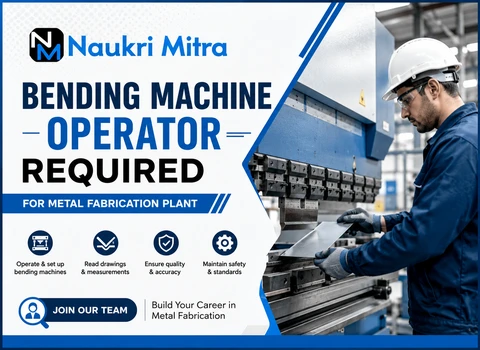
What Does a Bending Machine Operator Actually Do?
Walk into most metal fabrication plants, and you'll find sheets of raw metal on one end and finished parts on the other. Somewhere in between, someone has to turn flat steel into brackets, panels, frames, and enclosures with precise angles. That's the job of a Bending Machine Operator — running hydraulic or mechanical bending equipment to shape metal exactly to a drawing's specification. Right now, a fabrication plant in Ambala, Haryana is hiring for this role on a full-time basis, paying ₹27,000 a month.
Why This Role Rarely Goes Unfilled for Long
Sheet metal doesn't arrive at its final shape by accident. Every bracket, chassis part or structural panel needs a controlled bend, and getting that bend wrong by even a couple of degrees can ruin an entire sheet. That's expensive. So plants don't leave bending to whoever's free — they want someone who does it consistently, shift after shift. This is part of why the demand for trained operators stays fairly steady even when other floor positions fluctuate.
A Shift From Start to Finish
Most days begin with the operator pulling out the job card or drawing and determining what needs to be bent and at what angle. Before touching a full batch, they'll set the back gauge, select the right punch-and-die combination, and run one test piece. If that piece checks out against the drawing, production starts properly. For the rest of the shift, there's a rhythm of loading material, bending, measuring, adjusting pressure if the metal behaves differently than expected, and keeping pace with whatever comes next in the line — usually cutting or welding.
The Work Beyond Just Pulling the Lever
People outside the trade sometimes assume operating a bending machine is just pressing a pedal repeatedly. In practice, there's more judgment involved than that:
- Reading and interpreting engineering drawings correctly, including tolerances
- Setting up the machine fresh for each new job or batch
- Positioning sheets or bars so the bend lands exactly where it should
- Checking finished parts with measuring tools rather than eyeballing them
- Flagging bad material or a malfunctioning machine before it causes bigger problems
- Clearing scrap and offcuts so the floor stays safe to move around on
Factories, Workshops and the Kind of Places That Hire for This
You'll find this role in metal fabrication plants, obviously, but also in sheet metal workshops, structural steel fabrication units, and smaller ancillary units that supply parts to larger engineering or automotive manufacturers. Whatever the setting, the floor tends to be busy — several machines running at once, forklifts moving material, other operators nearby. Working comfortably in that environment matters as much as the technical skill itself.
Getting Familiar With the Equipment
The core machine here is the press brake, which might be hydraulic, mechanical, or CNC-controlled depending on the plant's setup. Alongside it, operators lean on measuring tapes, vernier calipers, angle gauges and try squares constantly — not occasionally, constantly — to confirm every bend matches spec. Over time, an operator also picks up things that aren't written in any manual: how a thicker sheet behaves differently under the same pressure, why spring-back varies between metals, and which die works better for a tight-radius bend versus a wide one.
What Makes Someone Good at This, Not Just Adequate
Plenty of people can run a bending machine. Fewer do it well consistently. The difference usually comes down to habits — checking the first piece of every new batch instead of trusting yesterday's setup, catching a drawing detail that's easy to skim past, knowing when a die actually needs to be swapped instead of pushing through with the wrong one. None of this is glamorous. It's mostly patience applied repeatedly.
What Employers Look for on Paper
For this kind of role, employers often prefer candidates who've had some machining or tool room training. Depending on the complexity of the work, that could mean an ITI certificate in a machining-related trade, a Diploma in Mechanical or Tool and Die Engineering, or similar vocational training. That said, hands-on exposure — to EDM machines, to reading engineering drawings under pressure, to using precision instruments day in and day out — tends to carry just as much weight as the certificate itself, sometimes more.
The Physical Side Nobody Mentions in Interviews
This is a standing job. Hours on your feet, lifting metal sheets, repetitive motion on foot pedals or control levers. It adds up over a shift. Some plants also run rotating shifts, including nights, when production demand picks up — worth asking about upfront if that's a concern for you.
Keeping the Floor Safe
Safety here isn't optional or occasional. Expect to wear safety shoes, gloves, and safety goggles as standard, with ear protection likely if the machines run loud. Lock-out procedures during maintenance aren't a suggestion — they're the difference between a routine repair and a serious injury. And the one habit every experienced operator drills into new hires: never put your hands anywhere near the die while the machine is live, no matter how confident you feel.
What Tends to Slow People Down
Heavier gauge sheets, unfamiliar dies, and machines that go down mid-shift — these are the usual headaches. Production targets don't pause for any of it, which creates real pressure some days. Operators who handle this well tend to keep a steady pace rather than rushing, and they flag a risky setup to a supervisor early, rather than hoping it works out.
Where This Can Lead Over Time
Stick with this trade long enough and doors open — handling CNC bending equipment, supervising a small team on the floor, or shifting toward quality checking within the same production line. What usually moves someone forward faster isn't just years on the job, but getting comfortable with complex drawings and being the person who can troubleshoot a machine issue without waiting for someone else to fix it.
Pay and What Else Might Come With It
This particular position — full-time and based in Ambala, Haryana, India — pays ₹27,000 per month. Beyond the base salary, some employers add extras like overtime pay, PF, ESI coverage, an annual bonus, uniforms, or transport and canteen facilities. None of that is guaranteed across the board, so it's worth confirming directly with the employer what applies to this specific role.