What Does a Surface Grinder Operator Actually Do?
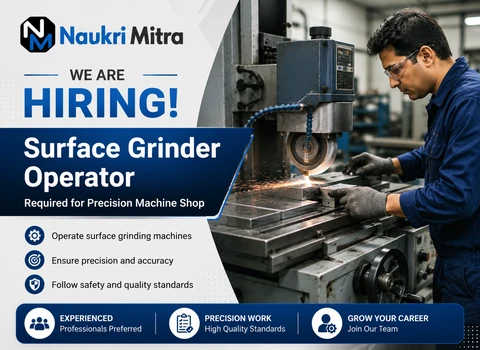
Walk into any precision machine shop, and you'll notice one machine that runs quieter but slower than the rest — the surface grinder. The person running it isn't cutting metal in big chunks as a lathe operator does. Instead, they're shaving off tiny amounts, sometimes just a few microns at a time, to get a part perfectly flat or perfectly sized. That's the job of a Surface Grinder Operator, and right now a Precision Machine Shop in Coimbatore, Tamil Nadu, India, is hiring for exactly this position on a Full-time basis.
If you're new to this trade, think of it this way: a lathe or milling machine gets a part close to its final shape, but grinding is what makes it exact. That difference between "close enough" and "exact" is the whole reason this job exists.
Why This Role Matters More Than It Looks
People outside manufacturing sometimes assume grinding is a minor, almost cleanup step. It isn't. Dies, gauges, molds, and precision fittings all depend on a flat, accurate surface to work correctly. If a mould half doesn't sit flush against its counterpart, the whole tool is useless. So companies don't hand this job to just anyone — they want someone who understands tolerances and won't rush a part just to finish faster.
Where This Kind of Work Is Usually Found
Grinding operators are needed across a fairly wide spread of industries:
- Tool rooms and die-making shops
- Automotive parts manufacturers
- General precision engineering workshops
- Pump, bearing, and motor component units
- Job-work shops handling contract manufacturing
What a Shift on the Floor Looks Like
Most days start with a quick check of the machine — is the wheel in good condition, is the coolant flowing properly, is the drawing for today's batch actually the latest revision? Small details like that matter more than people expect. Once the setup begins, the part is clamped to the magnetic chuck, carefully aligned, and grinding starts with light passes rather than a single aggressive cut. After every pass or two, the operator stops and measures. This back-and-forth between grinding and checking continues until the part matches the drawing. By the end of the shift, there's usually some paperwork too — how many pieces were finished, how many got rejected, and why.
The Everyday Responsibilities
- Reading and understanding engineering drawings, including tolerance marks
- Setting up and securely fixing workpieces before starting the machine
- Picking the right grinding wheel based on the material being worked
- Watching the process closely to prevent overheating or surface burns
- Checking finished parts with micrometers, dial gauges, or a surface plate
- Keeping the machine and coolant system clean and in working order
Machines, Tools, and How They're Actually Used
The core equipment here is the surface grinding machine itself, which spins an abrasive wheel across a flat workpiece held down by magnetism. In shops that handle more varied work, you'll also come across cylindrical grinders, tool and cutter grinders, and occasionally EDM machines for jobs that grinding alone can't shape properly. On the measuring side, micrometers, vernier calipers, dial indicators, and height gauges are the daily tools of the trade. None of this is useful, though, without the ability to read an engineering drawing correctly — that skill sits underneath almost everything else in this job.
Skills That Actually Matter Here
There's a technical side to this work, sure, but a lot of it comes down to patience. Grinding rewards operators who slow down and punishes ones who don't. Over time, experienced hands start noticing things a fresh operator might miss — a slight vibration that signals wheel wear, or a change in sound that means the coolant flow has dropped.
What Employers Tend to Check For
- Comfort reading engineering drawings, at least at a basic level
- Practical hands-on experience with measuring instruments
- Knowledge of grinding wheel grades and how to dress a wheel properly
- Consistency across long production runs, not just on a good day
- Basic upkeep habits — cleaning, oiling, general machine care
Education Background That Helps
Employers may prefer candidates with relevant machining or tool room training. Depending on the complexity of the work, an ITI certificate in a machining-related trade, a Diploma in Mechanical or Tool and Die Engineering, or similar vocational training is usually considered a good fit. That said, practical exposure counts just as much, if not more. Someone who has actually worked with EDM machines, handled engineering drawings, and used precision measuring tools on the shop floor often has an edge over a candidate with only classroom knowledge.
What the Body Goes Through — and What the Shop Feels Like
This is a standing job for the most part, with a fair amount of bending to check parts or adjust a fixture. It's not physically brutal like heavy lifting work, but hours on your feet do add up. Expect machine noise, some coolant smell in the air, and fine metal dust settling on surfaces nearby — normal conditions for a working machine shop. Shift patterns vary by employer and by how much production load a particular week brings; some precision machine shops around Coimbatore run rotational shifts, so being open to that kind of schedule tends to help during hiring.
Staying Safe Around the Machine
Grinding throws off fine particles and the occasional spark, so a few habits become non-negotiable over time:
- Safety goggles or a face shield, worn every single time you're near the wheel
- Gloves suited to handling sharp edges or warm components
- Safety shoes, in case something gets dropped
- Wheel guards checked and in place before the machine starts
- A work area kept clear of oil spills and stray metal shavings
What Makes This Job Harder Than It Sounds
The tricky part isn't the grinding itself — it's the pressure of working on a part that's already had money and time invested in it through earlier machining steps. One careless pass can ruin all of that. Add in day-to-day issues like a wheel that needs re-dressing, coolant that's picked up contamination, or a workpiece that's heated up and expanded slightly during grinding, and you get a job that demands quick, practical problem-solving rather than following a fixed routine.
Growing Within the Trade
Operators who consistently produce accurate, low-rejection work don't usually stay in the same spot for long. Many move on to handling trickier jobs — cylindrical grinding, tool-room precision work — or start taking charge of machine setups and quality checks for newer operators. Given enough years and a solid track record, it's not unusual to see someone from this line move into a supervisory role overseeing an entire grinding section.
Pay and What Else Might Come With the Job
This particular opening is Full-time, based in Coimbatore, Tamil Nadu, India, with a monthly salary of ₹26,500. Depending on the employer, similar roles in this industry sometimes come with extras like overtime pay, PF, ESI coverage, a festival bonus, uniforms, or transport and canteen facilities. None of these are guaranteed across every workplace, so it's worth confirming the specifics directly with the employer before assuming they apply.