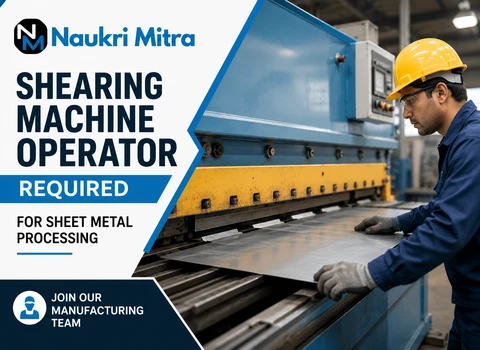
The Job Behind the Cut Metal Sheets in a Factory
Most people never think about how a flat metal sheet becomes a precisely sized piece ready for bending or welding. Someone has to cut it first, and that someone is usually a Shearing Machine Operator. In a sheet metal processing setup, this person operates the shearing machine that slices large sheets to the exact dimensions a job requires. There's no torch, no grinding, no heat involved - just a heavy blade forcing its way through metal until it splits cleanly along a line.
A couple of millimeters off and the piece might not fit where it needs to go later. That's really the whole job in one sentence: precision, repeated, all day.
Why Factories Keep This Position Filled
Metal sheets don't come pre-cut to whatever size a factory needs. They arrive as large sheets or coils, and someone has to bring them down to size before the real fabrication work starts. A factory could try cutting things by hand, but that wastes material and takes forever. Bringing in someone who actually knows how to run a shearing machine solves both problems at once. This particular opening is full-time, which tells you it's tied to ongoing production rather than a short-term or seasonal need.
What the Shift Actually Looks Like
The day starts with a quick machine check - blade condition, hydraulic pressure if that's the type of unit, and a look at the cutting schedule. After that it's mostly a loop: load a sheet, set the cut length, run the blade, check the piece, repeat. Some of the recurring tasks include reviewing work orders before starting, aligning sheets properly on the bed, adjusting blade clearance to match thickness, and inspecting finished pieces against drawings or reference samples.
It gets repetitive fast. Operators who treat that repetition as a chance to zone out are usually the ones who end up with bad batches. The ones who stay sharp through the routine tend to have far fewer problems.
The Part of the Job That Isn't About the Machine
Running the shear is only half of it. Someone still has to check that the sheet thickness is correct, that the cuts are actually square, and that the edges don't have burrs that'll cause headaches for whoever handles the metal next. Most operators end up keeping rough notes too - what got cut, how much time the machine sat idle, anything worth passing on to the bending or welding team down the line.
Factories, Workshops and Where This Role Shows Up
This kind of work isn't confined to a single industry. Fabrication units use shearing operators. So do appliance manufacturers, automotive component shops, and general engineering workshops. Faridabad, in Haryana, has a fair amount of metal fabrication and light engineering activity, which keeps openings like this one reasonably active locally. On the floor itself, the shearing section usually sits near other heavy equipment - press brakes, punching machines, that sort of thing.
Tools of the Trade
The shearing machine is the centerpiece - mechanical, hydraulic, or pneumatic depending on the setup, each with its own feel and speed. Beyond the machine itself, a few smaller tools show up constantly on the job:
- Steel rulers and tapes for quick length checks
- Vernier calipers when thickness has to be exact
- Try squares to confirm a cut is genuinely square, not just close
- Gloves and basic hand tools for moving sheets safely
Bigger factories sometimes have overhead cranes for the heavier loads, though that varies by unit. Understanding how the blade actually shears metal - forcing two edges past each other until the material fractures - helps explain why blade gap and pressure settings matter so much for getting a clean, even edge.
Skills That Actually Matter Here
Technical understanding helps a lot - knowing how different thicknesses of metal respond under the blade, and adjusting settings by knowledge rather than guesswork. But there's also a quieter skill set at play: staying patient through repetitive runs, catching a defect before it spreads across an entire batch, and being comfortable enough with engineering drawings to follow them without hand-holding. Operators who can read a drawing properly and trust their measuring instruments tend to produce noticeably less rework than those working on habit alone.
Education and Training Employers Look For
Employers may prefer candidates with relevant machining or tool room training. Depending on how complex the work gets, an ITI in a machining-related trade, a Diploma in Mechanical or Tool and Die Engineering, or equivalent vocational training may be considered suitable. Practical experience with EDM machines, engineering drawings, and precision measuring instruments is often valued just as much as the formal qualification itself. Freshers coming straight out of an ITI program shouldn't count themselves out either - genuine willingness to learn on the shop floor still counts for a lot in this line of work.
What the Body Goes Through
This isn't sit-down work. Expect long hours standing, some lifting and guiding of heavy sheets, and constant awareness of moving parts nearby. Hand-eye coordination matters more here than raw strength. Since it's a full-time role, shifts might rotate depending on how the factory schedules its production - a straightforward day shift in some units, general shift arrangements in others based on what the plant needs that week.
Living With the Noise and the Dust
Machine noise and metal dust are just part of working in a cutting section - there's no real way around that. What operators can control is how seriously they take safety. In practice, that means gloves, safety goggles, and steel-toe shoes as standard gear, ear protection where the noise gets loud, keeping hands well clear of the blade zone at all times, following proper lockout steps before any maintenance, and flagging worn blades or unusual sounds right away rather than waiting to see if it gets worse.
The biggest everyday challenges are usually handling heavy sheets without hurting yourself and staying mentally present through long, repetitive shifts. Operators who build a habit of double-checking settings before every cut generally deal with far fewer quality complaints later.
Where the Role Can Take You
Stay in this line of work long enough, and there's genuine room to move up. Experienced operators often shift into senior operator roles or shift-in-charge positions, or start operating more advanced cutting equipment as their understanding of the machines deepens. Strong measurement accuracy, a knack for troubleshooting, and the ability to guide newer operators are usually what push someone toward supervisory work within the same sheet metal processing line.
What the Pay Looks Like
For this role in Faridabad, Haryana, India, the salary is ₹25,500 per month, offered on a full-time basis. Some employers add extras on top of that - overtime pay, PF and ESI coverage, bonuses, uniforms, transport support, or canteen facilities, depending on the company. None of that is guaranteed across every employer, so it's worth confirming directly during the hiring process what's actually on the table.