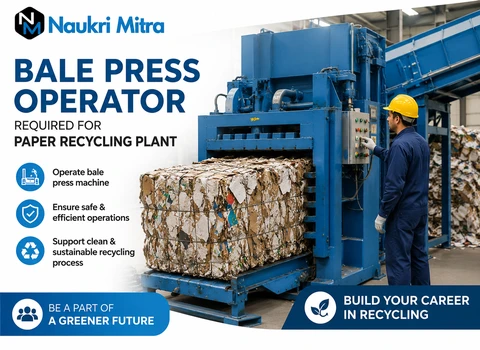
What a Bale Press Operator Actually Does
Walk into any paper recycling plant, and you'll hear it before you see it — the steady hiss and clank of a bale press compacting scrap paper into dense, wire-tied blocks. Running that machine is the job of a Bale Press Operator. It's a Full-time position based in Sonipat, Haryana, India, paying ₹27,800 a month, and it's the kind of role where freshers, ITI-trained candidates, and experienced factory hands all end up standing side by side on the same floor.
The work itself isn't complicated to describe, but it takes practice to do well. Loose paper waste enters one end, is compressed under heavy hydraulic pressure, and comes out the other end as a tight, stackable bale, ready for transport or resale.
Why This Role Exists in the First Place
Recycling plants don't just want to collect waste paper — they need to move it out efficiently, and loose scrap takes up too much space and is expensive to transport. A bale press solves that problem by shrinking large volumes of paper into compact blocks. But the machine only works as well as the person running it. Feed it too fast, ignore a pressure warning, or let scrap pile up unsorted, and output slows down almost immediately. That's the practical reason plants keep hiring for this position rather than treating it as an afterthought.
A Shift, Start to Finish
Most operators begin their shift with a quick walk-around: check the hydraulic lines, clear the feeding tray, make sure the pressure gauge is reading normal. Once the plant starts running, it's a repeating cycle — feed the press, watch the compression, pull out the finished bale, stack it, repeat.
It sounds simple written out like that. In practice, timing and rhythm matter a lot. Feed the machine unevenly, and you end up with lopsided bales that are harder to stack and transport.
What the Job Involves Day to Day
- Running the hydraulic or mechanical press safely, cycle after cycle
- Feeding sorted paper waste at a consistent pace
- Tying or strapping finished bales and stacking them for dispatch
- Keeping an eye on pressure gauges and control indicators
- Flagging odd noises, oil leaks, or pressure drops before they become breakdowns
- Clearing loose scrap so the floor stays safe to move around
Where You'll Actually Find This Work
This isn't a role tied to one type of factory. Paper recycling units are the obvious employer, but cardboard processing centers, scrap material warehouses, and waste management facilities all run similar equipment. Some packaging companies also press returned cartons before sending them back for reprocessing. Haryana's manufacturing base has grown steadily, and recycling has grown alongside it — which is part of why demand for trained press operators hasn't slowed down in this region.
The Machine, and Everything Around It
The bale press is the centerpiece, whether hydraulic or mechanically driven, but it's rarely the only equipment an operator touches. Wire tying tools or automatic strappers close out each bale. A weighing scale checks that bales meet weight specifications. Forklifts or hand trolleys move the finished product. And there are always basic hand tools nearby for small adjustments.
Understanding, even at a basic level, how hydraulic pressure builds inside the system helps here. An operator who can recognize the early signs of a pressure issue — a slower cycle, an odd sound — can flag it before it turns into downtime.
Skills That Actually Matter on the Floor
Technical knowledge helps, but plenty of this job comes down to habits built on the shop floor rather than anything taught in a classroom.
- A working understanding of hydraulic or mechanical press systems
- Comfort reading gauges and basic control panels
- Physical stamina — this job involves standing, lifting, and repetitive movement for hours
- Attention to detail while sorting and feeding material
- Familiarity with safety locks, guards, and emergency stop procedures
An ITI qualification in a mechanical trade, or equivalent vocational training, is often preferred by employers filling this kind of role. It's worth noting that while some machining-related positions require engineering drawing skills or precision measuring instruments, this particular job leans more toward production speed and consistency than toward tool-room precision.
What the Body Goes Through
Long hours on your feet. Repeated lifting of paper bundles. Working in reasonably close proximity to moving parts. Add paper dust and machine noise to that, and you get a working environment that rewards physical fitness and steady focus over anything else. Shift work is common in plants that run extended hours to meet processing targets, so rotational shifts shouldn't come as a surprise if the plant operates that way.
Staying Safe Around a Hydraulic Press
A press this powerful leaves little room for shortcuts. Gloves, safety shoes, dust masks, and ear protection in louder zones are standard gear for a reason. Machine guards stay on, always — operating with them removed is one of the fastest ways to get hurt on this job. Emergency stop functions need regular checks, not occasional ones. And if something feels off — a worn wire, a small leak, a strange vibration — reporting it immediately is far better than waiting to see if it gets worse.
Where New Operators Tend to Struggle
Getting the feeding rhythm right takes time; too fast or too slow and bale quality suffers. Jams caused by mixed or poorly sorted waste are another common headache in the first few weeks. Most of this smooths out once an operator gets familiar with the specific press model at their plant — every machine has its own quirks.
Building a Career Beyond the Entry Level
Operators who stick with this line of work often move into senior operator positions, take on basic machine maintenance duties, or step into shift supervision within the same plant. The skills carry over well too — years spent on a bale press translate reasonably easily to similar operator roles in packaging or broader waste management setups.
Pay and What Might Come With It
The position is Full-time, based in Sonipat, Haryana, India, with a monthly salary of ₹27,800. Beyond the base pay, some employers offer extras like overtime, PF and ESI coverage, bonuses, uniforms, or transport and canteen facilities. None of these are guaranteed across every plant, so it's worth confirming what's actually on offer directly with the employer before assuming they're included.