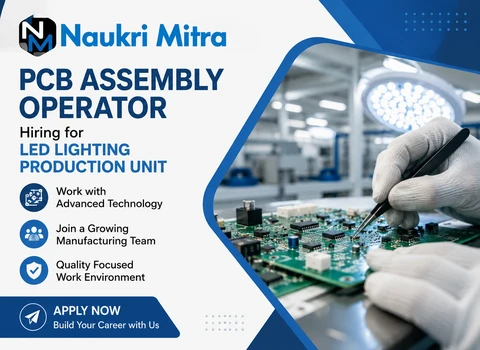
Understanding the Role of a PCB Assembly Operator
A PCB Assembly Operator works in an electronics manufacturing facility, fitting components onto printed circuit boards for finished electronic products. In the LED lighting industry, this role is central to production, since every LED fixture depends on a properly assembled circuit board to function. This is a Full-time position based in Baddi, Himachal Pradesh, India, and it suits candidates who enjoy hands-on, detail-oriented work on a production floor.
Why LED Lighting Manufacturers Recruit for This Position
LED lighting production runs on continuous assembly lines, and manufacturers need operators who can maintain consistent output without compromising quality. A single loose solder joint or misaligned component can cause an entire fixture to fail, so companies prefer operators who understand both speed and precision. As demand for energy-efficient lighting grows across India, production units increasingly look for reliable technicians who can support daily assembly targets.
A Typical Day on the Assembly Line
Work usually begins with a check of the workstation, tools, and component trays before the shift starts. From there, the operator moves through repetitive but focused tasks such as placing components, feeding boards through soldering equipment, and inspecting finished units. Most production units organize work in shifts, so shift work is common in this profession, especially when output targets must be met around the clock.
Core Responsibilities on the Floor
- Placing electronic components such as resistors, capacitors, LEDs, and connectors onto circuit boards
- Operating or assisting with wave soldering or reflow soldering machines
- Performing visual inspection of soldered joints for defects like cold joints or bridging
- Using a multimeter to test continuity and basic electrical parameters
- Packing finished boards or handing them off to the next assembly stage
- Reporting faulty components or machine issues to the shift supervisor
Industries and Facilities Where This Work Happens
Beyond LED lighting, this kind of assembly work is common across the broader electronics manufacturing sector, including units producing consumer electronics, power supplies, and automotive electronics. Operators typically work inside factory floors organized into assembly lines, with dedicated sections for component fitting, soldering, testing, and packing.
Machines, Tools, and Instruments Used Daily
Familiarity with certain equipment makes daily work smoother. Common tools include soldering irons, wave soldering machines, reflow ovens, tweezers, and component placement jigs. Measuring instruments such as multimeters and continuity testers are used to verify that a board is functioning correctly before it moves to the next stage. Some units also use magnifying lamps for close inspection of small components.
Skills That Help an Operator Succeed
Good hand-eye coordination and patience matter a great deal here, since components are small and mistakes are easy to make under time pressure. A basic understanding of electronic components, the ability to read simple circuit layouts, and the ability to follow standard operating procedures are valued skills. Freshers with an ITI in the Electronics, Electrician, or Fitter trades, or a Diploma in Electronics and Communication, are often preferred, though candidates with practical shop-floor exposure may also be considered, depending on the employer's requirements.
Physical Demands and Working Conditions
The job involves long periods of sitting or standing at a workstation, along with repetitive hand movements. Good eyesight, or corrected vision, is helpful given the fine detail involved in handling small components. The working environment is generally indoors and climate-controlled to protect sensitive electronic components from humidity and dust.
Safety Practices and Protective Equipment
Soldering work involves heat and fumes, so proper ventilation and safety habits are important. Operators are usually expected to use PPE such as safety glasses, anti-static wrist straps, and gloves where required, since static electricity can damage sensitive components. Following lockout procedures around machinery and keeping the workstation free of loose wires also reduces workplace accidents.
Common Challenges on the Job
Working at a steady pace for extended hours can be tiring, and identifying microscopic defects requires sustained concentration. Machine downtime or component shortages can also disrupt the daily rhythm of work, requiring operators to adapt quickly to changing priorities on the line.
Building a Long-Term Career in Electronics Assembly
With experience, a PCB Assembly Operator can move into roles such as line supervisor, quality inspector, or soldering specialist, and further training in SMT (Surface Mount Technology) processes can open doors to more technical assignments within the same production unit.
Salary and Benefits You Can Expect
For this Full-time PCB Assembly Operator position in Baddi, Himachal Pradesh, the monthly salary is ₹32,800. Depending on the employer, additional benefits may include overtime pay, PF, ESI, festival bonus, uniforms, and transport or canteen facilities, though these vary from one production unit to another.