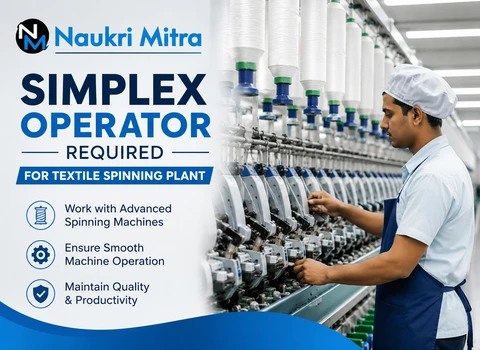
What It Means to Work as a Simplex Operator
There's a Full-time opening for a Simplex Operator at a textile spinning plant in Salem, Tamil Nadu. If you've never worked inside a spinning mill before, the job title alone probably doesn't tell you much. So here's the short version: the simplex machine (some call it a speed frame, others a roving frame) takes loose, untwisted fiber and turns it into roving - a slightly twisted strand that's still soft enough to draft further but strong enough to hold together on a bobbin. The person running that machine is the simplex operator.
Why This Machine Can't Run Itself
You'd think with so much automation in textile mills today, a machine like this could just be left alone. It can't. Sliver comes in from the carding section, gets fed through drafting rollers, picks up twist from a rotating flyer, and winds onto a bobbin - and any one of those steps can go wrong in seconds. A roller might not feed evenly. A thread might snap. A bobbin might fill up faster than expected. That's the reason mills in Tamil Nadu, home to a large share of the country's spinning capacity, keep hiring machine operators specifically for this stage rather than trying to run it unattended.
A Shift on the Floor
Walk into the simplex section during a shift, and you'll usually see the operator doing rounds - checking one machine, then the next, then back again. The day typically starts with a quick check of the machine and the sliver cans feeding it. From there it's mostly watching: catching thread breaks before they pile up, swapping full bobbins for empty ones (this is called doffing), and keeping an eye on roving thickness. It sounds repetitive, and honestly, a lot of it is. But small lapses later show up as quality problems in the yarn, so attention has to stay steady throughout the whole shift.
What the Job Actually Involves
- Threading sliver through the drafting zone and setting up the machine to run
- Watching for and fixing thread breakages as they happen
- Doffing bobbins and replacing them without stopping production for long
- Checking roving twist and thickness against the required count
- Flagging mechanical issues to the maintenance team instead of attempting complex repairs
- Keeping the machine area free of fly and loose fiber
Machines and Instruments You'll Get to Know
The simplex or speed frame is the main machine, but the job isn't just about that one piece of equipment. Operators handle sliver cans, roving bobbins, flyers, and drafting rollers daily and use simple gauges to check hank and twist per inch. Newer machines in some mills now come with digital displays showing production counts and speed settings, so a bit of comfort with basic screens helps, even if it's not strictly required.
Who Tends to Do Well in This Role
There isn't one fixed background that guarantees success here. Some operators come in with an ITI certificate in a textile or mechanical trade; others learn the entire job on the floor, starting as helpers before moving up. Employers often lean toward candidates with some machining or textile training when it's available, but hands-on familiarity with drafting, twist mechanics, and basic measuring tools usually counts for just as much as a certificate. What separates a good operator from an average one is mostly attentiveness - catching a problem before it becomes ten problems - and the physical stamina to keep moving through a long shift.
Where the Work Happens
This position is based in Salem, Tamil Nadu, at a spinning plant within India's broader textile manufacturing sector. Spinning units are generally large, open production halls with rows of machines running side by side, and the noise and lint in the air are part of daily life on the floor - not pleasant exactly, but manageable once you're used to it.
Shifts, Standing, and the Physical Side of It
Spinning mills rarely shut their machines down, which usually means rotational shifts, including night shifts at some point in the rotation. Expect to be on your feet for most of the shift, moving between machines rather than sitting at a station. It's not the heavy manual labor of construction work, but the constant movement and standing do take getting used to for someone coming from a desk job or another kind of trade.
Keeping Safe Around Moving Parts
Rotating flyers, moving rollers, and airborne cotton dust are the main hazards on a spinning floor. Most mills expect operators to wear ear protection due to machine noise, as well as a dust mask and closed-toe footwear. Tying hair back and avoiding loose sleeves or dupattas near the machine isn't just a rule - it's genuinely necessary around rotating parts. During maintenance work, machines are usually locked out before anyone reaches into them, and new operators are expected to follow that without shortcuts.
What Tends to Trip Up New Operators
The first few weeks are usually the hardest. Handling one thread break is easy; handling three across different spindles at the same time, while a supervisor is asking about output, is a different experience altogether. The noise takes some adjusting to, as does the repetition. Most people find their rhythm within a few weeks, once the movements stop feeling deliberate and start feeling automatic.
Moving Up From Here
Operators who stick with the trade for a couple of years often get handed more machines to look after at once, or get pulled into training newer workers. From there, some move into shift-level supervision within the spinning department, while others broaden out by learning the carding or ring frame sections as well, which makes them more useful across the whole spinning line - and generally more employable too.
Pay and What Else Might Come With It
This Full-time role pays ₹30,100 a month. On top of that, depending on how the employer structures things, workers may also receive overtime pay, PF and ESI coverage, an annual bonus, uniforms, or facilities such as transport and a canteen. None of these are guaranteed across every mill, so it's worth confirming what applies at the time of joining.