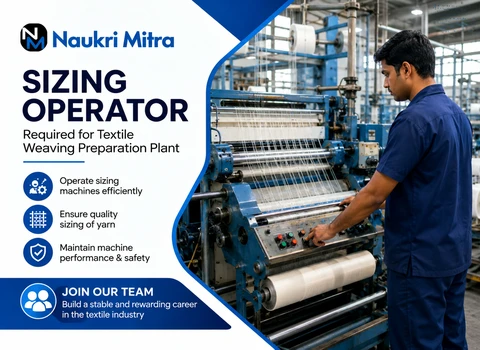
What Does a Sizing Operator Actually Do?
Before yarn ever touches a loom, it goes through a stage most people outside the textile industry have never heard of: sizing. A Sizing Operator handles this stage, coating yarn with a starch-based or chemical solution so it can survive the friction and tension of high-speed weaving. This particular opening is based in Bhilwara, Rajasthan, a Full-time position paying ₹28,900 a month. If you're researching this job for the first time, think of it as the step that turns raw, fragile yarn into something tough enough to run through a power loom without snapping every few minutes.
The Reason This Job Exists
Raw yarn is weak. It's hairy, uneven in places, and simply not built to handle the repeated pulling and rubbing that happens on a loom. Skip the sizing step, or get it wrong, and you end up with constant yarn breaks, stopped machines, and fabric that comes out with visible defects. That's why weaving preparation plants need someone dedicated to running the sizing machine properly, shift after shift. A single mistake in the size recipe or paste thickness can ripple all the way down to the finished cloth.
Walking Through a Regular Shift
The day typically starts before the machine even runs — checking the size box, the yarn beams, making sure everything's ready. Once production begins, the operator keeps an eye on paste consistency, the temperature of the size solution, and how much tension the yarn is under as it passes through. Some of the recurring tasks include:
- Mixing the size solution to the correct recipe and ratio
- Loading warp beams and threading yarn through the machine correctly
- Watching the drying cylinders so yarn comes out evenly dried, not patchy
- Spotting uneven coating, sticky patches, or broken ends and fixing them fast
- Logging machine speed, size pickup percentage, and daily output numbers
Getting Familiar with the Equipment
The sizing machine itself is the centerpiece — it comes with a size box, squeeze rollers, steam-heated drying cylinders, and a beaming section at the end. Beyond that, operators use viscosity cups to check how thick the size paste is, moisture meters to test whether the yarn has dried properly, and tension gauges to keep the warp threads properly tensioned. A working knowledge of steam boilers and basic electrical panels helps, too, since these machines operate on a mix of heat and mechanical motion.
What Separates a Good Operator from an Average One
Understanding yarn count, size recipe ratios, and how machine speed affects output matters, but so does instinct built from time on the floor — catching a yarn break before it becomes a bigger problem, reading a gauge at a glance, adjusting settings without slowing down the whole line. In Bhilwara's textile belt, employers often lean toward candidates who've completed an ITI in Textile Technology or hold a Diploma in Textile Engineering. That said, workers without formal certification who genuinely know the machine are considered too — experience counts for a lot here.
What the Body Goes Through on This Job
This isn't a desk job. Expect to be on your feet, moving around the machine, occasionally lifting yarn beams with mechanical support. There's steam nearby, heat, and humidity from the drying process, making the plant feel warmer than it actually is. Noise levels shift with machine speed — sometimes moderate, sometimes fairly loud. Shifts rotate in most weaving preparation units, since sizing machines usually run round the clock to keep pace with downstream weaving demand.
Staying Safe Around Steam and Moving Parts
Given the steam, hot rollers, and constantly moving components, safety isn't optional here. Gloves, closed footwear, and hearing protection in louder sections are standard expectations. Loose clothing near rotating rollers is a real hazard, so operators learn early to avoid it and to shut the machine down the moment something sounds off or yarn starts tangling unexpectedly. Steam lines and electrical connections are checked regularly, too — a small lapse here can lead to a serious accident.
Where the Job Gets Tricky
Humid weather causes more yarn breakage than most newcomers expect. Size paste viscosity doesn't always behave consistently, and machine downtime for cleaning eats into productive hours. New operators often struggle at first to judge the right pickup percentage — get it wrong and you either waste material or weaken the yarn. It usually takes a few months of hands-on practice before this starts feeling manageable rather than stressful.
What Actually Helps You Get Better at This
Reading the size recipe sheet accurately and understanding how humidity changes yarn behavior day to day cuts down on a lot of avoidable errors. Many experienced operators keep a personal log of which settings worked for which yarn counts — it sounds simple, but it saves time later. Flagging recurring machine faults to the shift supervisor quickly, rather than letting them slide, also keeps small issues from turning into major production losses.
Where This Role Can Lead
Operators who perform consistently well can move up to Senior Operator, take on shift supervision duties, or shift into quality-checking work within the sizing and warping section. Some, after years on the floor, end up training new recruits themselves — passing on the kind of practical knowledge that doesn't come from a textbook.
Pay and What Might Come With It
The role pays ₹28,900 per month for Full-time work in Bhilwara, Rajasthan, India. Depending on the employer, there may be additional benefits like overtime pay, PF, ESI, festival bonuses, uniforms, or canteen and transport facilities. None of these are guaranteed across every unit — they vary by company, so it's worth confirming specifics during the hiring process.
Should You Consider This Career?
If you don't mind standing shifts, working around steam and heat, and enjoy hands-on technical work where you learn by doing, this suits that mindset well. For freshers coming out of an ITI or Diploma program in a textile-related trade, it's a practical way into Rajasthan's textile manufacturing sector — one with real room to grow into more senior technical roles over the years.