
+ Post Job +
AI Safety Engineer Remote Job
Home โ€บ Agentic AI & New AI Engineering

AI Safety Engineer Remote Job

๐Ÿ“ Anywhere ๐Ÿท๏ธ Agentic AI & New AI Engineering ๐Ÿ’ฐ $125,000 / year

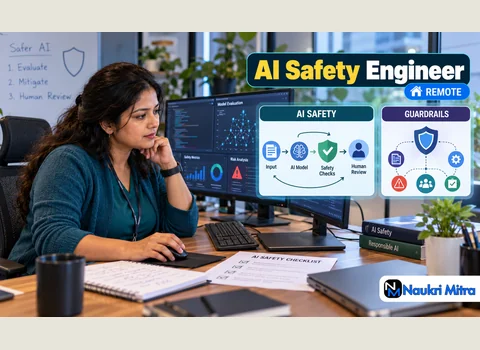
A safety classifier that blocks 6% of harmless questions tends to get switched off by the product team within a month, however well it catches the harmful ones. Keeping both numbers honest is the everyday task in these remote AI safety engineer jobs. The post is full-time and home-based, in any country, at $125,000 per year in USD. It is aimed at engineers with three to six years of ML or software experience who want to run the guardrails between a language model and its users.

Why the client wants one engineer accountable for its safety layers

The project team runs LLM features that customers use daily, and each needs checks on what goes in, what the model says back and what happens when someone tries to break it. The client wants one owner who treats those checks as production systems.

The seat exists because safety filters drift. A model upgrade changes the shape of outputs, and a threshold that looked sensible in March starts refusing cooking questions in June. This AI safety engineer job description comes down to catching that early.

Weekly work on classifiers, rails and abuse monitoring

  • Build and train safety classifiers in PyTorch, from data preparation to serving.
  • Deploy Llama Guard for input and output moderation, choosing the hazard categories each product needs.
  • Write NeMo Guardrails configurations and Colang flows for topic limits, refusals and escalation.
  • Evaluate harmful-content detection rates on labelled test sets, reported by category.
  • Tune thresholds and filters to reduce false positives without letting detection slip.
  • Monitor deployed safety systems for new abuse patterns.
  • Lead incident reviews and turn each finding into a test or a fix.

Three to six years in, with PyTorch to show: what the hiring team checks

The AI safety engineer skills that carry most weight here are ones you can point to in code or in an incident you handled.

  • Three to six years in ML engineering or software engineering.
  • Strong PyTorch: training loops, fine-tuning and evaluation you can defend.
  • Hands-on work with Llama Guard or NeMo Guardrails.
  • A bachelor's degree in computer science or a related field, the usual background.
  • Experience training classifiers and shipping safety systems to production, which counts heavily.

Helpful, though not required

  • Familiarity with the MLCommons hazard taxonomy behind Llama Guard categories.
  • Red-teaming or adversarial prompt testing.
  • Reading Hindi or another Indian language.

Salary, working hours and contract for the $125,000 safety seat

Pay is $125,000 a year, set in US dollars, for a full-time role: about โ‚น1.19 crore before tax at โ‚น95 per dollar, a value that shifts with the currency. When comparing the AI safety engineer salary per year across offers, check whether each figure is base pay or includes equity.

Among AI safety engineer jobs remote worldwide, this is a genuine one: no office or city is set. Like most AI safety engineer work from home jobs, the home setup is simple: a reliable connection, a laptop that runs Docker and a quiet room. Training runs on cloud GPUs.

Hazard log for a customer chatbot: where the safety case starts

The next sections follow one illustrative safety case: adding Llama Guard and NeMo Guardrails to a consumer finance help chatbot. First, what could go wrong:

  1. A user gets step-by-step help with card fraud or account takeover.
  2. A self-harm message gets a cheerful product answer.
  3. Pasted webpage text injects instructions that expose the system prompt.
  4. Over-blocking: "how do I kill a stuck payment" gets refused.

Layers of defence: Llama Guard at the door, NeMo Guardrails in the conversation

Layer one runs Llama Guard on each user message, reading the probability of the "unsafe" token as a score, so each hazard category gets its own threshold, not one yes or no. Layer two is NeMo Guardrails: Colang flows keep the bot on banking topics, send self-harm messages to a fixed supportive reply with helpline details, and refuse requests for the system prompt. Layer three checks the model's answer with Llama Guard again. Layer four is logging plus a weekly human sample.

Metrics before and after threshold tuning, on 2,000 labelled prompts

The set holds 400 harmful prompts and 1,600 ordinary questions, double-labelled.

  • Before, with one default threshold of 0.5: 352 of 400 harmful prompts caught, a false-negative rate of 12%; 96 harmless prompts blocked, a false-positive rate of 6%.
  • After, with per-category thresholds and a topical rail for payment vocabulary: 382 caught, a false-negative rate of 4.5%; 30 blocked, a false-positive rate of about 1.9%.

Most false positives came from the violent-crimes category reading banking slang literally: "kill the transaction", "my card is dead". Raising that threshold to 0.7 fixed most of them. The self-harm threshold went down to 0.3, because a miss there costs far more than an extra supportive reply. One reviewer's comment on the pull request: "Fine with 1.9% FP if self-harm FN is zero on the test set. Is it?" It was, on that set, which is not zero in production.

Incident review: the one-page postmortem

Eleven days after launch, the weekly sample caught account-takeover requests wrapped in role-play in romanised Hindi. The blameless summary:

  • Impact: 23 harmful answers reached users over about 36 hours.
  • Detection: a human sample, not an alert, itself a finding.
  • Root cause: no transliterated prompts in the test set.
  • Actions: 150 Hinglish prompts added to the eval set, an alert on flag rate by language, and a re-tune holding false positives under 2%.

Moving into remote AI safety engineer jobs from software or ML work

Most people here came from backend, ML or platform engineering, so the honest answer to "how to become AI safety engineer" is to add safety evaluation to skills you already have. A sensible AI safety engineer course to begin with is one of BlueDot Impact's free online programmes, then the open ARENA curriculum for PyTorch practice. No recognised AI safety engineer certification exists yet; ISO/IEC 42001 courses suit governance staff more than builders.

Genuine entry level remote AI safety engineer jobs are hard to find, and this opening is not one. Those searching for AI safety engineer jobs no experience tend to land annotation or red-teaming contracts: a fair first step, but a different job.

Resume lines and interview questions

An AI safety engineer resume should carry numbers: "Cut moderation false positives from 6% to 1.9% while holding self-harm recall" beats "worked on safety". Typical AI safety engineer interview questions include:

  1. Your false-positive rate doubles after a base model upgrade. What do you check first?
  2. Why set different thresholds for self-harm and profanity?
  3. Where would a prompt injection guardrail sit in a retrieval-based chatbot?

Safety engineer or trust and safety engineer, remote or hybrid, and where demand goes

A trust and safety engineer usually builds platform tools for human moderators: reporting flows, review queues and enforcement systems. This role builds model-side protection around an LLM.

Anthropic, OpenAI and Google DeepMind hire for safety engineering, though many roles there are hybrid; Anthropic's postings currently ask staff to be in an office at least 25% of the time. This listing has no link to them. Demand follows how many firms put LLMs in front of customers, plus rules such as the EU AI Act. No one can promise growth; if it stalls, the skills carry over to ML platform work.

Safety-job scams to screen out, and how to send your application

Watch for an onboarding or "laptop deposit" fee, anyone wanting your bank's SMS code or UPI PIN, recruiters who talk only over Telegram or WhatsApp, and an offer that skips the technical interview. You pay nothing here, now or later.

If you found this page searching for remote AI safety engineer jobs hiring now, send your resume with one paragraph on a safety system you built, including a metric. Shortlisted profiles get a technical screen.

Frequently Asked Questions

They build and run the protections around a language model: classifiers that flag harmful inputs and outputs, guardrail rules that keep conversations on track, and monitoring that spots new abuse. Much of the week goes on measuring detection and false-positive rates, then tuning thresholds.
A common pattern places a classifier such as Llama Guard on both the user message and the model's reply, with NeMo Guardrails flows handling topic limits and fixed responses in between. Each layer is tested on a labelled prompt set before launch and watched through logs afterwards.
PyTorch comes first, because you train and evaluate your own classifiers. The listing also asks for hands-on work with Llama Guard or NeMo Guardrails, so you should have shipped something with one or both.
A degree in computer science or a related field is typical, and this listing expects a bachelor's degree. Production experience with classifiers and safety systems still counts for more than the name of the degree.
The listed salary is $125,000 per year in USD, full-time. That converts to somewhere near โ‚น1.19 crore, an estimate that drifts as the rupee strengthens or weakens.
They hire for safety engineering, but many of their roles are hybrid or office-based; Anthropic, for instance, currently asks staff to spend at least a quarter of their time in an office. This fully remote listing is not with any of them.
Start by building a small safety layer on an open model, measuring its false-positive and false-negative rates, and publishing the results. Free programmes from BlueDot Impact and the ARENA exercises help fill the theory gaps.
Trust and safety engineers mostly build platform tools for human moderators and policy teams. This role builds model-side defences such as classifiers, guardrails and evaluations that act before a human ever sees the content.
Apply Now