
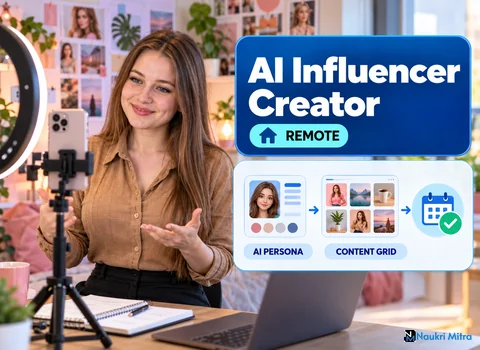
Name: Juno. Niche: budget balcony gardening for renters in small flats. Look: late twenties, cropped copper hair, freckles, a faded green work apron that never gets washed. Voice: dry, a little impatient with plant influencers who own greenhouses. Posting style: golden-hour carousels three times a week, one talking video on Sundays, captions that end by asking what died this week. Juno does not exist. She will not exist until someone builds her, keeps her face identical across every image, and gives her a personality that survives real followers. That builder is the person this listing wants, in one of the more hands-on online ai influencer creator jobs around.
The facts first. This is AI influencer creator work from home, part-time and freelance in style, open to people anywhere in the world, and it pays $30 per hour USD. No degree is required. What gets you hired is a sample character portfolio that shows you can do the whole build, not one lucky render.
Human creators who last tend to have a point of view before they own a ring light. Virtual characters are the same. The first phase is writing the character as a person: what she cares about, what she refuses to post, how she talks when a comment annoys her, which brands she would never touch. You will produce a short character bible covering backstory, values, vocabulary, humour, and the limits of what the persona will say.
Clients often arrive asking for "a fitness girl, but different." Your job is to make that specific enough that a stranger could write her captions. Generic personalities cannot be rescued by rendering.
Next comes the look. You will pin down face shape, skin texture, hair, typical wardrobe, a colour palette for her feed, and the settings she lives in. A reference sheet is the usual tool: front, three-quarter and profile views, a few expressions, two or three signature outfits. The point is repeatability. A character whose eye colour drifts between posts reads as fake in the bad sense, and followers notice faster than clients expect.
This is the technical heart of the role. Using a curated set of reference images of the invented character, you train a Flux LoRA, a small add-on model that teaches Flux to reproduce that specific face. Good results depend on dataset discipline: varied angles and lighting, consistent identity, clean captions for each training image, and sensible choices about steps and learning rate. Expect to train, test, notice the jawline going soft, and retrain.
One ethical line sits here, and it is firm. The training set must depict a character you created, never a real person scraped from someone's account. A lookalike of an actual human without consent loses clients and can bring legal trouble.
With the face locked, you generate the on-brand photos that fill the feed. Midjourney is strong for mood, styling and location ideas, and its reference features help keep a character close. Many creators then bring the face back through their Flux LoRA, with inpainting or image-to-image passes, so identity stays exact. You will also do ordinary photo editing: fixing hands, cleaning backgrounds, matching colour so a carousel looks like one afternoon.
Static images only go so far on Instagram and TikTok. HeyGen lets you turn the character into a talking avatar that reads scripts with lip sync. The craft is in the details: a voice that fits the bible, scripts short enough that the avatar keeps believable expressions, and trimming clips in a basic editor such as CapCut or Premiere so pacing feels human. Juno's Sunday video should sound like Juno, tired of everyone's monstera.
You will plan posting themes in weekly or monthly blocks: recurring series, seasonal hooks, the occasional trend the character would plausibly join. Captions carry personality more than images do, so you write them in her voice, keep a consistent sign-off, and decide which comments she replies to. A shared spreadsheet or Notion board usually holds the calendar so the client can approve posts before they go live.
Once posts are live, the audience tells you things: saves on carousels, watch time on clips, which jokes get replies. Part of this job is reading those signals in the platform analytics and adjusting: maybe Juno's sarcasm lands better in captions than on video, or her followers want more cheap-fix tutorials and fewer aesthetic shots. Small, deliberate changes keep the persona coherent. Rebuilding her every week does not.
You need a decent computer and fast internet. Training a Flux LoRA locally wants a recent graphics card with plenty of VRAM; if you lack one, you can rent cloud GPU time or use hosted training services instead. Typical software includes ComfyUI or a similar Flux front end, a LoRA training tool, Midjourney, HeyGen, an image editor and a video editor. Expect to fund those subscriptions yourself. Commercial use of what they generate is governed by each vendor's licence and the tier you are on, so read the terms before selling a character to anyone.
Disclosure is non-negotiable. Instagram and TikTok require labelling of realistic AI-generated content in many cases, and advertising rules in many markets require sponsored posts to be clearly disclosed. A virtual influencer gets both obligations. Her bio should say she is a digital character, and paid posts need the platform's branded content tools or a clear ad label. Never present the persona as a real human. These rules change regularly, so check each platform's current policy and the local ad code before every campaign.
Every billable hour on this role earns $30 USD, on a part-time basis. Part time AI influencer creator jobs rarely come with fixed weekly hours, so treat the rate as what an hour earns, not a promise of volume. Freelance AI influencer creator jobs appear on Fiverr, Upwork and similar marketplaces, usually as character builds, LoRA training or avatar video packages.
Your first client usually comes from proof, not pitching. Build one complete sample character of your own, with a reference sheet, a trained LoRA, a dozen consistent photos, two talking clips and a month of planned captions, then show the whole pipeline in your portfolio. Small agencies and brands testing a mascot respond to that far more than to a tool list, which is why AI influencer creator jobs for freshers are realistic when the sample is strong.
A human social media content creator sells themselves: their face, their life, their reactions on camera. An AI influencer builder sells a system. You are closer to a character designer, art director and social strategist rolled together, working behind a persona that is not you. The upside is privacy and the ability to run several characters for different clients. The downside is that audiences forgive a human's off day far more easily than an AI character's glitchy hands, and trust has to be earned with more transparency, not less.
Virtual influencers have had headlines that outran reality. Some characters built real audiences; many launched loudly and stalled because nobody gave them a reason to exist beyond novelty. The novelty layer may well be a fad; the skills underneath are not. Consistent character design, LoRA training, avatar video and audience-led iteration transfer to brand mascots, product visualisation and game or animation work. Build those skills, disclose honestly, and you are less exposed if the trend cools.
If this suits you, send a portfolio showing one character from concept to analytics, plus a note on the persona you would build for a brand you admire.