
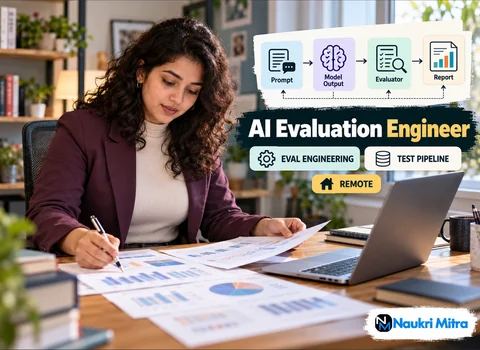
A retrieval-augmented assistant can score 0.81 on faithfulness one week and 0.84 the next without anyone changing a line of code, because the judge model, the sample and the questions all carry noise. Telling that noise apart from a real improvement is what these remote AI evaluation engineer jobs pay you to do. The job is full-time and location-free, with a salary of $125,000 (USD) per annum, for engineers with about three years in ML, data or software work who enjoy designing a fair test.
The project team runs LLM and RAG features that answer questions from documents. Every new prompt, embedding model or chunking scheme is pitched as better, and until now the evidence has been a few screenshots and a gut feeling.
This role owns the measuring instruments instead: benchmark sets, regression tests, quality dashboards and the method for comparing one model version with another. Your reports feed straight into go or no-go release calls.
The AI evaluation engineer job description comes down to an engineer who can write the test and then doubt it.
A quantitative bachelor's or master's is common but not mandatory; the minimum education accepted is high school, provided the experience is there.
Salary: $125,000 per annum, in US dollars. Taking the dollar at roughly ₹95, as it traded in late October 2026, you land close to ₹1.19 crore before tax, and that conversion floats. Hours are standard full-time and mostly asynchronous, from any country, with a few hours of overlap for release reviews.
This example is illustrative. A support assistant answers policy questions from a 1,200-page knowledge base, and users report that it cites the right document and then states a figure that is not in it. You write the hypothesis down first: "Splitting documents by section heading instead of fixed 512-token chunks will raise faithfulness without lowering answer relevancy." Pick the metric after seeing the scores and you will always find one that rose.
Two RAGAS metrics decide it. Faithfulness asks whether each claim in the answer is supported by the retrieved context; answer relevancy asks whether the answer addresses the question.
From 4,000 logged questions you draw 300, stratified by topic. Why 300? If per-question scores have a standard deviation near 0.25, the standard error is 0.25 divided by the square root of 300, about 0.014, so a 95% interval of roughly plus or minus 0.03. Fifty questions would give plus or minus 0.07 and hide a real gain. Before the main run you hand-label 60 answers against the judge; here it was marking "I could not find that in the policy" as unfaithful, so the judge prompt was rewritten.
Both versions answer the same 300 questions, so the comparison is paired. Baseline faithfulness is 0.81 and the new version scores 0.88. A paired bootstrap, resampling the question-level differences 10,000 times, puts the 95% interval for the gain at 0.04 to 0.10. Zero sits outside it.
Answer relevancy moves from 0.86 to 0.87, interval minus 0.01 to 0.03: no sign of harm, as the hypothesis required. One full RAGAS pass took about forty minutes of judge calls, so you repeat it with a second seed; the gain holds at 0.06.
The release note lists hypothesis, sample, both intervals, the judge check and one recommendation. A reviewer's usual first comment is "Is 0.07 bigger than last week's noise?", so the note answers it up front. The 300 questions then become a DeepEval regression suite with a faithfulness threshold just below the new score.
For AI evaluation engineer work from home jobs, a reliable laptop and stable broadband are enough. Judge models are mostly called through hosted APIs, so a local GPU is rarely needed.
The core AI evaluation engineer skills are Python, metric design, judge calibration and basic statistics. Testers already think in regression suites and edge cases; what they usually add is the habit of asking how much a score wobbles on its own.
No AI evaluation engineer certification is required by hiring teams. A public repo that evaluates a small RAG app with RAGAS and DeepEval, plus a written report, says more. Useful study includes the free DeepLearning.AI short course "Building and Evaluating Advanced RAG" and the paid "AI Evals For Engineers & PMs" cohort on Maven. An AI evaluation engineer course helps, but it does not replace three years of engineering.
Searches for AI evaluation engineer jobs no experience are common. Freshers usually start in data or QA roles; some entry level remote AI evaluation engineer jobs exist at larger teams, but this one is not entry level.
A strong AI evaluation engineer resume names the metric, the sample and the decision: "Built a 300-question RAGAS benchmark; a paired bootstrap showed a 0.07 faithfulness gain, and the change shipped." Common AI evaluation engineer interview questions:
An AI evals engineer and an evaluation engineer usually do the same job under two titles; some teams use "evals" for the person wiring tests into CI, while this listing leans towards measurement method and RAG quality metrics. Scale AI and Arize AI are known for evaluation work and tooling, named here only as examples, not as this employer. Growth runs towards evaluation lead or applied scientist roles, and the AI evaluation engineer salary per year varies widely by country and company.
Be wary of a "training kit" or registration fee, anyone who wants the OTP your bank texts you or your UPI PIN, recruiters reachable only on Telegram or WhatsApp, and offers made without any assessment. No payment is asked of you at any stage here, and the application is free: send your resume and, if you have one, an evaluation report you wrote. Among AI evaluation engineer jobs remote worldwide and remote AI evaluation engineer jobs hiring now, the applications that stand out show a measured result rather than a list of tools.