
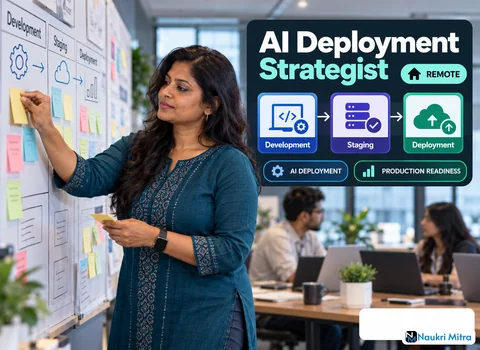
A pilot that wins applause in a demo and never reaches the operations floor costs a company twice: once for the build, and again for the credibility of the next AI proposal. This listing is one of the remote AI deployment strategist jobs created to prevent that. The post is full-time, fully remote and open in any country at $110,000 per year (USD), for someone with four to six years in consulting, solutions or product strategy and real exposure to enterprise AI work. You will help client leaders pick the use case worth funding, prove its value with data and carry it into production.
Most large organisations hold more AI proposals than they can fund. The project team behind this AI deployment strategist job description wants one person who can rank those ideas, attach a value to each and tell leaders, with evidence, which deserves next quarter's money.
Engineers build and integrate. You decide, with the client, what is worth building, who must agree, how success is measured and when a pilot has earned the right to scale. The output is a decision a finance director can audit.
The AI deployment strategist skills checked first are commercial judgement and comfort with raw data.
The AI deployment strategist salary per year here is $110,000 (USD) for full-time work, close to ₹1.05 crore when a dollar fetches around ₹95, a conversion that drifts. Because these are AI deployment strategist jobs remote worldwide, some client calls will fall early or late in your day; most teams agree a few hours of daily overlap.
You need a reliable laptop, backup internet, a good headset and a quiet room, and you will work in a SQL client, spreadsheets, slides and a shared workspace such as Notion or Confluence. Unlike many AI deployment strategist work from home jobs with vague pay, this one states its figure, and travel is not listed as a requirement.
Below is a condensed, illustrative case for an AI claims-triage assistant. The insurer receives 18,000 claims a month. Triage averages 14 minutes, and 9% of claims reach the wrong team.
The baseline came from a SQL pull of twelve months of claims, grouped by channel and claim type. The query took an afternoon; getting the head of claims operations to accept it took a week. The first rubric line in the team's template reads: "Every figure has a named owner and a source table."
At 14 minutes a claim, triage eats 4,200 handler hours a month, and the claims director wanted six more handlers. Three options went to the steering group:
Stakeholder mapping shaped the third option early. Compliance required a human to confirm every routing decision, and IT security wanted claims data kept in the insurer's own cloud region.
A six-week pilot with two regional teams covered 2,400 claims. Triage time fell from 14 to 6 minutes and misrouting from 9% to 5%. Handlers overrode 11% of suggestions, mostly multi-vehicle incidents. At full volume:
The call was a conditional go: scale to all motor claims, hold misrouting under 6% for four straight weeks, and keep senior sign-off on claims above $10,000. One steering member's only comment on the draft was "show me month seven, not month one", so the deck added a post-launch savings slide.
Consultants usually need stronger SQL and a grasp of how AI models are evaluated. Solutions engineers need sharper business-case writing. An MBA helps commercially and a technical degree helps when engineers challenge your sizing, but shipped projects matter most.
No single AI deployment strategist course is required, and an AI deployment strategist certification is optional. Useful picks are AI for Everyone on Coursera, Google Cloud's Generative AI Leader or AWS Certified AI Practitioner, and any SQL course with real datasets. Searches for entry level remote AI deployment strategist jobs mostly surface associate or intern titles. Anyone chasing AI deployment strategist jobs no experience is better off starting as an analyst at a consultancy or AI vendor.
A strong AI deployment strategist resume lists decisions with numbers: "Built business case for AI document routing; pilot cut processing time 38%; scaled to 1,200 users." Typical AI deployment strategist interview questions include:
Expect a take-home case too, often a small dataset and a five-slide recommendation, about three to four hours of work.
A forward deployed engineer writes code inside client systems. The strategist owns the problem, business case, stakeholders and rollout, and the two often pair up. Palantir has long used both titles, Scale AI advertises deployment strategist roles for enterprise teams, and OpenAI hires AI Deployment Managers for similar work. None of them is the employer here.
Growth runs from strategist to senior strategist, then deployment lead across several clients, and later head of AI transformation or product leadership.
Treat it as fake if an "offer" demands a registration or kit fee, asks for your UPI PIN or a banking OTP, lives only on Telegram or WhatsApp, charges to access a case study, or arrives without an interview. This listing costs candidates nothing.
Applying costs nothing; send a one-page resume and a short note on one AI project you moved from pilot to production, with the number that proved it. Remote AI deployment strategist jobs hiring now still deserve a careful application, and selection is never guaranteed.