📚 Table of Contents
- How These Two Work Models Actually Function
- Income Comparison: What Actually Pays More?
- Stability vs Flexibility: What Matters More in Real Life
- The Role of Skills in Determining Earnings
- Global Opportunities and Earning Potential
- Work-Life Balance and Day-to-Day Reality
- Long-Term Growth and Career Direction
- A Realistic Look at Earnings
- So, Which One Actually Pays Better?
- Final Thoughts
Freelancing vs. Remote Employment: Which Pays Better?
The way people earn a living has changed more in the last ten years than in the previous few decades combined. Work is no longer tied to a physical office, and career choices are no longer limited to traditional job roles. Today, two paths dominate the digital economy—freelancing and remote employment. At first glance, both look similar. You work from home, use digital tools, and serve clients or companies online. But when you look closely at income patterns, lifestyle, and long-term stability, the differences become much more important. So the real question isn’t just which pays better today—it’s which one can sustain and grow your income over time.How These Two Work Models Actually Function
Before comparing earnings, it helps to understand what each path really looks like in practice. Freelancing is independent work. You are not tied to one company. Instead, you work with multiple clients, often on short-term or project-based assignments. One week you might be writing content for a startup, and the next you could be designing a landing page for an overseas business. Income depends entirely on the number of projects you take and the rates you negotiate. Remote employment, on the other hand, is more structured. You are hired by a company, but instead of going to an office, you work from home or anywhere with internet access. Your salary is fixed and usually paid monthly, along with possible benefits such as paid time off or bonuses. Both give freedom from office life, but the way money flows into your account is very different.Income Comparison: What Actually Pays More?
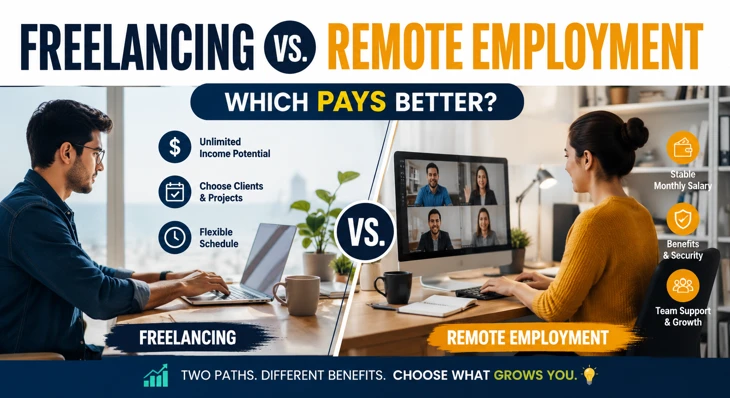
This is where things get interesting. There is no single answer because earnings depend heavily on experience, skill level, and consistency. Freelancers often start slow. Early income can feel unpredictable, and building a stable client base takes time. But once credibility builds, income potential expands quickly. Many experienced freelancers gradually move into higher-paying international markets, especially when they develop specialized skills. A key long-tail search trend —that freelance income increases with experience and niche specialization —reflects this reality: earnings are not fixed; they evolve with demand and positioning. Remote employees usually earn a predictable salary from day one. Even entry-level roles provide a stable monthly income. This makes financial planning easier and reduces uncertainty. However, salary increases tend to follow company structures, which means growth is steady but not always fast. In simple terms, freelancers can potentially earn more, but remote employees earn more consistently.Stability vs Flexibility: What Matters More in Real Life
Money is only part of the story. How that money comes in every month plays a huge role in decision-making. Freelancing offers freedom that many people find attractive. You decide your workload, choose your clients, and set your own schedule. Some months can be highly profitable if you take on multiple projects. But there are also quieter periods when income slows. This unpredictability is something every freelancer learns to manage over time. Remote jobs feel more structured. You know exactly how much you will earn each month, regardless of workload variations. That consistency brings comfort, especially for people with fixed financial responsibilities. The trade-off is less flexibility in how work is scheduled and how income grows.The Role of Skills in Determining Earnings
Skill level is one of the strongest factors influencing income in both career paths. In freelancing, specialized skills often translate directly into higher rates. For example, professionals in SEO, UI/UX design, software development, or performance marketing tend to command better pay than generalists. A common long-tail keyword pattern, such as "best high-income freelance skills for beginners and professionals," highlights how important skill selection is for long-term success. Remote employees also benefit from strong skills, but salaries are usually tied to job roles rather than individual negotiation. A software engineer or data analyst in a remote company may earn a high income, but the pay range is often predefined. So while skills matter everywhere, freelancers have more direct control over how those skills are priced.Global Opportunities and Earning Potential
One of the biggest advantages of digital work is access to global markets. Freelancers can work with clients from different countries, which often means earning in stronger currencies. This can significantly increase income potential compared to local markets. For example, a freelancer based in a lower-cost region may charge international clients at global rates, creating a strong income advantage. Remote employees working for international companies also benefit from global exposure, but salaries are usually fixed within company pay bands. This makes income stable but less flexible.Work-Life Balance and Day-to-Day Reality
Freelancing and remote employment also differ in how they shape daily life. Freelancers enjoy full control over their time. There is no strict schedule, which allows them to work at their own pace. However, this also means independently managing deadlines, client communication, and workload distribution. Remote employees follow a more structured routine. Work hours are usually defined, and tasks are assigned within a team environment. This creates stability but reduces flexibility during peak work periods. Neither model is perfect—it depends on whether you value independence or structure more in your daily routine.Long-Term Growth and Career Direction
Over time, both paths offer different types of growth. Freelancers grow by increasing their rates, building long-term client relationships, and expanding their service offerings. Many eventually move into consultancy or even start agencies. Income growth can be significant, but it depends heavily on self-marketing and consistency. Remote employees grow within organizational structures. Promotions, skill upgrades, and role changes gradually increase income. While this path is more predictable, it is also slower compared to successful freelance scaling.A Realistic Look at Earnings
To make this clearer, imagine two professionals with similar digital marketing skills. One works as a freelancer, taking multiple clients across different countries. Income varies month to month but has the potential to grow significantly as the client base expands. The other works remotely for a company with a fixed salary and steady workload. Income is stable, predictable, and secure, but growth depends on internal promotions. Over a long period, both can succeed financially—but the journey looks very different.So, Which One Actually Pays Better?
Instead of looking for a single winner, it’s more useful to think in terms of priorities. Freelancing tends to pay better when:- You have strong, in-demand skills
- You can consistently find and manage clients
- You are comfortable with income variation
- You prefer financial stability
- You want a predictable monthly income
- You value structured career growth