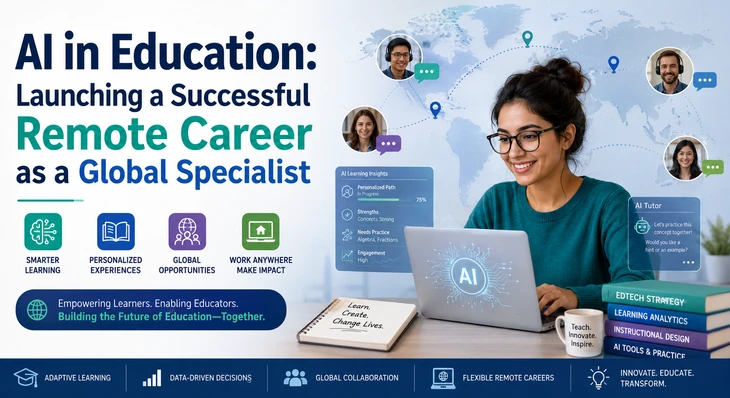
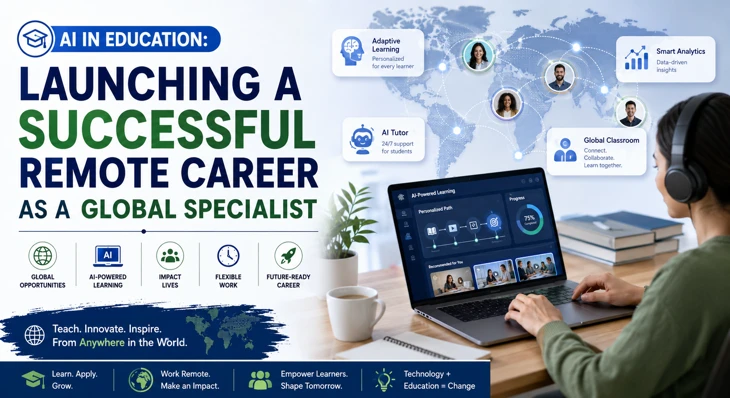
AI in Education: Launching a Successful Remote Career as a Global Specialist
Introduction
A few years ago, the idea of building a stable career entirely from your laptop while contributing to global education would have sounded unusual. Today, it is becoming normal. Artificial intelligence is quietly reshaping classrooms, learning apps, and even how teachers prepare lessons. And with that shift, a new kind of opportunity has opened up for professionals everywhere.
AI in education is no longer just a technical concept. It is something students interact with daily—sometimes without even realizing it. From personalized study plans to intelligent tutoring tools, AI is now part of how knowledge is delivered. And behind all of this, there is a growing demand for people who understand both education and technology.
That is where remote careers in AI education come in. You don’t need to be in a specific country or office. You just need the right skills, curiosity, and the ability to work with global systems that are changing how learning happens.
How AI is Quietly Reshaping Education
If you look closely at modern learning platforms, you’ll notice something interesting—they all feel slightly different for each learner. That is AI at work.
Instead of one fixed lesson for everyone, systems now adjust based on how a student performs. If someone struggles, the content slows down. If someone learns quickly, the difficulty increases. It feels almost like a personal tutor sitting beside each student.
Some of the most common real-world uses include:
- Learning apps that adjust difficulty based on progress
- Tools that give instant feedback on assignments
- Systems that highlight weak areas before exams
- Platforms that translate lessons into multiple languages
- Smart grading tools that reduce teacher workload
What makes this powerful is not just the technology, but the experience it creates. Learning becomes less stressful and more adaptive. And naturally, this shift is creating demand for professionals who can design and manage such AI systems in education careers.
Why Remote AI Education Jobs Are Growing So Fast
Education has always been tied to physical spaces. But that boundary is fading quickly.
Schools, universities, and edtech companies are now working with teams spread across different countries. A curriculum designer in India might work with a developer in Europe and a data analyst in the US—all on the same project.
There are a few clear reasons behind this shift:
The rise of online learning platforms has completely changed how education is delivered. At the same time, AI tools are becoming more accessible and easier to integrate into learning systems. Companies now want people who can help them build smarter education experiences, not just traditional content.
Another big reason is talent demand. There are not enough professionals who deeply understand both education and AI. This gap is creating significant opportunities for remote AI education jobs worldwide.
And perhaps the most important factor—companies now trust remote work. Results matter more than location.
Skills That Actually Matter in This Field
One of the most common misconceptions is that you need to be highly technical to enter this field. That is not entirely true.
What you really need is a mix of understanding how people learn and how digital systems support that learning.
Technical awareness helps, but doesn’t have to be advanced
You should be comfortable with:
- Basic ideas of how AI systems work
- Understanding data patterns at a simple level
- Using digital learning tools and platforms
- Knowing how AI supports content delivery
You don’t need to build algorithms. But you should understand what they are doing behind the scenes.
Education knowledge is equally important
This includes:
- Knowing how students learn and retain information
- Designing lessons for online environments
- Structuring content in a logical flow
- Evaluating learning outcomes
Soft skills make the difference
In remote global AI specialist jobs, communication matters a lot. You will often work with people from different cultures and time zones. So clarity, patience, and adaptability are key.
Career Paths You Can Explore
The field of AI in education careers is wide. You don’t have just one path—you have several directions depending on your background.
Some people move into consulting roles where they help schools adopt AI tools. Others work on designing digital learning experiences that adjust automatically for each student.
There are also roles focused on analyzing learning data. These professionals study how students interact with content and suggest improvements that make courses more effective.
In edtech companies, product-focused roles are growing quickly. These professionals ensure that AI tools are not just technically strong but also easy for learners to use.
And then there are remote tutoring and mentoring roles where AI tools assist educators in supporting students from around the world.
Each of these paths supports remote AI education jobs and offers flexibility that traditional careers often don’t.
How People Actually Build a Remote Career in AI Education
Starting something new always feels uncertain, especially in a fast-changing field. But most successful professionals follow a simple, steady path.
It usually begins with learning the basics—not in a rushed way, but with curiosity. Understanding how AI supports education is more important than memorizing technical details.
After that, practice becomes essential. Many people start small—creating sample lesson plans, analyzing mock datasets, or exploring how learning platforms function.
Over time, they build a portfolio that shows real thinking, not just certificates. This becomes their entry point into global AI specialist remote jobs.
Working with remote tools also becomes part of the journey. Platforms like Slack, Notion, Zoom, and Trello are not just tools—they are how global teams stay connected.
Eventually, opportunities start to appear on job platforms, through referrals, and via direct company applications. Consistency plays a bigger role than speed here.
Real Examples That Show the Impact
To better understand this field, it helps to look at real-world situations.
In one case, an online learning platform used AI to adjust math lessons in real time. Students who struggled received simpler explanations, while advanced learners were given more complex problems. This small change improved engagement significantly.
In another situation, a learning analyst noticed that students were dropping out of a course at a specific point. After reviewing the data, the content was redesigned. Completion rates improved noticeably after that.
Language learning apps are also using AI to help learners improve pronunciation instantly. Instead of waiting for feedback from a teacher, students get corrections immediately.
These examples show how AI in education careers directly influence learning outcomes across the world.
Challenges You Should Be Ready For
No career path is completely smooth, and this one is no exception.
One challenge is the speed of change. Tools and platforms evolve quickly, so continuous learning is part of the job.
Another challenge is collaboration across time zones. Working with global teams means adjusting schedules and communication styles.
There is also the challenge of balancing educational knowledge with technology understanding. It takes time to become comfortable in both areas.
But none of these are barriers. They are just part of the learning curve in remote AI education jobs.
What the Future Looks Like
If current trends continue, education will become even more personalized. Instead of fixed courses, learners will experience adaptive learning journeys shaped by AI.
We will likely see systems that act like digital mentors, guiding students through subjects step by step. Teachers will also use AI more as a support system rather than a replacement.
For professionals in this field, this means more opportunities—not fewer. Demand for people who understand AI in education careers will continue to grow globally.
FAQs
What is a remote AI education career?
It refers to jobs in which professionals work with AI-powered learning systems from anywhere in the world.
Do I need technical skills for this field?
Not always. Some roles require technical knowledge, but many focus on teaching, design, or analysis.
What kind of jobs exist in this space?
Roles like instructional designer, AI education consultant, learning analyst, and edtech specialist are common.
Can teachers switch into this field?
Yes, teachers often transition smoothly because they already understand how learning works.
Is this a long-term career option?
Yes, because education is becoming more digital and AI-driven every year.
Conclusion
AI is not just changing education—it is quietly rebuilding it. And with that change comes a real opportunity for professionals who want flexible, meaningful, and global work.
A remote career in AI education is not limited to one type of person. Whether you come from teaching, content creation, or technology, there is space for you to grow.
What matters most is staying consistent, staying curious, and being open to learning new systems as they evolve. Over time, this field can become a stable and rewarding global career path in AI education and remote AI education jobs.