📚 Table of Contents
- Introduction
- Real Career Stories in Cybersecurity
- Why Communication Can Make or Break Your Cybersecurity Career
- Simple Ways to Land a Remote Cybersecurity Role Faster
- How to Overcome Doubts When Starting in Cybersecurity
- Everyday Analogies That Make Cybersecurity Simple
- How to Stand Out With Authentic Applications
- Essential Skills and Tools for Remote Cybersecurity Analysts
- What the Future Holds for Remote Cybersecurity Careers
- Step-by-Step Roadmap to Your First Remote Cybersecurity Role
- Final Thoughts: Start Your Remote Cybersecurity Career Today
How to Get Hired as a Remote Cybersecurity Analyst
Introduction
Ever felt stuck scrolling through job boards, wondering how to land a stable, flexible cybersecurity career without leaving home? You’re not alone. Many people want to break into tech but feel weighed down by jargon, endless certifications, and unclear job requirements. The reality is encouraging: demand for remote cybersecurity analysts has exploded, and companies are eager to hire skilled professionals who can protect their systems from anywhere in the world. The challenge? Most beginners are unsure of where to start. They see listings for cybersecurity jobs from home or remote information security career opportunities and assume decades of experience are required. In truth, motivated newcomers can absolutely break into this space. Let’s walk through how.Real Career Stories in Cybersecurity
Take Alex, a former teacher who switched careers after seeing his school targeted by phishing scams. He started with free resources, earned an entry-level certification, and applied for entry-level cybersecurity remote roles. Within six months, Alex secured his first virtual security analyst position at a mid-sized company, where he now works from home, protecting financial data. Alex isn’t alone—Priya had a similar journey. With a cloud computing background, she explored cloud security remote opportunities and quickly transitioned into compliance work. Today, she balances flexible hours with a strong career in remote cyber defense. Miguel, once an IT support technician, sought more growth opportunities than his commuting job provided. After learning SIEM tools, he landed a SOC analyst remote position. His message: persistence and steady effort matter more than having the perfect résumé.Why Communication Can Make or Break Your Cybersecurity Career
Ever wondered why so many people struggle to break in? It isn’t just about mastering technology. Employers also want people who can explain complex risks in plain English. Think about it: could you explain a phishing attack to someone with no technical background? Can you translate complex jargon into clear, actionable steps? If you can, you already have an edge. That’s why hiring managers for an IT security analyst remote job often prize problem-solving and communication skills just as much as technical expertise. So what’s holding you back? Fear of rejection? Waiting for the “perfect time”? Even the best in the field once faced the same doubts.Simple Ways to Land a Remote Cybersecurity Role Faster
Don’t wait until you “know everything.” Even the pros are still learning—cybersecurity shifts every single day. The shortcut? Pick a clear path. You may want to try being a freelance cybersecurity consultant. Or a SOC analyst remote position matches your skills. Don’t chase every role at once. Learn the basics, build a small project portfolio, and you’ll be surprised how quickly opportunities appear. Another quick win: join online forums and communities. Share what you’re learning, ask thoughtful questions, and show your curiosity. Employers notice proactive learners.How to Overcome Doubts When Starting in Cybersecurity
It’s normal to feel stuck. You scroll through job boards filled with listings like penetration tester roles or threat monitoring specialist positions, and it seems like everyone else is already miles ahead. Maybe you wonder if you’ll ever measure up. But here’s reality: hiring managers aren’t chasing perfection. They seek someone curious, adaptable, and willing to improve continually. Think of network security remote jobs—recruiters wish to learners, not buzzword-repeaters. If you’ve told yourself, “It’s too late for me,” remember this: cybersecurity isn’t slowing down. Every new app or device creates fresh risks. That means there’s always room for someone willing to learn. Quick mindset reminders:- Everyone starts as a beginner
- Employers value persistence over perfection.
- Doubt is normal—progress comes with action.
Everyday Analogies That Make Cybersecurity Simple
Cybersecurity doesn’t have to feel abstract. Learning it is a lot like prepping for an exam—you don’t need to cram the whole book, focus on the sections that really matter. Similarly, targeting high-demand cybersecurity skills will yield better results than attempting to master every tool at once. A remote risk assessment analyst is like a safety inspector in a factory—except you’re checking servers and software instead of physical objects. Picture working as a work-from-home security analyst. It’s like being the hall monitor in school. You keep watch, call out suspicious behavior, and make sure everyone follows the rules. A remote data protection specialist? Think of it as guarding a family safe. Instead of jewelry, you’re protecting sensitive data from theft. And a remote risk assessment analyst is like a factory safety inspector—except you’re checking servers and software rather than machines.How to Stand Out With Authentic Applications
Want to grab attention? Don’t fall back on generic templates. Employers can spot copy-paste resumes instantly. Instead of saying, “I handled vulnerability assessments,” say, “During a simulated project, I identified and patched over 20 vulnerabilities, reducing system risk by 35%.” That’s specific, measurable, and compelling. If you’re applying for cybersecurity compliance roles, emphasize your knowledge of regulations such as GDPR or HIPAA. Show you understand real-world requirements. Hiring managers appreciate concrete examples more than buzzwords.Essential Skills and Tools for Remote Cybersecurity Analysts
To excel as a remote cybersecurity analyst, you’ll need both technical and people skills. At Naukri Mitra, we’ve tracked what employers prioritize, and here are some essentials:- Compliance Knowledge → Familiarity with ISO 27001, NIST, or GDPR is crucial.
- Vulnerability Management → Tools like Nessus, Qualys, or OpenVAS help identify system weaknesses.
- Information Assurance → Balancing usability with security is a valued skill.
- Forensics → Tools like EnCase or Autopsy enable incident investigations.
- Certifications → Security+, CEH, and CISSP demonstrate credibility.
- Endpoint Security → Protecting laptops, mobiles, and remote connections is more important than ever.
- Compliance frameworks (ISO, GDPR, NIST)
- Vulnerability scanners (Nessus, Qualys)
- Forensics tools (EnCase, Autopsy)
- Communication with non-technical teams
What the Future Holds for Remote Cybersecurity Careers
Remote cybersecurity isn’t a temporary trend—it’s the future. Organizations are increasingly relying on distributed teams to defend against threats, and the role of a remote cybersecurity analyst is growing rapidly.- Certifications like Security+, CISSP, or CEH make candidates stand out.
- Roles such as remote endpoint security specialists are becoming increasingly essential as the work-from-home trend continues to grow.
- The growing adoption of cloud technology is driving demand for remote security operations center roles and online cyber defense jobs.
Step-by-Step Roadmap to Your First Remote Cybersecurity Role
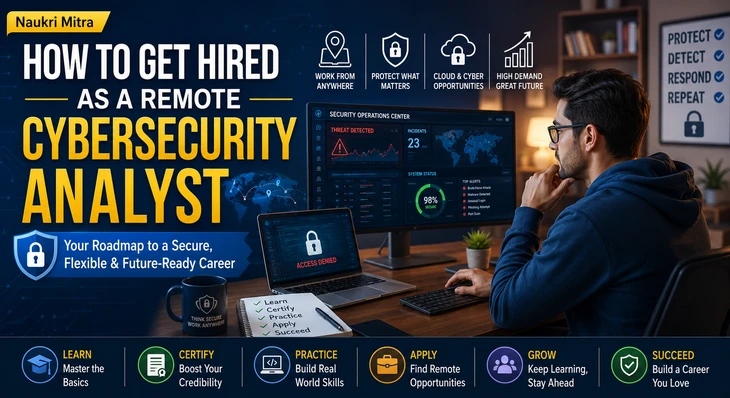
Getting started may feel overwhelming, but breaking it down helps. Here’s a simple roadmap:- Master the Basics → Networking, firewalls, common attack types.
- Choose a Focus → SOC, compliance, penetration testing, or assessment roles.
- Earn Certifications → Start with Security+ or CEH, then advance as needed.
- Build a Portfolio → Publish GitHub projects, write short blogs, or document case studies.
- Apply Strategically → Use trusted job boards like Naukri Mitra to find work-from-home cybersecurity opportunities.
- Prepare for Interviews → Focus on explaining scenarios, not just memorized answers.
- Keep Growing → Attend webinars, join online events, and continually add new skills.