📚 Table of Contents
- Introduction
- Real-World Impact & Stories
- How Digital Twins Power Everyday Systems
- Simple Truths for Beginners
- Overcoming Beginner Doubts
- Relatable Examples
- Straightforward Career Insights
- Key Skills / Tools / Insights
- Career Growth / Future Scope
- Step-by-Step Guide / How to Start
- Conclusion + Call-to-Action
Digital Twin Specialists: Exploring the Future of Remote Careers
Introduction
Technology is rewriting the rules of work faster than most of us expected. Entire industries are moving away from traditional setups and embracing digital-first strategies. Right in the middle of this change are Digital Twin Specialists. As companies lean into remote-first technology and innovative manufacturing, new career paths are emerging at a record pace. If you’re drawn to problem-solving, engineering, and remote innovation, this career space is worth exploring.Real-World Impact & Stories
Take the example of a European energy plant that nearly faced a system failure due to a turbine fault. Using its digital twin, engineers spotted unusual vibration patterns days before the real turbine would have broken down. That insight prevented millions in losses. Hospitals are also turning to digital twin models to test treatments. By simulating patient care scenarios, doctors can refine strategies before applying them to real patients. In aerospace, engineers now test entire aircraft virtually, saving years of design time. Automotive manufacturers rely on virtual modeling jobs to experiment with new vehicle designs, cutting costs and speeding up innovation. These aren’t theoretical ideas—they’re real examples of how Industry 4.0 professionals and remote monitoring specialists are transforming global industries.How Digital Twins Power Everyday Systems
Think about the unseen systems that keep planes airborne, city traffic flowing, or energy grids from collapsing. Behind all of these are teams of cyber-physical systems experts, simulation engineers, and real-time data analysts. Their work ensures complex networks run smoothly without us even noticing. It’s demanding work. Decisions must be based on accurate data, and mistakes can be costly. However, as automation and robotics expand, those who can adapt and learn quickly will have incredible opportunities ahead. The spread of smart city development jobs demonstrates how digital twins are becoming an integral part of daily life, from traffic design to sustainable energy use. Digital twin technology is also reshaping sports and entertainment. Stadiums now utilize these tools to predict crowd movement, enhance safety, and enhance fan experiences. These applications show the field's diversity—it’s not just factories and energy plants, but also smart infrastructure workforce roles that touch everyday life.Simple Truths for Beginners
You don’t need to be brilliant to start in this field. What matters most is curiosity and the willingness to learn. Many specialists began with modest projects—such as cloud-based engineering experiments or product lifecycle management tasks—before advancing to more advanced roles. Even modeling something as simple as household energy use can provide a practical foundation for tackling bigger challenges later. The good news? Entry into this career often comes through gradual exposure. You may start in a supporting role, working alongside simulation engineers, and then build expertise in predictive maintenance or digital transformation workforce projects. Over time, you’ll acquire the depth needed to lead larger initiatives.Overcoming Beginner Doubts
If you feel intimidated by cloud simulation platforms or sustainable technology careers, you’re not alone. Every professional once started at zero. Even the best data-driven decision makers struggled early on. What helped them succeed was persistence, practice, and the ability to learn from mistakes. Employers today aren’t expecting perfection—they want people who can keep learning as technology evolves. It also helps to remember that industries are looking for adaptability as much as technical mastery. Employers understand that technology is evolving fast, so they value people who can learn quickly and stay flexible as new tools emerge. The learning curve might feel steep, but once you gain momentum, opportunities open quickly.Relatable Examples
Think about school group projects. If one person didn’t do their part, the entire project suffered. Now scale that up to a factory. That’s why predictive maintenance roles and remote monitoring specialists matter so much. They keep things on track, just like that dependable classmate who checked everyone’s work. Similarly, virtual prototyping engineers test product designs virtually before they’re ever manufactured, thereby avoiding costly mistakes. City planning works the same way. Students once built cardboard models to test layouts. Today, engineers use full-scale digital twins of neighborhoods to predict traffic, energy consumption, and waste management. It’s the same principle—only applied with modern tools and far higher stakes. Another example can be drawn from sports training. Athletes and coaches now use digital twins of the human body to test performance strategies and reduce injury risks. Just as students practice mock exams before finals, professionals test scenarios in safe, virtual environments before trying them in real life.Straightforward Career Insights
Success as a specialist comes down to knowing which tools matter most. Technical ability is essential, but so are communication and creativity. You need to translate complex models into insights that decision-makers can easily understand and utilize. Employers are seeking candidates who can effectively integrate technology with practical problem-solving skills.Key Skills / Tools / Insights
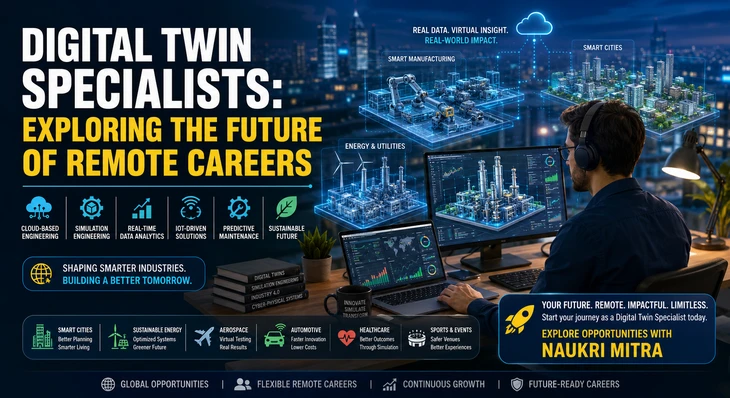
Core skills every aspiring specialist should build include:- Cloud-based engineering: creating scalable digital replicas.
- Simulation engineering: accurately modeling real-world processes.
- Connected workforce solutions: collaborating seamlessly across borders.
- Real-time data analysis careers: interpreting live streams of information.
- Industrial Metaverse Opportunities: Designing Within Immersive Environments.
Career Growth / Future Scope
The future for Digital Twin Specialists is bright. Remote work technology has already changed offices, and now it’s changing factories, hospitals, and cities. Roles in innovative city development, automation, robotics, and sustainable technology are expanding rapidly. Analysts predict that the digital twin industry could exceed $100 billion globally by 2030, underscoring just how rapidly adoption is accelerating. Insights from Naukri Mitra confirm growing demand for predictive maintenance, IoT-driven careers, and product lifecycle management specialists. This surge is fueling a growing digital transformation workforce, creating secure career paths for specialists worldwide. Beyond traditional industries, the industrial metaverse is emerging as a new frontier. Here, specialists will design immersive replicas of factories, cities, and even ecosystems. These environments will enable massive-scale experimentation, creating jobs that didn’t exist just a few years ago.Step-by-Step Guide / How to Start
Here’s a simple path into the field:- Start with the basics: Learn about digital replicas and cloud simulation platforms through introductory engineering courses.
- Experiment: Run small personal projects or join open-source modeling efforts.
- Network: Connect with Industry 4.0 professionals and cyber-physical systems experts.
- Apply for internships or entry-level IoT-driven careers to gain hands-on experience.
- Stay current: Follow advances in real-time analytics, automation, and sustainability.
- Find mentors: Guidance from experienced professionals accelerates growth.
- Keep building: As your confidence grows, aim for larger projects involving predictive maintenance or virtual prototyping engineers.