📚 Table of Contents
- Introduction
- Understanding Remote AR/VR Development in Real Terms
- Skills You Actually Need to Enter Remote AR/VR Development
- Core Technical Skills
- Soft Skills That Matter More Than People Expect
- Tools That Power Remote AR/VR Development Workflows
- Step-by-Step Path to Start Your Career
- Start With the Basics
- Build Small, Real Projects
- Build a Portfolio That Shows Your Work
- Apply for Remote Opportunities
- How AR/VR Is Being Used in the Real World
- Challenges You Should Be Ready For
- The Learning Curve Feels Heavy at First
- Hardware Can Be a Limitation
- Performance Optimization Is Tricky
- Communication Across Teams
- Practical Tips to Grow Faster in This Field
- Future of Remote AR/VR Development Careers
- FAQs
- What is remote AR/VR development in simple terms?
- Do I need coding experience to start?
- Which is better for beginners: Unity or Unreal Engine?
- Can AR/VR development be done completely remotely?
- How long does it take to become job-ready?
- Conclusion
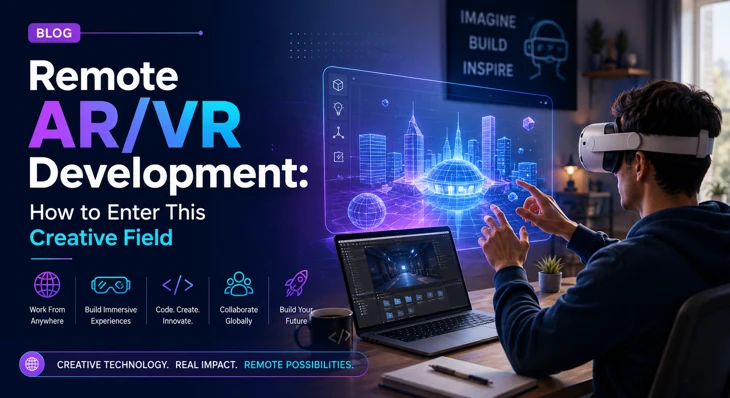
Remote AR/VR Development: How to Enter This Creative Field
Introduction
Remote AR/VR development is no longer something experimental or limited to gaming studios. It has quietly become one of the most practical and fast-growing career paths in modern tech. From virtual classrooms to immersive product demos, companies are actively investing in augmented reality (AR) and virtual reality (VR) experiences that can be built and managed by distributed teams. What makes this space especially interesting is how naturally it fits a remote work culture. A developer sitting in Bhopal, Berlin, or Boston can contribute to the same VR product without ever stepping into an office. That shift has opened doors for beginners and experienced developers alike. At its core, remote AR/VR development blends creativity, storytelling, and technical problem-solving. You are not just writing code—you are building digital worlds people can step into.Understanding Remote AR/VR Development in Real Terms
When people hear “AR/VR development,” it often sounds complex or overly technical. In reality, it’s closer to building interactive 3D experiences that respond to users in real time. In remote setups, the workflow is surprisingly collaborative. One developer may be working on environment design, another on interaction logic, while someone else handles optimization or 3D assets. Everything comes together through cloud tools and shared repositories. Remote AR/VR development is widely used in:- Immersive gaming experiences
- Virtual training simulations
- Remote education platforms
- Healthcare visualization tools
- AR-based shopping and try-before-you-buy apps
Skills You Actually Need to Enter Remote AR/VR Development
Many beginners assume they need advanced degrees or expensive equipment to get started. That’s not true. What matters more is consistency and a structured learning path.Core Technical Skills
Most AR/VR development work is built on game engines. If you understand one of them deeply, you are already ahead of many beginners. Key skills include:- Unity 3D (very widely used in AR/VR development)
- Unreal Engine for high-end immersive projects
- C# programming for Unity-based applications
- Basic C++ for Unreal Engine workflows
- Understanding 3D space, physics, and interactions
- AR toolkits like ARCore (Android) and ARKit (iOS)
Soft Skills That Matter More Than People Expect
Remote AR/VR development is not just technical—it’s highly collaborative. You will need:- Clear communication in distributed teams
- Ability to explain technical issues simply
- Time management without supervision
- Problem-solving mindset when things break (and they often do)
- Patience while debugging complex 3D interactions
Tools That Power Remote AR/VR Development Workflows
Behind every immersive experience is a stack of tools that make remote collaboration possible. Some of the most commonly used tools include:- Unity and Unreal Engine for building experiences
- Blender for 3D modeling and animation
- GitHub for version control and team collaboration
- Figma for interface and UX planning
- Slack or Discord for day-to-day communication
- Cloud services like AWS or Azure for deployment and storage
Step-by-Step Path to Start Your Career
There is no single “correct” way to enter this field, but there is a clear progression most developers follow.Start With the Basics
Before jumping into AR/VR, get comfortable with programming fundamentals. Learn how logic, variables, and functions work. Then move into a game engine like Unity. Start by exploring simple scenes and understanding how objects behave in 3D space.Build Small, Real Projects
This is where learning becomes real. Try building:- A simple VR room you can walk through
- An AR filter that places objects in real space
- A basic interactive 3D puzzle
Build a Portfolio That Shows Your Work
In remote AR/VR development, your portfolio speaks louder than certificates. Include:- Short demo videos
- GitHub project links
- Simple explanations of what each project does
Apply for Remote Opportunities
Once you have a few projects, start exploring freelance platforms and remote job boards. You can also join AR/VR communities where small startups often post collaboration opportunities. Many developers land their first remote AR/VR role through networking rather than formal applications.How AR/VR Is Being Used in the Real World
The real power of AR/VR is not just entertainment—it’s practical problem-solving. In education, students can walk through ancient cities rather than just read about them. In healthcare, surgeons can practice procedures in controlled virtual environments. In retail, customers can see how furniture looks in their homes before buying. Even real estate companies now offer virtual walkthroughs, saving time for both buyers and agents. Remote AR/VR developers quietly power all of these experiences. Their work often goes unnoticed, but it directly shapes how users interact with digital content.Challenges You Should Be Ready For
Every exciting field comes with its own learning curve, and AR/VR is no exception.The Learning Curve Feels Heavy at First
You are dealing with programming, design, physics, and user experience all at once. It can feel overwhelming at first.Hardware Can Be a Limitation
Not everyone has access to high-end VR headsets or testing devices, especially when working remotely.Performance Optimization Is Tricky
Even small mistakes can lead to lag or discomfort in VR environments. This requires careful tuning and testing.Communication Across Teams
Working remotely means depending heavily on written communication. Misunderstandings can slow progress if instructions are unclear. Despite all this, most developers find that consistency solves more problems than talent alone.Practical Tips to Grow Faster in This Field
If you want to grow faster in remote AR/VR development, focus less on theory and more on building.- Keep experimenting with new ideas
- Rebuild small features from real apps you admire
- Stay active in developer communities
- Watch how experienced developers structure their projects
- Don’t wait for perfect knowledge before starting