
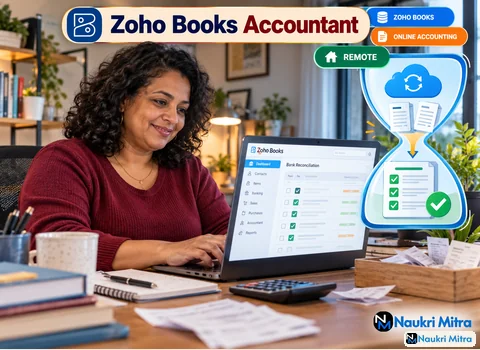
What does a client's ledger look like on the last day of the month? When the bank feed has done its job, most transactions are already sitting in the right accounts, waiting for a quick review and a click. When it hasn't, you open Banking to a pile of uncategorised lines, a transfer that shows up twice, and a vendor payment nobody can explain. This listing is for people who like turning the second picture into the first. It is one of our remote zoho books accountant jobs, Full-time, with no country restriction, done entirely online and paid at $450 per month (USD). The work is invoicing, bank feeds, GST preparation, inventory and monthly reports for clients who run their books in Zoho Books.
In short, you keep the ledger true, every day, so month end is a review and not a rescue. A Zoho Books accountant creates sales and purchase documents, matches the bank feed to them, keeps item and stock records in line with reality, gets GST data ready for filing, and hands the client a set of reports they can act on. You also answer questions in plain English, because the person reading your P&L is usually a business owner, not another accountant.
Full-time here means you hold a regular share of client files and are around during working hours for queries.
Most days start in the Sales module. You raise invoices from quotes or sales orders, apply the right tax treatment to each line, and send them from inside Zoho Books so the client's customer gets a clean PDF and a payment link if the client uses one. When goods come back or a price was wrong, you issue a credit note and apply it against the open invoice instead of editing history.
Receivables are where small mistakes grow. You will watch the ageing view, set up payment reminders the client has approved, and flag customers who keep slipping. A short note listing who is past due is often worth more than any report.
On the other side, you record bills from suppliers, attach the scanned copy, and code each line to the correct expense or item. Vendor credits get the same care as credit notes on the sales side. Getting input tax right at this stage saves rework later, because GST figures are only as good as the bills behind them.
The bank feed is where most of the daily work happens. Zoho Books pulls in statement lines, suggests matches with existing invoices and bills, and lets you write rules for repeat items such as rent, software subscriptions or bank charges. Your job is to accept the right suggestions, correct the wrong ones, and build rules carefully so they do not quietly misfile things for months.
Reconciliation follows. You compare the closing balance in Zoho Books with the statement, chase down the difference, and leave a note for anything you cannot settle without the client. A good habit: never mark an account reconciled while a mystery line is still parked in a suspense account.
Clients who sell physical goods depend on the Items screen. You set up items with the right units, tax rates and HSN or SAC codes, track stock movements from sales and purchases, and run adjustments when a physical count does not match the system. Stock errors flow straight into cost of goods sold, so a wrong adjustment shows up in the margin the client sees.
For Indian clients, you prepare GST reports from Zoho Books for filing: checking outward supplies, reviewing input tax credit against supplier data, and fixing tagging errors before anything is submitted. You do not need to memorise every rule, but you do need to know where to look. GST requirements, due dates and thresholds change, so always confirm the current position on the official GST portal or with the client's tax adviser before a return goes out. When something looks unusual, the right move is to ask, not to guess.
Zoho Books can produce a long list of reports, but most clients only read a handful. At the close of each month you share a short, checked pack. A typical set of month-end deliverables looks like this:
Write the covering email as if the client will read it on a phone between meetings.
Because you work remotely, access is set up properly from day one. Clients invite you as a user with a role that fits the job, often an accountant role with permission to post transactions and run reports but not to change subscription or billing details. You should be comfortable reading role permissions and asking for less access, not more, when that is enough.
You will also work across several organisations. Zoho Books lets one login switch between separate organisation files, each with its own currency, tax settings and chart of accounts. The skill is discipline: check which organisation is open before you post, keep a separate checklist per client, and never copy a rule from one company to another without reviewing it.
Many good accountants learned on Tally, and that transfers well. Tally Prime is fast, keyboard-driven and familiar to many Indian businesses and their auditors. For remote work, the main difference is where the data lives. Zoho Books runs in the browser, so you and the client see the same live file, bank feeds arrive without exporting statements, and access is controlled through user roles. With Tally, remote work usually means extra setup for data sharing or remote access, and that is a client decision. Neither is simply better. If you know Tally well, you mostly need to learn Zoho's screen layout and its banking and automation tools.
The qualification we look for is a B.Com or M.Com with one to two years of accounting experience. A zoho books accountant certification is a bonus; check Zoho's own site for current options and costs.
Work of this kind is often handled by Zoho Books partner firms and small practices that manage cloud ledgers for several clients. Showing working knowledge, not only a certificate, helps with any of them. If you are hunting for entry level remote zoho books accountant jobs, be realistic: expect to spend one to two years doing hands-on accounting, ideally including bank reconciliation and GST work, before you are ready for a role like this. Practise in a Zoho Books trial organisation, build a sample set of books for an imaginary trading business, and be ready to explain your reconciliation steps in an interview.
Of the zoho books accountant work from home jobs we post, this one carries a Full-time salary of $450 per month (USD). Beyond Zoho itself, the zoho books accountant skills that matter are solid Excel for checking exports and clear written English. Equipment is simple: a laptop on a connection that does not drop.
As for demand, many small businesses like keeping their books in the cloud because owners can see figures without waiting for a file, and bank feeds cut down on manual entry. Those ledgers still need people who can keep them accurate. Software can suggest a match. Someone still has to know whether it is right.