
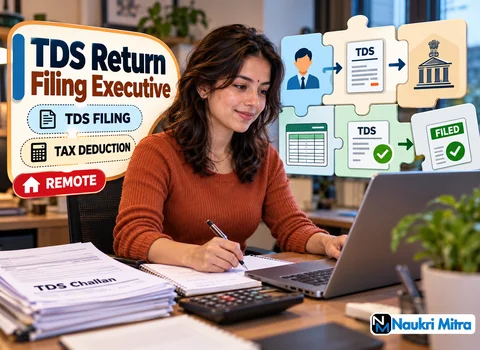
Start with one salary payment. The accountant books the salary in Tally, tax is deducted at source, and the deducted amount is deposited against a challan. At the end of the quarter, every such deduction is collected into a return, checked by a validation utility and uploaded to the income tax system. Once the return is processed, the deductee's certificate can be downloaded from TRACES and handed over. The person who moves each entry along that path is the TDS return filing executive, and this vacancy sits among the remote tds return filing executive jobs open now. The seat is full-time, worked entirely from home in any country, and pays $450 a month in USD.
Picture the work as a relay with four handovers: the books, where the deduction is posted; the bank, where the challan is paid; the return, where each deductee's PAN, payment and matching challan are listed; and the certificate, Form 16 or Form 16A, generated after processing.
A mistake at any handover travels forward. A wrong PAN in the books becomes a wrong PAN in the return and a missing credit for the deductee. Much of this job is catching errors early, while they are cheap to fix.
In plain terms, you prepare and file TDS statements for the clients or the business you are assigned to. Salary deductions go into Form 24Q. Deductions on other payments, such as contractor bills, professional fees or rent, go into Form 26Q. You compile deductee and challan details from Tally, build the return in the Return Preparation Utility (RPU), validate it with the File Validation Utility (FVU), file it online, and later download certificates from TRACES.
The other half of the work is clean-up. When the system flags short deduction, late filing or PAN errors, you trace the cause and prepare the fix.
Most filers follow this order for a quarterly statement.
That list is also a fair outline of how to file TDS returns in Form 24Q and 26Q; the forms differ in their deductee schedules, not in the steps.
Your toolkit is small and specific. Tally is where the source entries live. Excel is where you clean deductee data, sort challans and spot duplicates. RPU is the offline utility for preparing the statement, and FVU checks the file format before upload. Both run on Java, so your laptop needs the utilities installed and kept current. TRACES is the portal for default reports, justification files, correction requests and certificate downloads.
Because filings happen on portals, a stable internet connection matters more here than in many remote roles. Keep backups of every validated file and acknowledgement, organised by client and quarter.
Accuracy comes first. You will handle long lists of names, PANs and amounts, and a single swapped digit can block a credit. Next is a working grasp of TDS rules: which payments attract deduction, how sections are applied, and when quarterly statements are expected. You do not need to memorise every figure, but you should know where to check current rules and do so each quarter.
Excel matters more than people expect. Lookups, filters and pivot tables turn a messy export into a tidy deductee sheet. Clear emails matter too, since you will often chase clients for a missing PAN or challan copy.
These tds return filing executive work from home jobs need a B.Com or other commerce graduate who has spent six months or more, up to two years, on TDS work. You should be comfortable with RPU, FVU, TRACES and Tally, and able to manage deductee data in Excel. You also need your own laptop with the Java utilities set up.
Openings like this are usually posted by chartered accountant practices, accounting outsourcing firms and the in-house finance teams of mid-sized businesses. Since these are tds return filing executive jobs remote worldwide, the employer could be anywhere, though the filings themselves are Indian TDS statements.
Full-time hours on this desk earn $450 a month, paid in USD. Any tds return filing executive salary elsewhere will depend on the employer, the number of clients handled and the depth of experience. Workload tends to peak around quarterly filings and ease in between.
Processing can produce a default, and someone has to read it and find the cause.
A short deduction default means the tax deducted looks lower than expected for that payment. A wrong section code is one possible cause. A late filing default arises when a statement reaches the system after its expected date. In both cases you download the justification report from TRACES, explain the line items to your senior or the client, and prepare whatever correction the facts support. You do not decide liability yourself.
PAN errors come up often. You collect the correct PAN, update the deductee row and file a correction statement. Challan mismatches are handled the same way after checking the bank record. Log every correction.
If you are starting from scratch, begin where the work begins. Learn Tally entries for TDS, then practise building a sample statement in RPU with made-up data and running it through FVU. A short tds return filing executive course can give structure, though no tds return filing executive certification is required here.
Junior posts that ask for no experience do exist in CA practices. This listing asks for six months, so freshers should first gain that through articleship or an internship. On your tds return filing executive resume, name the forms you have prepared, the number of deductees you handled and the tools you used. For tds return filing executive interview questions, be ready to explain the difference between Form 24Q and 26Q, walk through an FVU error you fixed, and describe how you would handle a PAN mismatch.
TDS return filing and GST return filing are often grouped together, but they look at different things. TDS deals with tax cut from specific payments and credited to a named person's PAN. GST deals with tax on supplies and input credit claimed by the business itself. Many executives learn both over time.
Growth usually runs from executive to senior executive, then to a direct tax team lead who reviews others' filings and handles notices. Some move into income tax return preparation or tax audit support.
Check a posting before sharing documents. Warning signs include requests for money to secure the post, pressure to share your own banking passwords or OTPs, interviews held only over chat with no named contact, and pay that sounds far above the work described. Never share client data from a previous job.
To apply, attach your resume and mention which TDS forms you have prepared and one correction you resolved.