
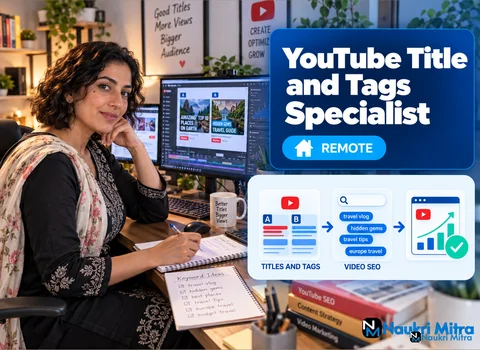
Type "how to clean" into the YouTube search box and stop. Before you press anything, a list drops down: cast iron pan, white trainers, a washing machine drum, AirPods. Every line in that list is a phrase real people typed, in their own words and their own order. Matching a video's title to that language, honestly and without promising more than the video gives, is the whole craft. This listing covers online youtube title and tags specialist jobs: part-time, remote, welcoming applicants based in any country, paying $18 per hour in USD. You handle the words around each video: title, tags, description and chapters.
At heart, the youtube title and tags specialist job description is metadata. A creator sends a finished video; you research how people search for the topic, write title options, add a few relevant tags, write the description, mark chapters, and later check whether any of it moved the numbers. No editing, no thumbnail design. You choose words, and you should enjoy arguing with yourself over whether "fix" or "repair" is the verb people actually type.
Start with the autocomplete, because it is free and it is the viewer talking. Then open vidIQ and TubeBuddy, which show rough search interest for a phrase, related phrases, and how crowded the results already are. A phrase with modest interest and weak existing results is often a better target for a small channel than a huge one owned by big names.
Treat the scores as estimates and cross-check them in YouTube Studio, where the search terms report shows what the channel's viewers typed to find earlier videos. If the audience searches "beginner sourdough" and never "sourdough for dummies", you have your answer. Both tools have free and paid plans; the specialist normally covers that cost, so confirm today's prices.
Write several options rather than one polished guess: a plain search version, a curiosity version, one that names a specific result, one aimed at a particular viewer ("for small kitchens"). Read them aloud. Cut filler. Send the creator the two strongest with a sentence on why.
One rule keeps this work clean: a title can intrigue, but it must describe what is in the video. Promise a dramatic result and deliver a modest one, and viewers leave early and say so in the comments. Misleading clickbait wins a click and costs trust. Write titles you could defend to the person who clicked.
YouTube currently allows titles of up to 100 characters, but that is rarely the real limit. In search results, on phones and in the suggested column, long titles get cut off, so put the key phrase near the start. "Cast iron pan rescue: removing rust in one afternoon" survives truncation better than a version that saves the topic for the end.
For tags, YouTube sets a combined limit of roughly 500 characters across all tags on a video. Limits like these can change, so check what YouTube Studio shows when you are working rather than trusting any guide, this one included.
Do tags still matter? Less than many people assume. YouTube's own guidance says tags play a minimal role in discovery and are mainly useful when a topic is commonly misspelled. Title, thumbnail, description and viewer response do most of the work. So a good tag list is short: the main phrase, one or two close variants, and common misspellings of a brand or name ("tubebudy", "vid iq"). Unrelated tags do nothing useful and break YouTube's spam policies. When a creator asks you to fill all 500 characters, explain why you won't.
The description is the second home for search language. Its opening lines appear under the video and in some search views, so restate the topic there in natural sentences, then add what the video covers and any links the creator wants. Write for a person first.
Chapters are timestamps listed in the description that split the video into labelled sections. The list must start at 0:00, and YouTube sets minimums for how many chapters there are and how long each runs; check the current Help Center wording. Chapter labels deserve the same care as titles, because viewers scan them to decide whether to stay. "Removing surface rust" beats "Part 2". Watch the video at normal speed while you mark them; skimming it at double speed is how a chapter ends up starting mid-sentence, and creators notice.
Some of the best work happens after upload. Many channels have good videos that never found an audience. In YouTube Studio you check impressions, meaning how often YouTube showed the video, and impressions click-through rate, meaning how many of those viewers clicked. Steady impressions with poor clicks point at packaging, and a better title is a cheap fix to try.
Alter just one element each time. If the channel has YouTube's built-in testing available, use it; otherwise record the old title and the date, leave the thumbnail alone, and compare a fair window before and after. Then report plainly what changed, what happened to impressions and click-through, and what you would try next. A test that did nothing is still a result.
A thumbnail designer builds the image; a title specialist builds the words. Viewers see both at once, so the jobs overlap more than their names suggest. The best pairs split the work: the image shows the situation, the title adds what the picture cannot say. If both repeat the same three words, one is wasted. You may see a thumbnail draft first and suggest tweaks to its text, but you will not design it.
No degree is required, and beginners who already understand YouTube SEO can apply. That makes this a realistic option among youtube title and tags specialist jobs for freshers, provided you can show the knowledge. The core youtube title and tags specialist skills are comfort with vidIQ, TubeBuddy and YouTube Studio, strong English for titles that are clickable yet accurate, and an understanding of search versus suggested traffic. Search viewers arrive with a phrase in mind. Suggested viewers arrive from another video and respond more to curiosity and fit.
YouTube's Creator Academy courses help, especially on metadata and analytics. Treat them as learning, not a credential. No youtube title and tags specialist certification is asked for here, and a paid youtube title and tags specialist course is optional. Proof of good titles counts for more, which is also why youtube title and tags specialist jobs no experience searches are less hopeless than they sound: a reviewer can judge your rewrites in minutes, whatever your history. Bring a short list of before and after examples and be ready to explain each choice.
The youtube title and tags specialist salary per hour here is $18 USD, part-time. Because this is youtube title and tags specialist work from home, location does not matter as long as you reply within a reasonable window. Hours follow the upload schedule, so weekly income is never guaranteed.
Freelance youtube title and tags specialist jobs also appear on gig sites like Fiverr and Upwork, usually labelled YouTube SEO or video metadata. Rates vary with niche and proof, and platform fees and rules shift, so review the conditions first.
Pick three public videos from small channels in a niche you know. For each, write a before and after: the current title, keyword notes, three replacements, a tag list and a chapter outline. That pack shows how to become youtube title and tags specialist material before anybody has hired you, and it works as a youtube title and tags specialist resume that shows rather than claims.
Typical youtube title and tags specialist interview questions test judgement: shorten this title for a phone, which tag would you drop, how would you know a retitle worked. For part time youtube title and tags specialist jobs, a creator mostly wants proof you will watch the video before writing a word about it.