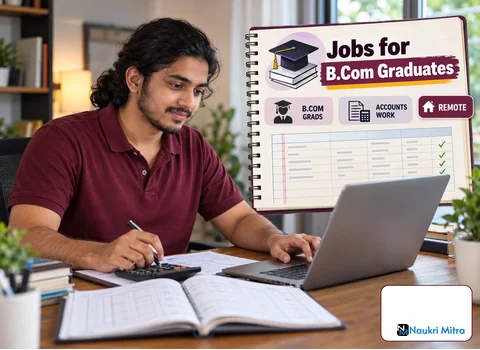
Monday morning, a client's books show ₹48,620 in the current account. The bank statement for the same date says ₹48,502. The gap is ₹118, and a junior has already spent forty minutes ticking cheques against the passbook. Then someone scrolls to the last page of the statement and finds it: a quarterly SMS and service charge of ₹118, debited by the bank and never posted in the books. One bank charges the entry later; both figures read ₹48,502, and the reconciliation closes. Hunts like that one fill much of the working day in these work-from-home jobs for B.Com graduates. Remote and part-time, the role pays USD 6 hourly and accepts people from any country.
Advertisement
A normal day in work-from-home jobs for B.Com graduates
A remote accounts executive usually starts with a client folder: supplier bills, sales invoices, courier receipts, sometimes a phone photo of a handwritten voucher. The day then runs roughly like this:
- Posting purchase, sales, and expense vouchers in Tally Prime or QuickBooks, with the right ledger, date, and narration on each one.
- Recording the GST portion of each entry against the correct tax ledgers, as set up by the senior accountant.
- Downloading the bank statement and matching it line by line with the bank book, like the ₹118 example above.
- Preparing simple ledgers, outstanding lists and summary sheets in Excel.
- Writing a short note to the senior accountant whenever something does not tie: a missing bill, a duplicate payment, a party name that appears two different ways.
That last point matters. You are not expected to fix every oddity yourself, only to spot it, note it clearly, and pass it up.
Remote jobs for B.Com graduates in accounting and finance
Commerce graduates who want home-based work usually land in a handful of roles: bookkeeping assistant, accounts executive, accounts payable or receivable support, and reconciliation clerk. Firms that hire for these include CA and accounting firms with overseas or out-of-town clients, accounting outsourcing companies that keep books for small businesses abroad, and growing startups that need part-time help before they can afford a full-time accountant. For many, these are the first online jobs after graduation. Freelance marketplaces such as Upwork also carry bookkeeping projects, though you bid against experienced people there. None of these is the employer here; they are simply where online jobs for B.Com graduates and other remote accounting roles tend to come from.
This listing sits in the bookkeeping and reconciliation corner: not invoice typing, not financial analysis, but ledger work done carefully.
Tally Prime or QuickBooks: what you should be able to do
Tally Prime is common with Indian small and mid-size businesses; QuickBooks is more common with clients in the US, UK, and elsewhere. Be comfortable in at least one and willing to learn the other.
In Tally Prime
Create and alter ledgers under the right groups, pass entries in the voucher screens (purchase, sales, payment, receipt, journal, contra), use the bank reconciliation screen to enter clearing dates, and pull a day book or ledger report for a date range.
In QuickBooks
Enter bills and expenses, record invoices and payments received, categorize transactions coming in from the bank feed, and run the reconcile tool against a statement ending balance. Tally jobs for B.Com graduates and QuickBooks roles reward the same habit: read the source document properly before you press save.
GST work from home, kept at the right level
You will see GST on almost every bill. At this level the task is mechanical: capture the taxable value and the tax amounts shown on the document, post them to the ledgers your senior has set up, and make sure the party's GSTIN is entered correctly. The senior accountant decides how a supply should be taxed, or whether input credit is available. If a bill looks wrong to you, for example, the tax total does not add up to the figure printed, flag it. Don't guess or correct the supplier's numbers on your own.
Excel skills that actually get used
Many firms give a short Excel test before onboarding, so practice these until they are routine:
- SUMIF and SUMIFS to total a party's bills by month.
- VLOOKUP or XLOOKUP to match a bank narration against a list of invoice numbers.
- Pivot tables to summarise expenses by head.
- Conditional formatting to highlight entries where the books and bank differ.
- Text functions like TRIM and LEFT to clean up messy bank exports.
A typical test hands you two sheets, books and bank, and asks for the unmatched items. Doing that with formulas rather than by eye puts you ahead.
Courses: GST Practitioner, ACCA, CMA and what they mean here
Short courses can help a fresher stand out, but none are required for this listing. A GST Practitioner course gives a structured view of returns and registrations, which makes the entries you post easier to understand. ACCA and CMA are longer professional qualifications aimed at a career in accounting or management accounting; they are a serious commitment of time and money. Before signing up, check the syllabus, fees, and recognition directly with the provider, and ask yourself whether you want the qualification itself or just the practical skill. For this role, a free Tally or QuickBooks practice company and steady Excel practice will help you more in the first month.
Freshers and those with a year behind them
A B.Com degree is required. Freshers can apply, and one year of accounts experience helps without filtering anyone out. Think of it less as a graduate trainee work-from-home post and more as real bookkeeping with a senior checking your work.
If you are just out of college, show you can do the basics without supervision: set up a dummy company in Tally Prime or a QuickBooks trial, post a month of made-up transactions, and reconcile it against a statement you build yourself. Mention it when you apply. That is how B.Com freshers land their first remote accounting job, and it answers a common question: how to get a remote job after graduation when your CV is still empty.
If you already have a year in an office, say what you handled: how many ledgers, whether you reconciled the bank monthly, which software.
Your laptop, client data and confidentiality
You need a laptop and a stable connection. Client books, bank statements and GSTINs are confidential. Keep your system updated, use a screen lock and a strong password, avoid public Wi-Fi when you have client files open, and never forward documents to personal email or chat groups. If the firm gives you remote desktop access or a shared drive, work only inside it.
Month-end peaks, hourly pay and fee demands
This part-time work pays USD 6 for every hour logged. Weekly hours are left open: work follows client volume and usually bunches up near month-end. Like many part-time jobs for B.Com graduates, it pays for time worked rather than a monthly salary. A separate caution: a genuine accounting firm will not charge a registration fee, hold a security deposit, sell you a software kit, or ask you to invest. Jobs for B.Com graduates without investment never require payment from you, and Naukri Mitra charges no application fee either, so drop any conversation that turns to money.
Growth, and the analyst question
An accounts executive records and checks what has already happened. A financial analyst uses those finished numbers to build forecasts and budgets, usually with stronger Excel modeling and often a finance qualification. Starting in accounts is a sound route, because knowing how books are built helps when you later read them as an analyst. From bookkeeping, people move to handling a full client set, then month-end closing, then supervising juniors or preparing audit working papers. Meeting deadlines and writing clean narrations are what seniors tend to notice.
CV details and the short test
Apply with a short CV that states your B.Com passing year, the accounting software you have used, your Excel level, and any courses you have completed. Add two lines on your laptop and internet setup and your usual weekly availability. If you built a practice company, say so. Then expect a short Excel or Tally test, which is normal for entry-level remote jobs for accounts graduates.