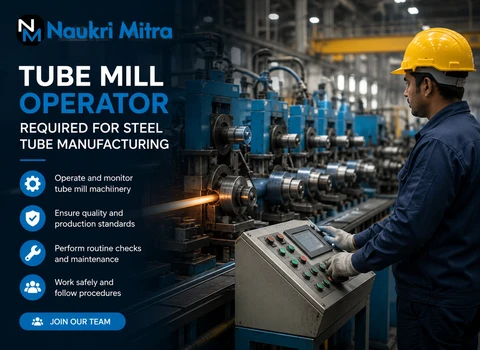
What Does a Tube Mill Operator Actually Do?
Steel tubes don't start out as tubes. They begin as flat coils of steel that get uncoiled, rolled, shaped, and welded into round or square pipes. The person running that whole process is the Tube Mill Operator. It's a hands-on job, part machine handling and part quality control, and it works well for freshers looking for their first factory job as well as workers who already have a few years on the shop floor behind them.
Where This Role Fits in the Steel Industry
Tube manufacturing feeds into many other industries — construction, furniture, automotive parts, even irrigation and fencing. So when a plant needs to maintain steady output, it needs operators who can run the mill without constant supervision. This particular opening is a full-time role in Raipur, Chhattisgarh, one of the industrial hubs in central India where steel and metal processing units are fairly common.
How a Shift Usually Plays Out
Most days start the same way: check what the last shift produced, look over the raw coil that's about to go in, and get the mill ready. From there, it's a mix of feeding material, watching the weld line, and pulling finished tubes off for inspection. On a typical shift, an operator might handle:
- Loading and aligning steel coils on the uncoiler
- Setting roller pressure based on tube diameter and wall thickness
- Keeping an eye on the weld seam as tubes come through
- Checking straightness, length, and surface finish on finished pieces
- Logging output numbers and any machine readings that need tracking
Responsibilities Beyond Just Running the Machine
Operating the mill is only part of it. There's also the quality side — catching a bad weld before it results in a rejected batch, flagging wear on rollers before it causes defects, and working with the quality team when something doesn't look right. When the line switches to a different tube size, the operator is usually involved in swapping out rollers and dies as well, which requires both patience and a decent understanding of the machine's setup.
The Equipment You'll Be Working Around
A tube mill isn't one machine — it's a line of them. Forming rollers shape the flat strip into a round profile; a welding unit (often high-frequency induction welding) joins the edges; and sizing rollers bring the tube to its final dimensions before a cutting unit trims it to length. Around all this, operators also rely on:
- Vernier calipers and micrometers, for checking diameter and wall thickness
- Straightening and sizing rollers
- Hydraulic or pneumatic control panels
- Ordinary hand tools — wrenches, spanners — for day-to-day adjustments
Knowing how these pieces work together makes troubleshooting much faster when something goes wrong mid-shift.
What Employers Tend to Look For
Formal qualifications matter, but not as much as people sometimes assume. An ITI in a machining-related trade or a Diploma in Mechanical Engineering is usually considered a good starting point, as it teaches how to read engineering drawings and use measuring instruments correctly. That said, plenty of employers weigh hands-on comfort with rolling and welding equipment just as heavily as the certificate itself. A sharp eye for spotting defects early is worth more on the floor than most people expect.
Physical Side of the Job
This isn't a desk job. Expect to be on your feet for most of the shift, lifting coils or finished tubes now and then, and working fairly close to moving parts. The plant floor tends to run warm and noisy, which is normal for any unit doing metal forming and welding. Shift work is standard in this line of work, so night shifts come up regularly once production ramps up.
Staying Safe on the Floor
Safety isn't optional in a steel processing unit — it can't be. Lockout-tagout procedures must be followed during all maintenance work, and staying alert around spinning rollers or freshly welded seams is part of the job. On the PPE side, expect to wear a safety helmet, gloves, safety shoes, ear protection, and goggles, since sparks and metal shavings are a regular part of the environment.
Where New Operators Usually Get Stuck
Getting roller pressure right for different tube thicknesses takes time to learn — too much or too little, and the weld quality suffers. Machine breakdowns during a busy production run are another common headache, and they test how quickly an operator can think on their feet. Most people get past these early struggles by sticking close to a senior technician and asking questions rather than guessing.
Growing Within the Trade
Operators who stick with it tend to move into senior operator positions, shift supervisor roles, or specialize in machine setting and roller changing — jobs that pay better because fewer people can do them well. Gaining knowledge of new tube sizes, materials, and updated welding methods keeps an operator's skills relevant as plants upgrade their equipment over time.
Pay and What Usually Comes With It
This is a full-time position based in Raipur, Chhattisgarh, offering a monthly salary of ₹26,500. Beyond the base pay, workers in similar roles sometimes get access to overtime pay, PF, ESI, an annual bonus, uniforms, and in some cases transport or canteen facilities — though these vary from one employer to another and aren't guaranteed.
A Few Honest Tips for Anyone Considering This Path
Spend your first few weeks watching more than doing — ask why a roller is set a certain way instead of just copying it. Keep a small notebook of defects you come across and their causes; they add up faster than people expect. If you like working with machines and want steady, practical employment in a growing part of India's steel manufacturing sector, this is a solid place to build that career.