
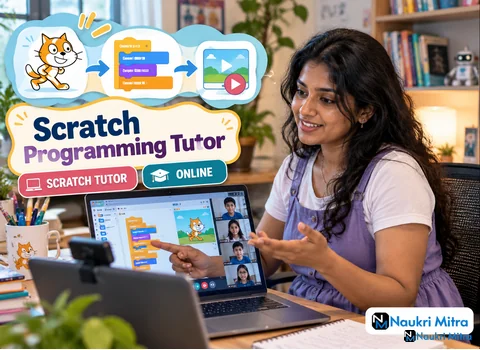
By the end of a good first lesson, a seven-year-old has a cat on the screen that follows the mouse pointer around the stage and says "meow" the moment it touches it. This listing covers online scratch programming tutor jobs, where your task is to get children to that small win, and then to the next one, over a live video call. It is a part-time post taught online, tutors can apply from any country, and the pay is fifteen US dollars an hour.
Most classes follow a simple order: a quick look at what the student made since last time, one new idea, a short build where the child drives the mouse and you guide, and a little task to try before next week.
The written scratch programming tutor job description is short, but in practice it covers a few steady duties:
New tutors often find it hard to keep their hands off the keyboard, yet a child who drags the block in remembers it.
Kids rarely want to learn "loops". They want to make something. Projects come first, and the concepts arrive inside them.
Start with chase games like the cat and mouse pointer, then move to a catch game where apples fall and a bowl slides left and right. Later comes a maze or a clicker game with a score, each adding one new idea.
Costume switching makes a sprite walk, a bird flap or a candle flicker. Animation is a gentle way to show that timing and order matter.
Interactive stories suit quieter kids who are less excited by scores. Two sprites have a conversation, the reader clicks to choose which door to open, and the scene changes. This is where broadcasts start to make sense, because one character has to tell the other when to speak.
Every Scratch script starts with a hat block, such as "when green flag clicked" or "when this sprite clicked". To a child, an event is a doorbell. Nothing happens until someone presses it, and then the sprite answers.
Ask a child to make the cat take ten steps, and they will often stack ten move blocks. Then show them "repeat 10". The cat chasing the pointer works because of a "forever" block that keeps checking where the mouse is.
A score is the classic first variable. Each time the bowl catches an apple, the box called "score" goes up by one. A label on a box is easier for a young mind than the word "variable", and you can introduce the real word once the idea sticks.
Children around five to seven, or anyone still learning to read, often do better in ScratchJr. It runs on tablets, uses picture blocks instead of words, and snaps scripts together left to right like a train. The same ideas are there in simpler form: a start trigger, movement, repeats and messages between characters.
A good ScratchJr class is short and very visual. When they start asking for things ScratchJr cannot do, such as keeping score, they are probably ready for the full Scratch editor.
A frozen screen loses a young student in seconds. The laptop needs to run the Scratch editor and a video call together without lag, and a quiet spot keeps the child's attention on the stage. A headset with a microphone helps a lot.
For ScratchJr on a tablet, the child may need a parent to hold the device toward the camera, or to use the tablet's own screen sharing if the call app supports it.
The listing wants a graduate or college student with strong Scratch ability and basic programming logic. Teaching kids before is welcome but not required, which makes these good scratch programming tutor jobs for freshers. Being familiar with both the MIT Scratch editor and ScratchJr is expected, along with clear English and a patient, fun style.
The scratch programming tutor skills that matter most in a live class are not always technical. You need to wait while a child thinks, turn a wrong answer into a question, and keep a seven-year-old laughing without losing the thread of the lesson.
Without a teaching background, the answer to "how to become scratch programming tutor" begins with a small portfolio. Build a handful of your own projects, including a game and a story, and practise explaining each one out loud as if to a child.
Scratch tutoring is paid at $15 USD an hour on a part-time basis. Published scratch programming tutor salary figures vary widely by platform and country, so rely on this listing's hourly figure. The number of classes you get each week depends on student demand and your availability, so it is fair to see it as part-time income that moves with demand rather than a fixed schedule.
Scratch tutoring is offered through kids' coding schools and online tutoring platforms, and some parents look for tutors directly. Freelance scratch programming tutor jobs also appear on general tutoring sites. Look for listings that are clear about pay per hour and never ask you for money to join.
To start teaching, you can usually expect a short application, a conversation about your Scratch experience, and a demo or trial class where you teach a mock lesson. Common scratch programming tutor interview questions include how you would explain a loop to a six-year-old, how you handle a child who goes quiet, and how you would fix a sprite that will not stop moving.
On your scratch programming tutor resume, list the projects you have built, any time spent with children, and your setup.
Parents often ask whether their child should skip blocks and go straight to Python. For most kids under about ten, Scratch is the easier start. Blocks remove typing and missing brackets, so a child can focus on the thinking, which is the part that carries over.
Python and other text languages make sense once a child is reading and typing comfortably and starts hitting the limits of blocks. Events, loops and variables work in much the same way in both, so a child who has built a Scratch game already understands the shape of a Python program.
For a student or recent graduate who enjoys kids and likes Scratch, it can be a good fit. Scratch programming tutor work from home also suits people who want evening or weekend sessions alongside study.
It is less suited to someone who wants steady full-time hours or who finds young children tiring. Part time scratch programming tutor jobs like this one work best for people who enjoy seeing a child's first working project on screen.