
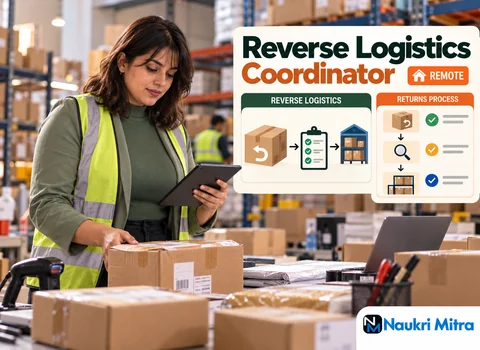
Nearly all of logistics is built to push goods out towards customers. This role handles everything that travels the other way: the jacket ordered in two sizes, the kettle with a dented lid, the birthday present that was never going to be worn. Out of the many remote reverse logistics coordinator jobs posted online, this one is full-time, pays $810 USD per week, and is open to applicants in any country, so your desk can be wherever your laptop and a steady connection happen to be.
Every return has a life story, and your job is to make sure it ends properly. So rather than a list of duties, here is that story, start to finish.
A customer opens the returns portal and says the shoes pinch. That click creates a return merchandise authorisation, the RMA, and from then on the item has a number and a paper trail. Your first look is quick but careful. Is the order inside the return window? Was it a final-sale item? Has this same customer sent back eleven pairs this season? Most requests are routine and the software approves them on rules you help maintain. The odd ones land in your queue, and those are where you earn your weekly pay.
Processing returns and RMAs well mostly means reading what people actually wrote. "Doesn't fit" and "arrived broken" lead to very different outcomes, and customers pick whatever reason sits at the top of the dropdown more often than you would think.
Next comes the decision. Return policies look simple on the website and grow branches the moment real cases arrive. A hypothetical example: a customer wants a refund on a sofa cushion bought during a promotion, using a discount code, partly paid with a gift card. Which portion goes back to the card, which becomes store credit, and does the code come back to life? You apply the written policy, and when the policy is silent, you escalate with a clear recommendation instead of a shrug.
Exchanges deserve extra care. An exchange keeps the sale, which the business likes, but only if the replacement is actually in stock. Promising a size that sold out yesterday turns one unhappy customer into a very unhappy one.
Once approved, the customer gets a prepaid label, a QR code for a drop-off point, or instructions for a box-free return at a partner location. You will deal with carriers when a parcel stalls at a depot for nine days or shows as delivered to a warehouse that swears it never saw it. Patience and a tracking number go a long way. Keep notes; carrier claims are won by whoever has the cleaner timeline.
You will not be on the dock yourself, since this is a work-from-home seat, but you will live with the dock's decisions. Warehouse staff scan the returned item and grade it: resellable as new, resellable as open box, refurbish, liquidate, or recycle. Your part is coordinating with warehouses on returned stock, chasing the parcels that arrive without a label, matching the RMA to what was really in the box, and querying grades that look off. When a customer claims they returned a laptop and the box held a brick, you are the person assembling the photos and the scan history.
The refund should fire once, for the right amount, after the item is received and graded, unless the policy allows instant refunds for trusted customers. Duplicate refunds happen when a support agent and the returns system both act on the same order. A good coordinator spots that pattern early in the daily Excel reconciliation, before finance finds it at month end.
For many coordinators this is the most interesting part of the reverse logistics coordinator job description. Every return carries a reason code, and once you sort a few weeks of them in a pivot table, patterns start talking. One shirt style returned far more often for "runs small" means the size chart is wrong. A spike in "damaged in transit" on glassware points at the packaging, not the courier. You track these reasons and flag product or packaging problems to the merchandising, quality or warehouse teams, with a tidy summary they can act on.
Most online sellers run returns through a dedicated platform. Loop Returns is common with Shopify stores and leans hard on exchanges. Narvar covers tracking and post-purchase messaging alongside returns. Happy Returns is known for box-free drop-off points. You should be familiar with at least one of them, and the logic carries across: rules, reason codes, refund triggers, label generation.
Strong Excel is expected. Lookups, pivot tables, conditional formatting and a habit of checking totals before sending anything. The reverse logistics coordinator skills that matter most are boring in a good way: accuracy, written clarity, and the calm to tell a frustrated customer no without sounding like a robot.
Remote work requirements are practical. You need a reliable computer, a stable internet connection good enough for video calls, a quiet spot for carrier phone calls, and enough overlap with your team's working hours to answer the warehouse when it asks a question. Because the role is open worldwide, expect some shifts in time zones and plan your day around the warehouse's cut-off times. Written English that leaves nothing ambiguous helps a great deal.
A forward logistics coordinator plans shipments to customers or stores: purchase orders, pick-pack-ship, delivery windows. The goods are new, the paperwork is predictable, and the volume is forecast. Reverse work is messier. Items come back in unknown condition, at unpredictable times, for reasons you have to decode. Forward coordinators tend to think in pallets; returns people think in single units and customer stories. Many professionals do both over a career, and having run returns makes you better at outbound, because you have seen what poor packing costs.
A bachelor's degree is helpful but not always required. One to three years in logistics, customer service or warehouse returns is the usual background, and a customer service desk handling refund tickets is a common first rung. The kinds of employers that hire for this include online retailers, third-party logistics providers (3PLs) that run returns for several clients, and consumer brands selling direct to customers.
On your reverse logistics coordinator resume, show numbers you were actually responsible for: returns processed per day, a policy you helped rewrite, a reason-code report that changed a product page. Name the returns platforms you have used. Typical reverse logistics coordinator interview questions are scenarios: a disputed refund, a lost return parcel, or a spike in damage claims. Walk the panel through how you would check the facts before deciding.
Coming in with a thinner background? Here is how to become a reverse logistics coordinator anyway. A short reverse logistics coordinator course on supply chain basics, plus self-study in Excel and a returns platform's help documentation, can fill gaps. For a reverse logistics coordinator certification, the ASCM CLTD (Certified in Logistics, Transportation and Distribution) is a plus here; it covers reverse flows within a wider logistics syllabus and signals you take the field seriously.
Returns desks are good training grounds because you see every weak spot in a supply chain. Coordinators often move into returns or reverse logistics analyst roles, team lead positions, returns operations management, or broader supply chain planning. Some shift towards vendor and carrier management, others into e-commerce operations or product quality. Progress depends on the employer and on you, but the habit of following one item from request to resale teaches you how the whole operation fits together, and that knowledge travels well.